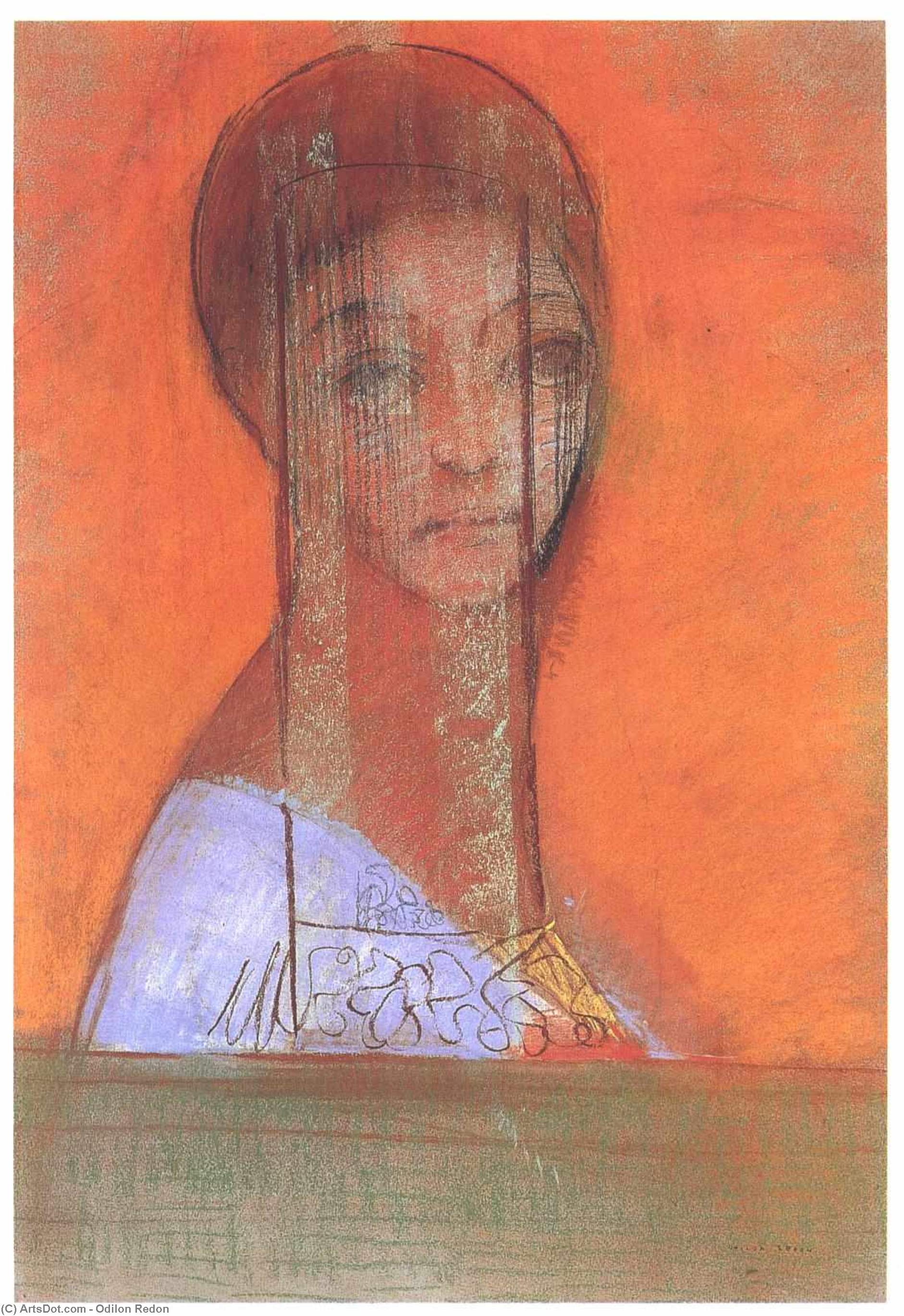
Veiled Woman: An Exploration of Symbolism and Dreamlike Impression
Odilon Redon’s ‘Veiled Woman,’ created in 1895, stands as a cornerstone of Symbolist art—a movement dedicated to conveying profound emotions and ideas beyond mere visual representation. Housed at the Kröller-Müller Museum in Otterlo, Netherlands, this drawing transcends simple portraiture, inviting viewers into a realm of subconscious contemplation and symbolic interpretation.
- Composition & Elements: The artwork depicts a woman’s head and upper torso against a striking orange backdrop. Two birds flank the figure, while a clock dominates the upper-middle section—each element deliberately chosen to enrich the composition's narrative and contribute to its enigmatic atmosphere.
- Symbolism & Interpretation: Symbolist artists believed objects held deeper meanings than their surface appearance. The veil itself symbolizes mystery or concealment, mirroring the woman’s gaze downwards, perhaps reflecting upon hidden truths. Similarly, the birds represent freedom and aspiration, contrasting with the stillness of the figure. The clock serves as a reminder of time's passage and eternity—themes central to Symbolist thought.
- Light & Its Role: Redon skillfully employs light – or rather its absence – to heighten the painting’s mood. The orange hue of the background acts as a luminous counterpoint to the woman’s pale complexion, creating depth and emphasizing her serene expression. This diffused illumination contributes to the artwork's dreamlike quality, mirroring the ethereal aesthetic favored by Symbolists.
- Artistic Context: Redon was firmly rooted in the Symbolist movement, which reacted against Impressionism’s focus on capturing fleeting moments of sensory experience. Artists like Jules Bastien-Lepage and Edvard Munch explored similar themes—the subconscious mind, spirituality, and the beauty of decay—resulting in artworks that prioritized emotional resonance over photographic accuracy.
- Technique & Materials: Executed in pastel on blue paper, ‘Veiled Woman’ showcases Redon's masterful technique—scumbling and layering pigments to build up texture and color with remarkable subtlety. The loose brushstrokes convey a sense of spontaneity while simultaneously capturing the artist’s meticulous attention to detail. This method aligns perfectly with Symbolist ideals, prioritizing expressive gesture over precise realism.
Ultimately, ‘Veiled Woman’ is more than just an image; it's a conduit for contemplation—a testament to Redon’s ability to distill complex ideas into a visually arresting composition. Its enduring appeal lies in its capacity to provoke introspection and invite viewers to engage with the profound symbolism embedded within its delicate hues and evocative lines.