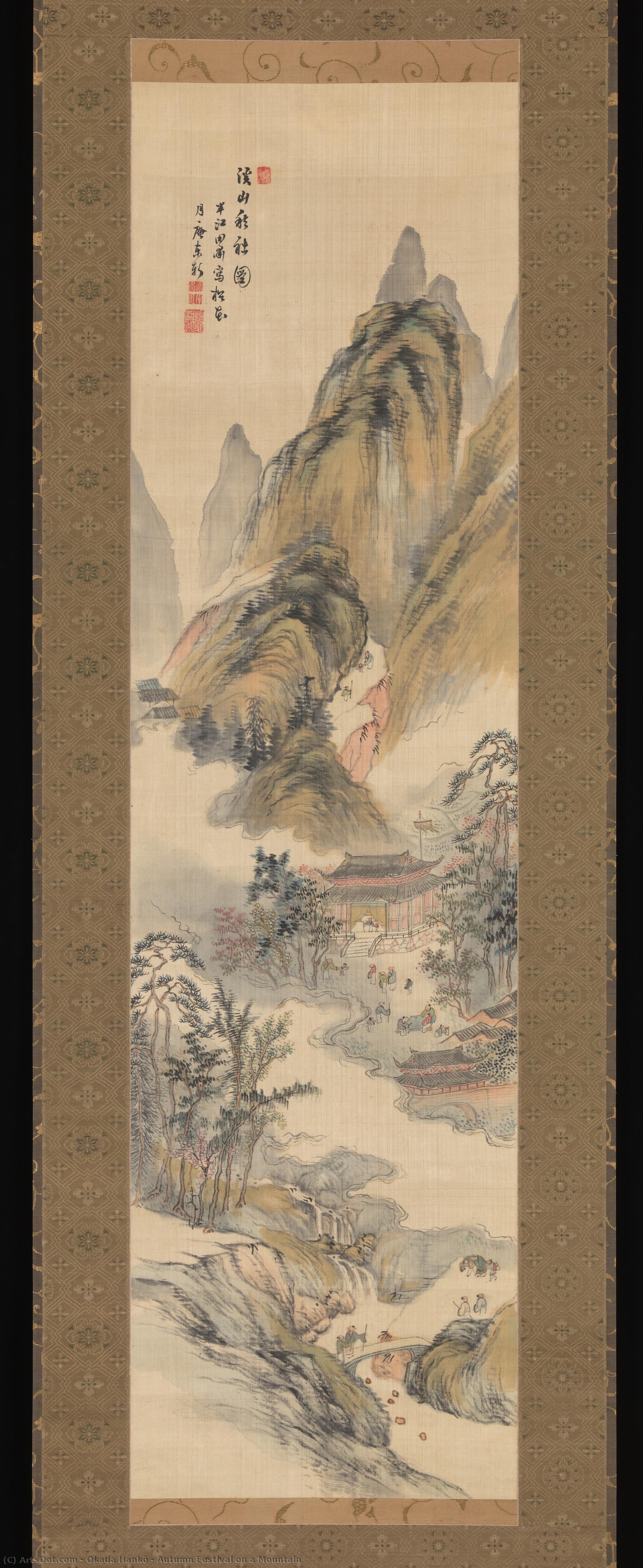
Explore Okada Hankō's masterful Edo-period Nanga paintings! Known for intricate brushwork & subtle colors, his works capture serene landscapes & cultural themes.
This tall, narrow composition rendered in the Chinese literati-influenced manner of the Nanga school features distant towering peaks, a pavilion in the middle ground, and tiny figures meandering along mountain paths and a foreground bridge. The image is gently reminiscent of Chinese literati paintings of scholar-gentlemen in a mountain setting. Washes of color endow the scene with an atmosphere of seasonal change, a quality that combines with soft, parallel brushstrokes on foliage and rocks, and the rounded contours of the mountains to give a sense of warmth and lyricism that is distinctive to much of Hankō’s landscape painting.Hankō, a third-generation Nanga artist, was the son of one of the school’s great second-generation masters, Okada Beisanjin (1744–1820). The poetic nature of his work contrasts with his father’s more spontaneous-looking, often linear landscape scenes.