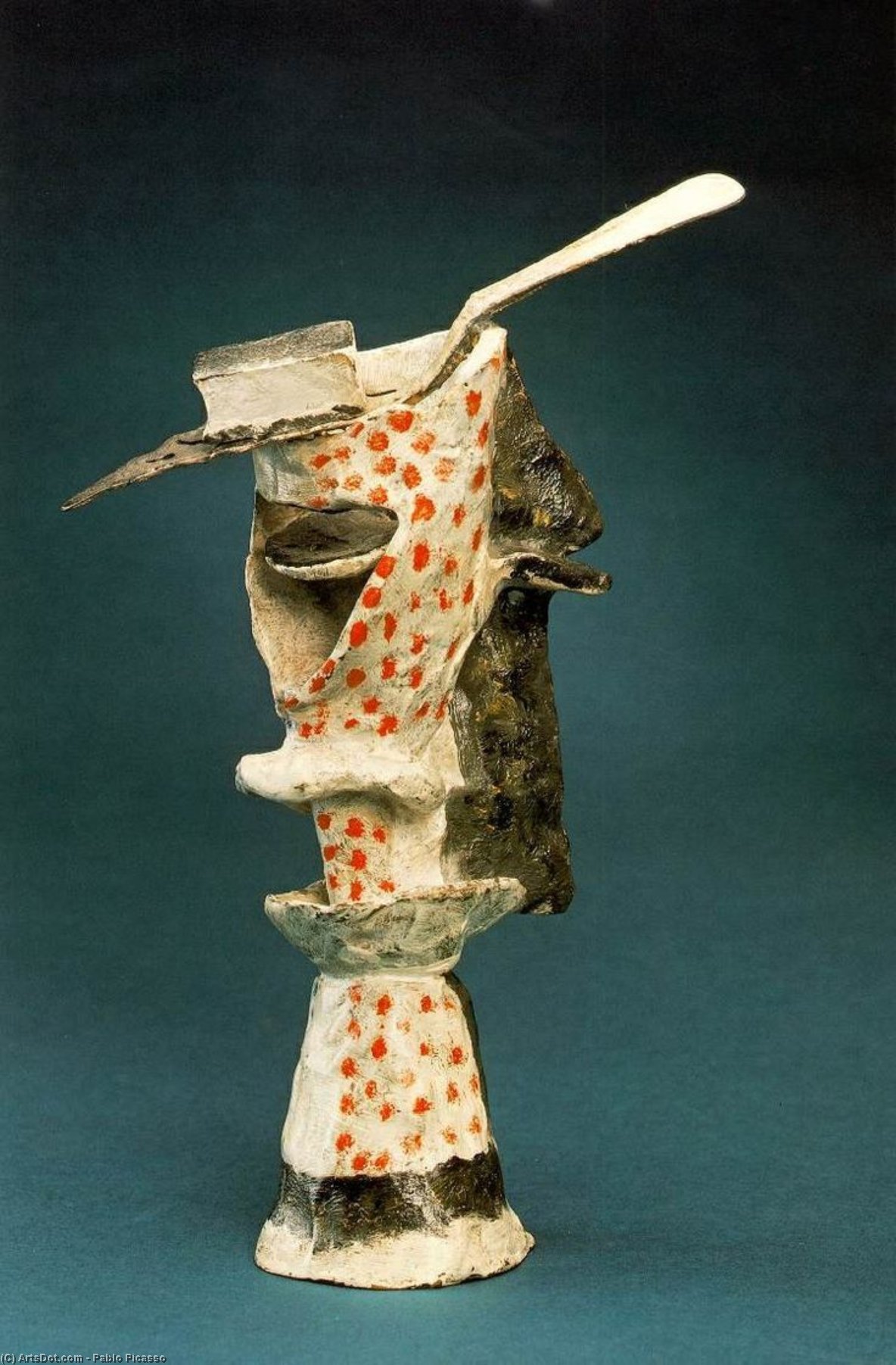
Introduction to the Painting
Pablo Picasso's A Glass of Absinthe, created in 1914, is a seminal work that exemplifies the artist's experimentation with Cubism. This painting, measuring 21 x 16 cm and classified under the Art Nouveau style, showcases Picasso's innovative approach to depicting everyday objects.
Artistic Context: The Cubist Movement
The early 20th century saw the emergence of
Cubism, a revolutionary art movement that rejected traditional techniques of perspective and representation. Instead, Cubism emphasized geometric forms and fragmented images. This movement had a profound impact on modern art, influencing not only painting but also sculpture and architecture.
Composition and Symbolism
The image is a close-up of a sculpture or art piece featuring a face with a spoon in its mouth. The face appears to be made from various materials such as clay, ceramic, or stone. The spoon is positioned vertically and slightly to the left of the center of the face. Two other spoons are visible: one on the right side of the main sculpture and another towards the top-left corner of the image. This unique composition captures attention with its unconventional use of everyday objects like spoons.
Artistic Influences
Picasso's work during this period was influenced by his contemporaries, including
Piet Mondrian, who also explored Cubism in works such as
Tableau no. 2 Composition no. V. Picasso's own experimentation with Synthetic Cubism is evident in paintings like
Glass and newspaper.
Conclusion
A Glass of Absinthe by
Pablo Picasso is a testament to the artist's pioneering spirit in Cubism. This painting, along with other works like
Still life with Gobleet, demonstrates Picasso's ability to transform ordinary objects into extraordinary art pieces. For those interested in exploring more of Picasso's Cubist works,
A Glass of Absinthe is a compelling example of his innovative style.
At ArtsDot, we offer high-quality, handmade oil painting reproductions of famous artworks like
A Glass of Absinthe. Our team of skilled artists ensures that each reproduction captures the essence and detail of the original piece. Visit our website to explore more Cubist masterpieces and other art movements.