A Moment of Serenity in the Rose Period
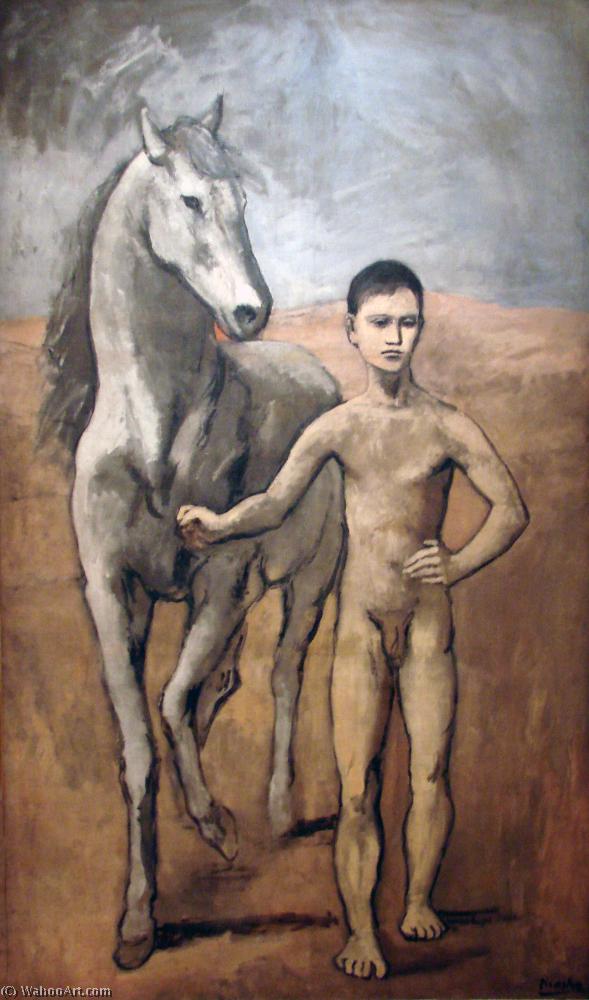
In the vast, transformative journey of Pablo Picasso’s career, few moments capture the delicate transition between melancholy and warmth as exquisitely as Boy holding a horse. Painted during the pivotal years of 1905-1906, this masterpiece emerges from the artist's celebrated Rose Period, a time when the somber, monochromatic shadows of his Blue Period began to recede, replaced by a palette of earthy ochres, soft browns, and tender tones. The painting presents a scene of profound quietude: a young boy, clad only in a simple loincloth, stands in intimate companionship with a horse. There is an undeniable sense of peace in the way the boy rests his hand upon the animal's head, a gesture that transcends mere physical contact to suggest a deep, soulful connection between human innocence and the raw strength of nature.
As we gaze upon this work, we are not merely looking at a portrait of two figures, but witnessing the dawn of a revolution. While the subject matter feels almost pastoral and classical, the execution hints at the radical shifts that would soon define the twentieth century. The composition possesses a rhythmic harmony, where the weight of the horse and the slight, vulnerable frame of the boy balance one another within the frame, creating a sanctuary of stillness that invites the viewer to pause and reflect.
The Architecture of Form and Emotion
Technically, Boy holding a horse serves as a fascinating bridge between traditional representation and the burgeoning language of Cubism. Picasso began to experiment here with the fragmentation of form, utilizing geometric planes to construct the figures. Rather than relying on the rigid, academic perspective of the past, he employs a proto-Cubist approach, where the contours of the boy and the horse are defined by overlapping shapes and subtle shifts in light. This technique does not obscure the subject but rather enhances its emotional resonance; by flattening the surface and simplifying the anatomy, Picasso strips away the unnecessary, leaving behind only the essential essence of the encounter.
The use of oil on canvas allows for a rich, tactile quality that grounds the painting in an organic reality. The earthy color palette—dominated by warm siennas and muted umbers—lends the piece a timeless, almost archaeological feel, as if we are uncovering a memory from a lost era. For the discerning collector or interior designer, this mastery of tone offers incredible versatility. The painting’s naturalistic hues allow it to integrate seamlessly into sophisticated, contemporary spaces, providing a focal point that is both intellectually stimulating and visually soothing.
Symbolism and the Spirit of Connection
Beyond its formal brilliance, the artwork is steeped in profound symbolism. The boy’s nakedness serves as a powerful metaphor for purity and vulnerability, representing an unshielded openness to the world. In contrast, the horse stands as a symbol of stability, endurance, and untamed power. The interaction between them—the gentle touch of a hand against a powerful brow—speaks to the delicate interdependence of all living things. It is a study in resilience and tenderness, suggesting that even within the most powerful forces of nature, there exists a capacity for gentleness.
For those seeking to bring a piece of art history into their personal environment, a high-quality reproduction of this work offers more than just decoration. It offers an invitation to contemplation. Whether placed in a sunlit study or a quiet corner of a living room, Boy holding a horse radiates a sense of historical importance and emotional depth. It is a testament to Picasso’s ability to capture the fleeting beauty of youth and the enduring strength of the spirit, making it an incomparable addition to any curated collection of fine art.