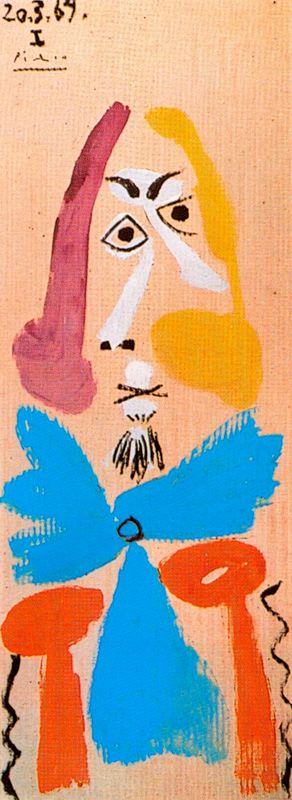
Explore Picasso’s groundbreaking Cubist masterpiece, ‘Bust of a Man 2,’ a fragmented portrait reflecting the era's modernist spirit and showcasing his masterful geometric style—a captivating piece to enrich your art collection.
A Fragment of Cubist Revolution
In the annals of modern art, few moments are as seismic as the emergence of Pablo Picasso’s Bust of a Man 2. Painted during the transformative years of 1915-16, this work serves as a profound testament to the radical departure from tradition that defined the Cubist movement. At its core, the painting is far more than a mere portrait; it is an intellectual inquiry into the very nature of sight. Picasso invites us to look beyond the surface of a human face and instead witness a deliberate dismantling of visual illusion. Through his masterful hand, the subject—a man draped in a striking blue scarf—is not presented as a singular, static entity, but as a complex arrangement of fractured planes that challenge our perception of depth and reality.
The technique employed here is a quintessential example of Analytical Cubism. Rather than relying on the soft gradients of light and shadow used by the Impressionists, Picasso dissects his subject into a rhythmic architecture of geometric shapes—cubes, cylinders, and cones. The blue scarf, for instance, does not exist as a unified piece of fabric; instead, it is composed of intersecting planes that recede and advance within the composition. This method allows the artist to present multiple viewpoints simultaneously on a single canvas, capturing the essence of the subject from various angles at once. There is a captivating tension in how these fragmented elements coalesce, creating a sense of movement and structural complexity that remains intellectually stimulating even decades after its creation.
Symbolism and the Modern Spirit
Beyond the technical brilliance, Bust of a Man 2 carries a subtle, theatrical energy. The delicate application of pink to the nose and mouth suggests a hint of stage makeup, hinting at Picasso’s lifelong fascination with performance, masks, and the duality of identity. This touch of color provides a vital emotional anchor amidst the otherwise austere, geometric deconstruction of the face. It serves as a reminder that even within the most rigorous intellectual experiments, there remains a pulse of human vulnerability and character.
For the discerning collector or interior designer, this piece offers an unparalleled opportunity to introduce a sense of historical gravity and avant-garde sophistication into a space. The painting’s palette—a sophisticated interplay of cool blues, earthy tones, and soft pink accents—allows it to function as a powerful focal point in contemporary settings. Whether placed in a minimalist gallery-style room or a richly textured study, a high-quality reproduction of this masterpiece brings with it the restless, revolutionary spirit of Paris in the early 20th century. It is an invitation to contemplate the beauty found in fragmentation and the enduring power of a vision that dared to redefine the world.