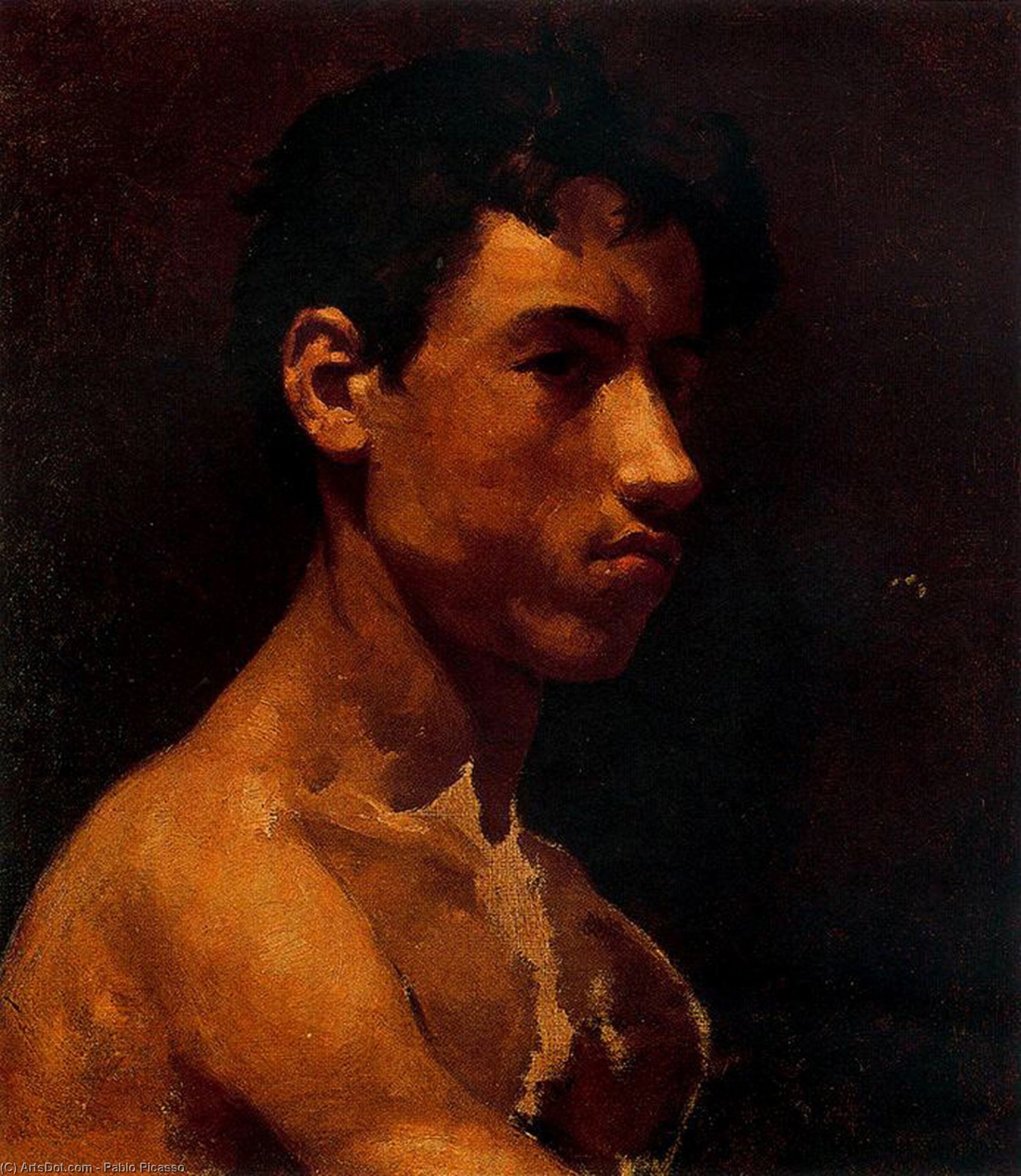
The Gaze of a Fragmented Soul
In the stark, monochrome landscape of Pablo Picasso’s
Bust of a Young Man, one is immediately arrested by a gaze that feels both ancient and startlingly modern. Created during the mid-1920s, this work serves as a profound window into the artist's mastery of psychological depth through the lens of Cubism. The subject, a young man rendered in a palette of deep blacks and luminous whites, does not merely look at the viewer; he challenges them. There is an unmistakable intensity in his eyes, a sense of searching that transcends the flat surface of the canvas. By stripping away the distractions of color, Picasso forces us to confront the raw essence of the figure, turning a simple portrait into a meditation on identity and the weight of human experience.
The painting captures a moment where the boundaries between the subject and the space around him begin to dissolve. The subtle presence of secondary figures in the background adds a layer of narrative mystery, suggesting that this young man is not an isolated entity but part of a larger, more complex social or psychological tapestry. This interplay of light and shadow creates a haunting atmosphere, making the piece an evocative centerpiece for anyone drawn to art that speaks to the complexities of the human condition.
The Architecture of Cubist Vision
To look closely at this masterpiece is to witness the very mechanics of a revolution. Picasso utilizes the core principles of Cubism to deconstruct the traditional notion of a portrait. Rather than relying on the illusion of three-dimensional realism, he employs
geometric planes that intersect and overlap, shattering the face into a series of multifaceted perspectives. This technique allows us to perceive the subject from multiple angles simultaneously—a frontal view merging with glimpses of a profile—creating a dynamic visual rhythm that keeps the eye in constant motion.
This approach was heavily influenced by the structural innovations of Paul Cézanne, whose emphasis on volume and form provided the foundation for Picasso’s experimentation. In
Bust of a Young Man, we see the rejection of academic perfection in favor of a more conceptual truth. The fragmentation is not merely a stylistic choice; it is a deliberate attempt to represent how we truly perceive the world—not as a static image, but as a collection of shifting viewpoints and layered impressions. For the art lover, this technical brilliance offers an endless opportunity for discovery, as each viewing reveals new intersections of line and shadow.
An Essential Element for Sophisticated Interiors
For the discerning collector or the visionary interior designer, a high-quality reproduction of this work offers much more than mere decoration; it provides an intellectual and aesthetic anchor for a room. The monochrome palette makes it an incredibly versatile piece, capable of harmonizing with a wide array of modern design styles.
- Minimalist Sanctuaries: In a space defined by clean lines and neutral tones, the stark contrast of Picasso’s black and white planes adds much-needed structural drama without overwhelming the environment.
- Contemporary Galleries: For those curating bold, avant-garde collections, this piece serves as a historical touchstone, connecting modern sensibilities to the radical origins of 20th-century modernism.
- Textural Depth: The intricate interplay of geometric shapes provides a visual texture that complements smooth surfaces like marble, glass, or polished concrete, adding a layer of sophisticated complexity to luxury interiors.
Owning a reproduction of such an iconic work allows one to invite the spirit of the Parisian avant-garde into the home. It is a conversation starter, a piece of history, and a profound statement of taste that continues to resonate with the energy of a revolution that changed the course of art forever.