A Study in Vulnerability and Connection: Picasso’s Deux Femmes Nues
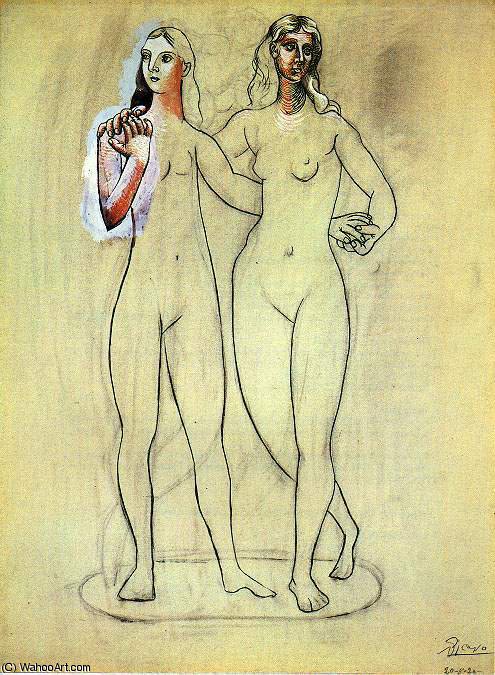
The painting “Deux femmes nues” (Two Naked Women) by Pablo Picasso stands as a testament to the artist's enduring fascination with the human form and his masterful manipulation of Cubist principles. Created sometime between 1923 and 1925, during Picasso’s prolific period in Paris—a time marked by experimentation and collaboration with Dora Maar—this artwork transcends mere representation; it delves into profound psychological complexities and embodies a captivating interplay of visual language.
- Subject Matter: At its core, the painting depicts two nude women positioned side-by-side, their postures conveying both stillness and subtle dynamism. Picasso’s deliberate choice to portray figures in fragmented perspectives—characteristic of Cubism—challenges conventional notions of realism, prioritizing instead an exploration of form and spatial relationships.
- Style & Technique: Picasso's signature Cubist style is evident throughout “Deux femmes nues.” He employs geometric shapes – cubes, cylinders, and cones – to dissect the human body into multiple planes simultaneously. This technique isn’t simply about breaking down form; it’s a conscious effort to capture not just what we see but also how we perceive it—the simultaneous presence of different viewpoints.
- Historical Context: The painting emerged from Picasso's relationship with Dora Maar, a Moroccan photographer who became his muse and collaborator. Maar’s influence is palpable in the expressive gaze of one woman and the slightly averted posture of the other, reflecting the tensions inherent in their artistic partnership. Furthermore, the artwork aligns itself with broader artistic currents of the era—the avant-garde movement—which rejected academic conventions and championed innovation.
Symbolism & Emotional Resonance:
The nude figures themselves are laden with symbolic significance. They represent vulnerability, exposure, and a confrontation with primal instincts – themes frequently explored by Picasso throughout his oeuvre. However, the positioning of the women—one slightly behind the other—suggests an unspoken connection, hinting at intimacy and perhaps even a shared experience of emotion. The fragmented planes contribute to this emotional impact, mirroring the fractured nature of perception and conveying a sense of disorientation that invites contemplation.
Interior Design Considerations:
“Deux femmes n’est une striking piece for any interior space seeking an infusion of artistic energy. Its bold geometric forms and muted palette—primarily ochre, brown, and gray—create a sophisticated backdrop that complements minimalist aesthetics beautifully. Reproductions crafted with archival pigments offer exceptional color fidelity, allowing collectors to appreciate the nuances of Picasso's original vision.