A Moment Frozen in Time: The Quietude of Picasso’s Femme Assise
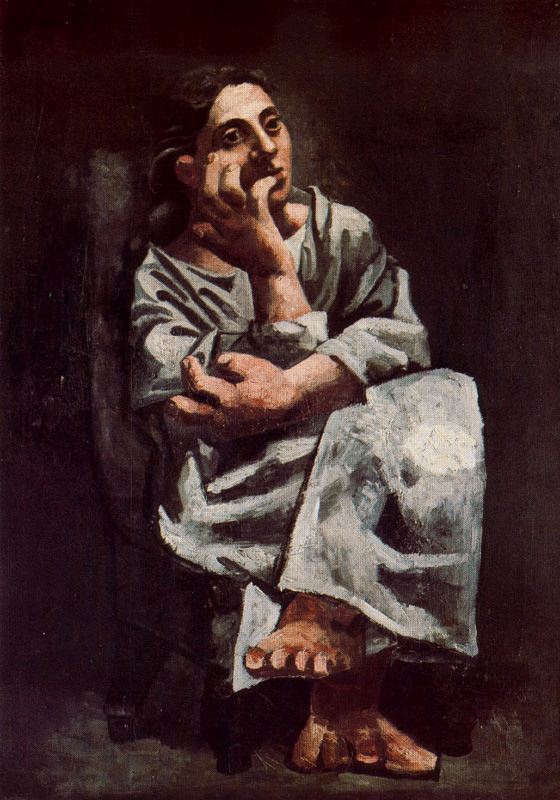
In the vast, often turbulent ocean of Pablo Picasso’s legendary career, there exist rare, tranquil harbors where the master pauses to explore the profound depths of stillness. “Femme assise” (Woman Seated) is one such masterpiece, a captivating portrait that invites the viewer into a private sanctuary of thought. Unlike the frenetic energy or the fractured, aggressive geometries found in his later Cubist periods, this work presents a figure captured in a moment of deep, quiet introspection. The subject sits with a poised, almost statuesque presence, her hands clasped near her face in a gesture that suggests a mind wandering through its own labyrinth of memories and reflections. It is a painting that does not demand attention through noise, but rather commands it through a haunting, silent gravity.
The technical execution of the piece reveals Picasso at a pivotal crossroads of artistic evolution. Painted during the transformative years of 1908-1909, the work retains a delicate connection to realism while subtly beginning to dismantle traditional perspective. Through the masterful use of oil on canvas, Picasso employs a sophisticated interplay of light and shadow to sculpt the woman’s form. One can observe the meticulous rendering of the fabric draped around her torso and the subtle, tender shading of her skin, which lends the figure a palpable, breathing quality. Yet, beneath this representational surface, there is an experimental tension; the artist begins to manipulate form and space, hinting at the revolutionary deconstruction of reality that would soon define the Cubist movement. The palette, dominated by muted and earthy tones, works in harmony with a dark, minimalist background to ensure that every ounce of emotional weight remains focused on the subject herself.
The Intersection of Tradition and Revolution
To understand the profound impact of Femme assise, one must look toward the historical currents swirling around Picasso during his formative years in Paris. This period was marked by an intense dialogue between the classical traditions of the past and the radical influences of the new century. The painting breathes the spirit of Paul Cézanne’s geometric explorations, yet it also whispers of the primal power found in African sculpture and masks—elements that would soon allow Picasso to shatter the window of Renaissance perspective forever. In this work, we see the artist standing on the threshold of greatness, using the familiar language of portraiture to prepare the world for a new way of seeing.
For the discerning collector or interior designer, this painting offers more than mere aesthetic beauty; it provides an emotional anchor for any space. The composition’s inherent balance and its subdued, contemplative atmosphere make it an ideal centerpiece for rooms designed for reflection, such as a private study, a library, or a sophisticated lounge. It possesses a timeless quality that transcends modern trends, offering a sense of intellectual depth and historical prestige. To possess a high-quality reproduction of this work is to bring a piece of art history’s most significant turning point into one's home—a permanent invitation to pause, to breathe, and to engage in the same quiet contemplation that Picasso so beautifully immortalized on canvas.