A Fragmented Vision of Modernity
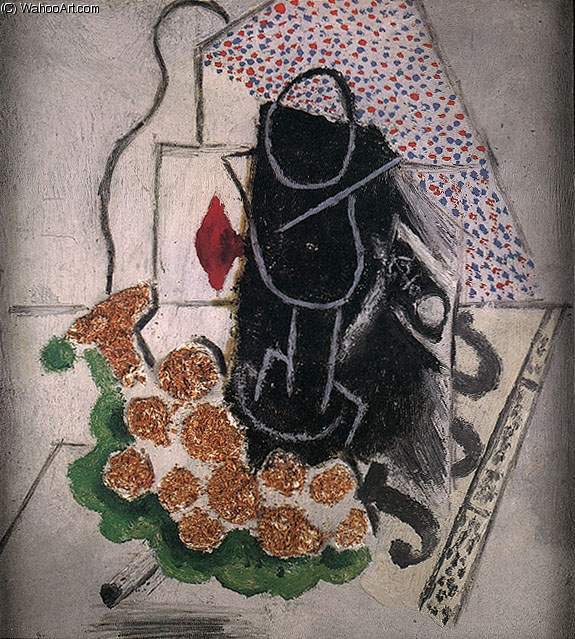
In the annals of art history, few moments are as seismic as the emergence of Cubism, and few works capture this radical shift with such profound clarity as Pablo Picasso’s “Grappe de raisin, pipe, verre, et journal”. Painted in 1914, this masterpiece serves as a visual manifesto of the Synthetic Cubist phase, a period where Picasso and his contemporaries sought to dismantle the very foundations of traditional representation. Rather than offering a window into a stable, recognizable world, this still life presents a fractured reality, inviting the viewer to participate in a complex intellectual puzzle. The arrangement of everyday objects—a cluster of grapes, a pipe, a glass, and a newspaper—becomes a playground for geometric experimentation, where the boundaries between object and space begin to dissolve.
The brilliance of this work lies in its rejection of Renaissance depth and single-point perspective. Picasso replaces the illusion of three-dimensional space with a sophisticated interplay of overlapping planes and intersecting angles. The table surface is no longer a flat plane but a series of fractured facets that mirror the fragmented perception of the modern age. As one gazes upon the composition, the eye is led through a labyrinth of shapes; the organic curves of the grapes are reimagined as angular, geometric forms, while the rigid lines of the pipe and glass are deconstructed into polygons and triangles. This technique creates a sense of spatial ambiguity that is both disconcerting and deeply stimulating, challenging the observer to reconstruct the scene within their own mind.
The Language of Color and Form
To encounter this painting is to experience a masterclass in controlled palette and structural precision. Picasso utilizes a subdued, earthy color scheme—dominated by rich ochres, deep browns, and warm reds—which anchors the composition despite its inherent fragmentation. These tones are applied in flat, deliberate planes, eschewing the soft blending of traditional oil painting in favor of a more graphic, architectural aesthetic. This lack of tonal nuance emphasizes the structural clarity of the work, allowing the strong black outlines to define the contours of each element with striking authority. The result is a surface that feels remarkably smooth and unified, where color serves not to mimic light, and shadow, but to build the very scaffolding of the image.
Beyond its formal qualities, the artwork carries a profound emotional resonance that speaks to the anxieties and aspirations of the early 20th century. The deconstruction of familiar objects can be interpreted as a reflection of a world in flux, caught in the rapid industrialization and scientific upheavals of the era. There is a certain intellectual tension held within the stillness of the subject matter; while the objects themselves represent moments of leisure and quiet contemplation, their shattered presentation suggests a deeper disruption of the status quo. For the collector or the designer, this piece offers more than mere decoration; it provides a sophisticated focal point that embodies the spirit of innovation and the enduring power of the avant-garde.
Whether displayed in a contemporary gallery setting or as a centerpiece in a curated interior, a high-quality reproduction of this Picasso masterpiece brings with it an aura of historical significance and aesthetic depth. It is a work that demands attention, rewarding the viewer with every new angle and every rediscovered plane, making it an incomparable choice for those who appreciate art that challenges, inspires, and transforms the space it inhabits.