A Poignant Encounter in Ink and Shadow
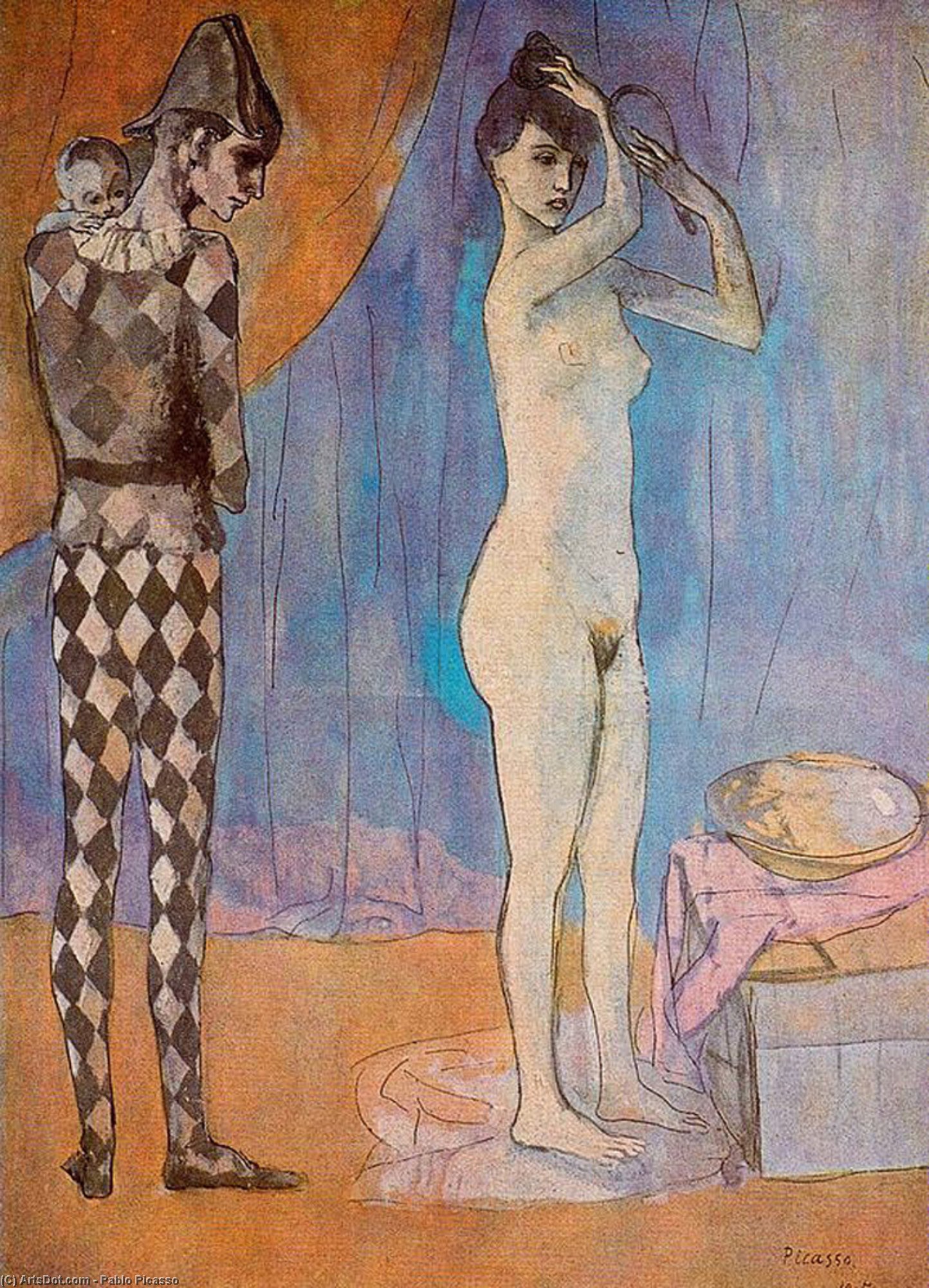
In the quiet, evocative depths of Pablo Picasso’s 1905 masterpiece, "Harlequin's Family," we find ourselves transported to a moment suspended in time, where the boundaries between theatrical performance and domestic intimacy blur. This delicate work, executed with meticulous precision through ink on paper, captures a scene that feels both deeply personal and hauntingly universal. At its heart lies a woman, her figure rendered with a sense of contemplative stillness, her gaze drifting upward as if lost in a private reverie. Beside her stands the Harlequin—that iconic, bittersweet figure from the commedia dell’arte tradition—whose presence introduces an element of the theatrical and the enigmatic into an otherwise quiet domestic tableau.
The composition is a masterclass in subtle storytelling. Every element within the frame serves as a silent narrator; the woman holds a comb with a delicate grace, a gesture that speaks to the rhythms of daily care and domesticity, yet her other hand rests upon her head, hinting at an underlying vulnerability or perhaps a weight of introspection. The presence of a simple chair, a bowl tucked into the corner, and a clock hanging prominently above her head anchors the scene in reality, while simultaneously imbuing it with a sense of passing time and the fleeting nature of existence. It is a painting that does not merely show us a scene; it invites us to inhabit its atmosphere.
The Convergence of Symbolism and Style
Created during a pivotal era in Picasso’s formative years, "Harlequin's Family" acts as a bridge between the emotional weight of Symbolism and the structural innovations that would soon define Cubism. While the artist was deeply influenced by the Post-Impressionist legacies of Cézanne and Gauguin—adopting their penchant for subjective perception over objective reality—this particular work leans into a more psychological landscape. The muted, earthy tones and the careful use of line create a sense of melancholic beauty, reflecting the anxieties and uncertainties of a world on the cusp of modern transformation.
For the discerning collector or interior designer, this piece offers a profound emotional resonance. It is not merely an aesthetic object but a window into the artist's evolving psyche. The Harlequin himself serves as a powerful symbol—a character often used by Picasso to represent the artist’s own multifaceted identity and the inherent drama of human relationships. To possess a reproduction of such a work is to bring a piece of art history’s most revolutionary spirit into one's space, offering a focal point that encourages deep thought and provides a sophisticated, soulful energy to any curated environment.
A Timeless Addition to the Modern Collection
Whether viewed as a study in early modern technique or as an evocative piece of narrative art, "Harlequin's Family" remains strikingly relevant. The interplay of light and shadow, the delicate linework, and the profound sense of mystery make it an ideal centerpiece for those seeking to infuse their interiors with intellectual depth and classical elegance. It is a work that rewards repeated viewing, revealing new layers of meaning with every encounter—a true symphony of symbolism that continues to captivate the heart and mind long after the first glance.