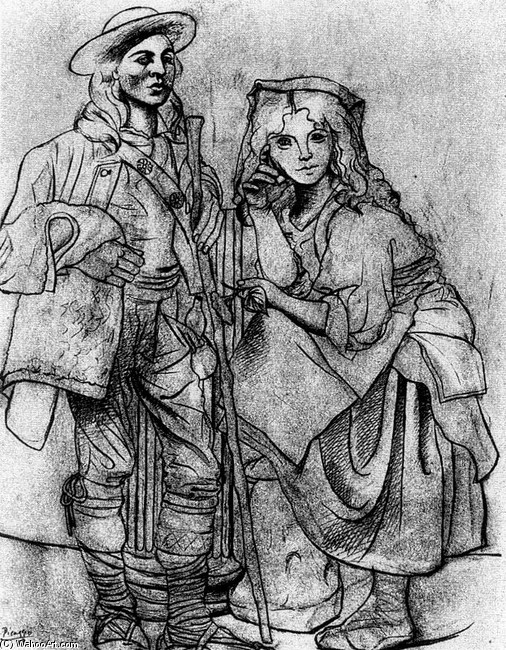
A Quiet Resonance in Graphite: The Soul of Italian Peasants
In the vast, revolutionary trajectory of Pablo Picasso’s career, there exist moments of profound stillness that offer a striking contrast to his later, more fractured masterpieces. “Italian Peasants” is one such moment—a deceptively simple yet deeply resonant study captured in the delicate medium of graphite on paper. Created between 1908 and 1909, during Picasso's formative years in Barcelona, this drawing serves as a window into a period of intense experimentation. While the world would later come to know him as the architect of Cubism, here we encounter an artist deeply enamored with the weight of human presence and the quiet dignity of rural life. The work transcends mere sketching; it is a meditation on vulnerability and the subtle, unspoken connections that bind individuals together in the shared experience of existence.
The subject matter focuses on two figures, likely men, positioned in such close proximity that their very silhouettes seem to merge into a single narrative unit. There is an undeniable intimacy in their posture, a sense of domestic quietude that invites the viewer to lean in and listen to the silence of the scene. Through his masterful control of graphite, Picasso captures more than just anatomy; he captures atmosphere. The composition is dominated by these figures, pushing them toward the foreground to confront the viewer with an honest, unadorned portrayal of human life. This sense of immediacy makes the piece particularly captivating for those who appreciate art that speaks through presence rather than spectacle.
Mastery of Line and the Texture of Life
Technically, “Italian Peasants” is a triumph of tonal variation and linear precision. Picasso employs an extensive use of hatching and cross-hatching, a hallmark of his early technical prowess, to sculpt form out of the flat surface of the paper. These rhythmic, overlapping lines do not merely delineate edges; they breathe life into the subjects. One can almost feel the coarse texture of fabric, the ruggedness of skin, and the soft weight of hair through the varying density of his strokes. This meticulous attention to detail allows for a sophisticated play of light and shadow, where a single, implied light source casts deep shadows that provide the figures with a remarkable sense of three-dimensional volume.
For the discerning collector or interior designer, the aesthetic appeal of this work lies in its monochromatic elegance. The black and white palette lends the piece a timeless, classical quality that integrates seamlessly into a variety of sophisticated environments. Whether placed in a minimalist modern gallery or a richly textured traditional study, the drawing’s strong linear emphasis and organic shapes provide a grounding element of sophistication. It offers a textural richness that invites close inspection, making it an ideal centerpiece for those seeking to introduce a sense of historical depth and intellectual curiosity into a curated space.
A Legacy of Connection and Observation
Beyond its technical brilliance, the emotional impact of “Italian Peasants” lies in its ability to evoke empathy. In an era of rapid industrialization and shifting social structures, Picasso’s focus on the humble, everyday existence of the peasantry reflects a profound respect for the fundamental human condition. The drawing functions as a symbolic exploration of connection—the way bodies lean into one another, the way shadows overlap, and the way shared space creates a sanctuary of quiet observation. It is a piece that celebrates the beauty found in the mundane and the strength found in vulnerability.
Owning a high-quality reproduction of such a seminal work allows one to bring a fragment of art history’s most transformative mind into the home. This drawing is not just an object of beauty; it is a conversation starter, a piece of the very foundation upon which modern art was built. It serves as a constant reminder of the power of observation and the enduring relevance of the human story, captured through the steady, searching hand of a young genius on the cusp of changing the world forever.