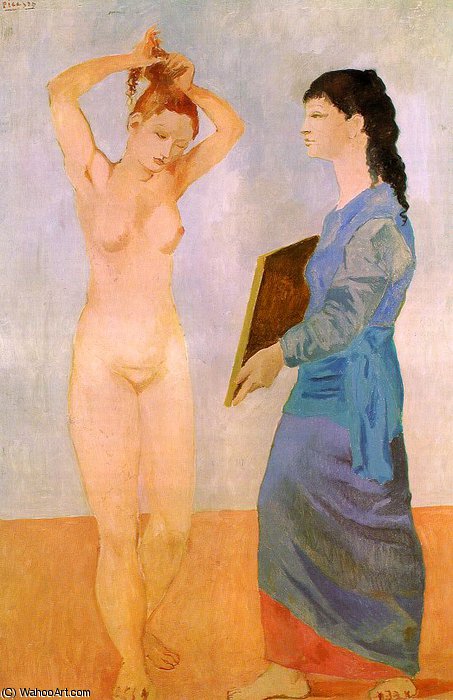
A Moment Frozen in Time: Decoding Picasso’s ‘La Toilette’
Pablo Picasso's “La Toilette,” completed in 1906 during the evocative transition of his Rose Period, transcends mere portraiture; it is a profound meditation on femininity, observation, and the subtle complexities of human interaction. Painted against the vibrant backdrop of Montparnasse’s artistic milieu—a time when Picasso had relocated to Paris seeking freedom from academic constraints—this deceptively simple composition reveals layers of meaning that continue to fascinate scholars and collectors alike. The painting captures a quiet, intimate act of self-reflection, inviting the viewer into a private sanctuary where the boundaries between the subject and the observer begin to blur.
The scene depicts two women, Fernande Olivier and Dora Maar, engaged in a quiet moment of preparation before a mirror. Picasso’s masterful use of perspective—a technique subtly borrowed from Byzantine iconography—creates an illusionistic space where the figures appear to exist simultaneously within and outside the frame. The positioning of Olivier, seated with her back turned towards the viewer, contrasts sharply with the direct gaze reflected in the mirror, establishing a dynamic interplay between observation and introspection. This deliberate arrangement underscores Picasso's fascination with capturing psychological states rather than merely reproducing physical appearances, making it an ideal piece for those who appreciate art that speaks to the soul.
The Beauty of Simplicity: Style and Technique
“La Toilette” exemplifies Picasso’s embrace of Naïve Art principles, a stylistic movement that deliberately eschewed rigid academic conventions in favor of direct observation and expressive simplification. Unlike the polished surfaces characteristic of Academic painting, Picasso employs a bold, earthy palette dominated by ochre, terracotta, and muted reds. These tones reflect the profound influence of Iberian sculpture and Byzantine art, lending the work a timeless, almost ancient quality. The brushstrokes are loose and gestural, conveying an immediate sense of emotion and movement rather than striving for photographic accuracy.
For the interior designer or art enthusiast, the technical brilliance of this piece lies in its ability to command attention through texture and tone. The way the light interacts with the muted pigments creates a warmth that can transform any room, providing a sophisticated focal point that feels both modern and deeply rooted in history. It is a masterclass in how color and form can be used to evoke a sense of atmosphere without the need for overwhelming detail.
An Enduring Legacy for the Modern Collector
Beyond its aesthetic appeal, “La Toilette” serves as a window into the restless, evolving mind of one of the twentieth century's most transformative figures. As we look back at Picasso’s journey—from the somber, melancholic depths of his Blue Period to the fractured brilliance of Cubism—works like this represent a crucial moment of transition and discovery. The painting captures a sense of peace and social intimacy that remains universally relatable, making it a timeless addition to any curated collection.
Whether you are an art lover seeking to deepen your connection to the masters or an interior designer looking for a high-quality reproduction that brings a touch of Parisian elegance to a space, this work offers unparalleled inspiration. Owning a piece that embodies such profound historical significance allows one to live alongside the very evolution of modern creativity, bringing the spirit of Montparnasse into the contemporary home.