A Poignant Encounter in the Desert Sands
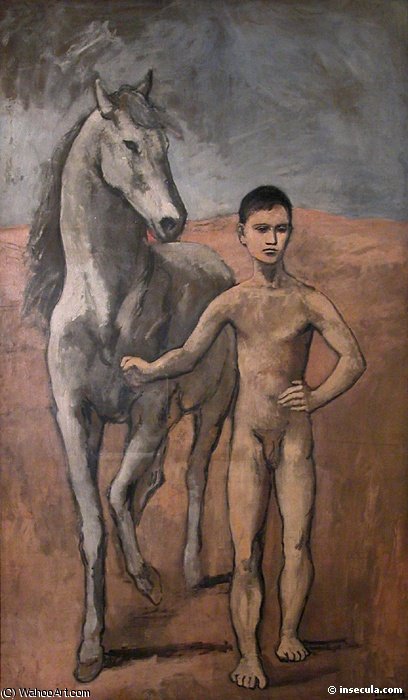
In the quiet, sun-drenched expanse of Pablo Picasso’s “Le meneur de cheval,” we are invited into a world that feels simultaneously ancient and deeply personal. Painted between 1905 and 1906, this masterpiece captures a moment of profound stillness amidst a desolate landscape. The scene presents a striking juxtaposition: a nude man standing in contemplative repose beside a horse, their forms etched against an arid, sandy backdrop. There is an undeniable sense of solitude in the composition, as if the viewer has stumbled upon a private ritual occurring far from the bustle of civilization. The presence of distant figures and a solitary bird soaring above adds layers of life to the barren environment, yet the primary emotional weight remains anchored in the silent connection between the human figure and the animal companion.
As we gaze upon this work, we witness Picasso at a pivotal moment in his artistic evolution. During this period, often associated with his Rose Period, the artist began to move away from the somber, monochromatic shadows of his earlier Blue Period toward a more nuanced exploration of form and light. The technique employed here is a masterful blend of classical realism and burgeoning abstraction. While the musculature of the man is rendered with a meticulousness that speaks to Picasso’s rigorous academic training, the horse possesses a simplified, almost primal energy. His brushstrokes are expressive and textured, imbuing the canvas with a tactile quality that allows the viewer to feel the heat of the desert and the grit of the sand.
Symbolism and the Human Condition
Beyond its visual beauty, “Le meneur de cheval” serves as a profound study in symbolism. The horse, an eternal emblem of nobility, strength, and fertility, stands as a powerful force of nature. By placing a naked man alongside this creature, Picasso explores the delicate tension between human vulnerability and the untamed spirit of the wild. This confrontation suggests a search for balance—a way for humanity to find its place within the vast, often indifferent cycles of the natural world. The desert itself acts as a psychological landscape; its isolation and harshness mirror the internal struggles of the soul, reflecting the artist's own experiences with loss and profound personal transition.
For the discerning collector or interior designer, this painting offers much more than mere decoration. It is an evocative piece that brings a sense of historical depth and intellectual intrigue to any space. Whether placed in a contemporary gallery setting or a classic study, the work’s ability to command attention through its quiet intensity makes it a timeless choice. A high-quality reproduction of this masterpiece allows one to inhabit the same atmosphere of contemplation and strength that Picasso captured over a century ago, making it an enduring investment for those who appreciate art that speaks to the very essence of the human experience.