A Poignant Echo of the Blue Period
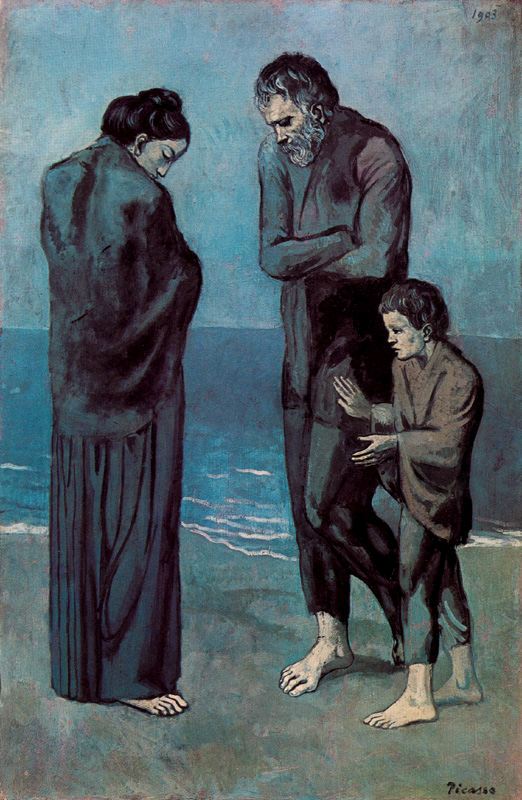
In the somber, evocative depths of Pablo Picasso’s 1903 masterpiece, Los Pobres a Orillas del Mar (The Poor on the Shore), we encounter one of the most moving expressions of the artist's early Blue Period. This canvas serves as a profound window into a time when Picasso’s brush was heavy with the weight of human sorrow and social empathy. The painting captures a quiet, familial moment set against the desolate beauty of a windswept coastline, where the boundaries between the physical landscape and the internal emotional state of the subjects seem to dissolve. For the discerning collector or lover of fine art, this work offers more than just a visual experience; it provides an intimate encounter with the vulnerability of the human condition.
The scene unfolds with a delicate, almost spectral presence. Three figures—a man, a woman, and a child—stand anchored to the shoreline, their silhouettes etched against a backdrop of muted sea and sky. There is a palpable sense of stillness, yet beneath the surface lies a turbulent narrative of resilience. The way the man and woman gaze toward an unseen horizon suggests a shared contemplation of a future that is as uncertain as the shifting tides. Beside them, the child, clutching his father’s hand, acts as a poignant symbol of innocence preserved amidst the harsh realities of poverty. This interplay between the fragility of youth and the weary resignation of adulthood creates a narrative tension that continues to captivate viewers decades after its creation.
Mastery of Tone and Texture
Technically, Los Pobres a Orillas del Mar is a triumph of atmospheric storytelling. Picasso utilizes a restricted palette dominated by melancholic blues, deep greens, and shadowy tones, a hallmark of his Blue Period that effectively communicates feelings of loneliness and despair. The artist eschews hyper-realistic detail in favor of a flattened perspective and thick, textured brushstrokes that imbue the canvas with a raw, physical energy. This tactile quality mirrors the ruggedness of the beach and the weathered lives of those depicted, making the environment feel as much a character in the story as the people themselves.
For interior designers and art enthusiasts looking to curate a space of depth and reflection, this piece offers an unparalleled emotional anchor. The composition’s understated elegance allows it to integrate seamlessly into sophisticated environments, providing a focal point that invites long periods of contemplation. Whether displayed in a quiet study or as a centerpiece in a contemporary gallery setting, the painting’s ability to evoke both sadness and a flickering sense of hope makes it a timeless addition to any high-quality collection. It is not merely a depiction of a moment in time, but an enduring testament to the strength found within the shadows of existence.