A Tender Moment: Exploring Picasso’s *Mere et Enfant*
This evocative painting, *Mere et Enfant* (Mother and Child), offers a poignant glimpse into Pablo Picasso's exploration of familial bonds and emotional depth. While the exact date remains unknown, this work appears to reside within his transitional period following Cubism, showcasing a softening of form and a renewed focus on human connection.
Subject & Composition
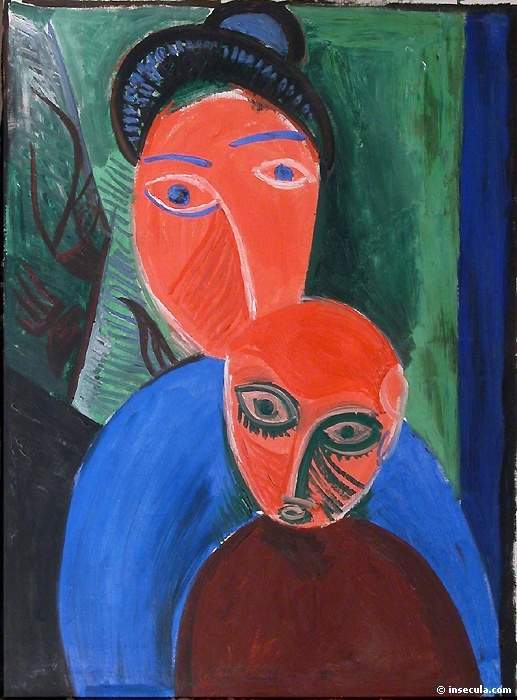
The artwork centers around the intimate relationship between a mother and her child. The composition is deliberately simple yet powerful: two figures are centrally placed, with the mother positioned slightly above and to the left of the child – a subtle indication of protection and guidance. This arrangement draws the viewer’s eye directly to their interaction, fostering a sense of quiet contemplation. The shallow perspective emphasizes the immediacy of this bond, pulling us into their private world.
Style & Technique
*Mere et Enfant* demonstrates Picasso's masterful handling of paint and his evolving stylistic approach. While echoes of Cubism remain in the simplified forms and flattened planes, there’s a clear move towards greater expressiveness. The loose, gestural brushstrokes create a dynamic texture, particularly within the abstract background of greens and blacks. This isn’t a precise portrait; rather, it's an *impression* of motherhood – a feeling captured through color and form.
The visible layering of paint suggests a process of building emotion, adding depth to the figures beyond mere physical representation. Acrylic paints appear to be the medium used, lending vibrancy and saturation to the colors.
Historical Context & Influences
Born in Spain in 1881, Pablo Picasso revolutionized art throughout his long career. After rigorous academic training, he quickly rejected convention, co-founding Cubism with Georges Braque. Following this groundbreaking period, Picasso explored various styles, including the Blue and Rose Periods, each reflecting his emotional state and artistic experimentation. *Mere et Enfant* emerges during a time of personal transition for the artist – around 1921, close to the birth of his son Paulo – potentially influencing the tender subject matter.
This period saw Picasso moving away from strict Cubist fragmentation towards a more classical sensibility, yet retaining elements of expressive distortion.
Symbolism & Emotional Impact
The image resonates with universal themes of motherhood, protection, and nurture. The somewhat melancholic or introspective undertone suggests the complexities inherent in these relationships – perhaps hinting at vulnerability, responsibility, or even a sense of isolation.
The abstract background doesn’t distract from the figures but rather amplifies their emotional weight, creating a space for contemplation. Some scholars suggest connections to Picasso's personal life and friendships, potentially interpreting the work as a tribute to lost loved ones.
For Collectors & Designers
*Mere et Enfant* is more than just a depiction of mother and child; it’s an exploration of human emotion rendered with Picasso’s signature brilliance. Its subdued palette and expressive brushwork make it a versatile piece for interior design, complementing both modern and traditional settings.
- Its emotional depth adds character to living spaces.
- The abstract elements provide visual interest without overwhelming the room.
- A high-quality reproduction captures the essence of Picasso’s technique and artistic vision.
This artwork is a testament to Picasso's enduring legacy, offering a timeless reflection on the power of familial love.