A Tender Encounter: The Soul of Picasso’s Early Mastery
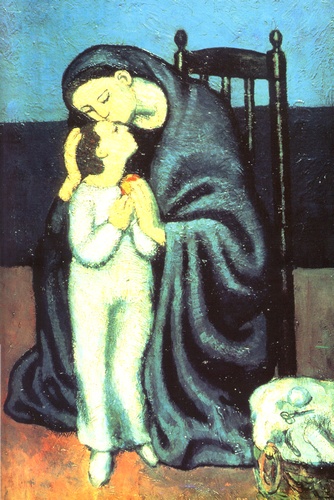
In the vast, revolutionary tapestry of Pablo Picasso’s career, there exist moments of profound stillness that predate the fractured geometry of Cubism. “Mother and Child (Maternity),” painted in 1901, is one such masterpiece—a poignant window into the artist's formative years. Before he became the architect of modern abstraction, Picasso possessed a remarkable ability to capture the raw, unadorned essence of human connection. This painting transcends mere portraiture; it is an intimate study of maternal devotion, rendered with a precision that speaks to the tender vulnerability of both mother and infant. As one gazes upon the woman cradling her child, there is an immediate sense of quietude, a sanctuary of warmth found within the simple act of nurturing.
The composition invites the viewer into a private world, where the outside chaos of the turn of the century fades into insignificance. The subject matter—a mother in a dark, hooded dress holding her son—is deceptively simple, yet it carries an emotional weight that resonates deeply with anyone who has experienced the bonds of family. Picasso utilizes a muted, earthy palette dominated by browns and ochres, which serves to ground the scene in a sense of timelessness and organic warmth. This color choice does not merely decorate the canvas; it creates an atmosphere of serenity, allowing the subtle emotional nuances of the figures' postures to take center stage.
The Grace of Neo-Romanticism and Technical Brilliance
To understand the impact of this work, one must look toward the movement of Neo-Romanticism. Moving away from the fleeting, light-obsessed experiments of Impressionism, Picasso embraced a style that prioritized emotional depth and expressive form. In “Mother and Child,” we see the artist’s mastery of technique as he balances meticulous observation with artistic interpretation. He does not simply transcribe reality; he elevates it through a sophisticated layering of pigments and a deliberate use of tonal variations. The way light catches the folds of the woman's black dress or the soft skin of the infant demonstrates a technical prowess that foreshadowed his later, more radical innovations.
There is a rhythmic quality to the brushwork—a subtle, swirling energy that breathes life into the stillness of the scene. While the figures remain anchored in a moment of repose, the artist’s hand introduces a dynamic vitality, suggesting the very pulse of life itself. For collectors and interior designers, this piece offers a unique opportunity to introduce a sense of classical elegance and emotional gravity into a space. It is a work that does not demand attention through loud colors or jarring shapes, but rather commands it through its profound dignity and the quiet strength of its subject matter.
A Timeless Addition to the Discerning Collection
Beyond its aesthetic merits, “Mother and Child” serves as a historical bridge. It captures Picasso at a pivotal moment in his life, reflecting the influences of his Spanish heritage and his burgeoning identity within the Parisian art scene. The painting’s ability to evoke empathy makes it an ideal centerpiece for any curated collection or high-end interior design project. Whether placed in a sunlit gallery or a sophisticated living space, the artwork acts as an emotional anchor, providing a sense of peace and continuity.
For those seeking to acquire a high-quality reproduction, this piece represents more than just decor; it is an investment in a legacy of human emotion. The subtle textures and the deep, soulful shadows of the original are beautifully preserved in hand-painted recreations, allowing the spirit of Picasso’s 1901 vision to live on within the modern home. It remains a testament to the idea that even in the most minimalist of subjects, there lies an infinite universe of feeling.