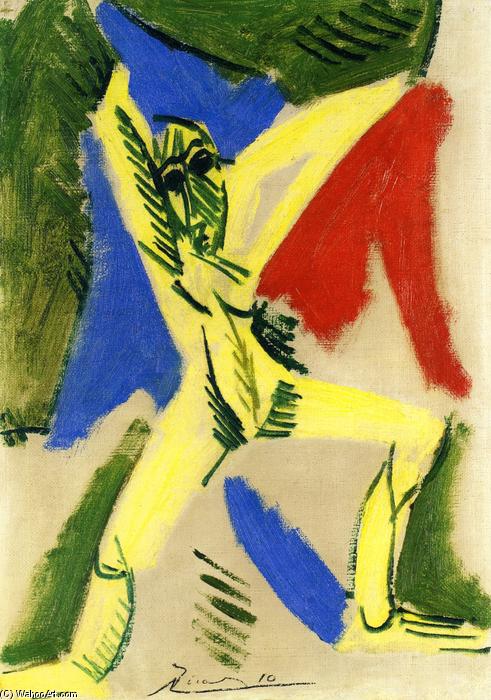
Pablo Picasso’s ‘Nude with Drapery,’ painted in 1907, exemplifies Naïve Art/Primitivism. Influenced by Cézanne's exploration of form and structure, it utilizes geometric abstraction and a restrained palette—a cornerstone of Cubism and a testament to Picasso’s revolutionary style.
Nude with Drapery (Study for ''The great dancer'')
Pablo Picasso’s *Nude with Drapery (Study for ‘The Great Dancer’)*, painted in 1907, stands as a cornerstone of Naïve Art / Primitivism—a stylistic rebellion against the formal conventions dominating European art at the turn of the century. This oil on canvas piece isn't merely an image; it’s a distillation of Picasso’s burgeoning fascination with African sculpture and his nascent exploration of Cubist principles, offering a glimpse into the genesis of one of his most iconic works—*Les Demoiselles d’Avignon*.
- Style: The painting embodies Naïve Art's core tenets: simplicity, directness, and an eschewal of academic precision. Picasso deliberately rejects illusionistic depth and perspective, prioritizing geometric forms and flattened planes to convey a sense of immediacy and raw emotion.
- Technique: Picasso employs a bold palette—primarily blues, yellows, and greens—characterized by thick impasto brushstrokes that lend texture and physicality to the canvas. This technique reflects his influence from Cézanne’s emphasis on sculptural form and foreshadows the revolutionary approach of Cubism itself.
- Historical Context: Created during Picasso's formative years, *Nude with Drapery* emerged against a backdrop of artistic experimentation fueled by Impressionism and Post-Impressionism. The Salon des Indépendants in Paris served as a catalyst for challenging established norms, prompting artists like Picasso to push boundaries and redefine visual representation.
- Symbolism: Beyond its aesthetic qualities, the painting carries symbolic weight. The nude figure embodies vulnerability and primal beauty—themes prevalent in Picasso’s engagement with African art, which captivated him with their expressive power and rejection of idealized representations.
The influence of Paul Cézanne is palpable throughout Picasso's oeuvre during this period. Cézanne’s groundbreaking work introduced new modes of representation, prioritizing the underlying structure of objects over superficial appearance—a concept that profoundly impacted avant-garde artistic movements like Cubism. Picasso meticulously studied Cézanne’s landscapes and portraits, absorbing his techniques for capturing volume and solidity on a flat surface.
The painting *Nude with Drapery* is more than just an artistic exercise; it's a pivotal step in Picasso’s journey toward establishing his distinctive Cubist style. As evidenced by reproductions at ArtsDot.com and Museo Nacional Thyssen-Bornemisza, this artwork exemplifies Picasso’s innovative vision—a testament to his ability to synthesize disparate influences into a singular aesthetic language that continues to inspire artists today. Explore the legacy of Picasso's groundbreaking work!