A Window into Picasso’s Soul
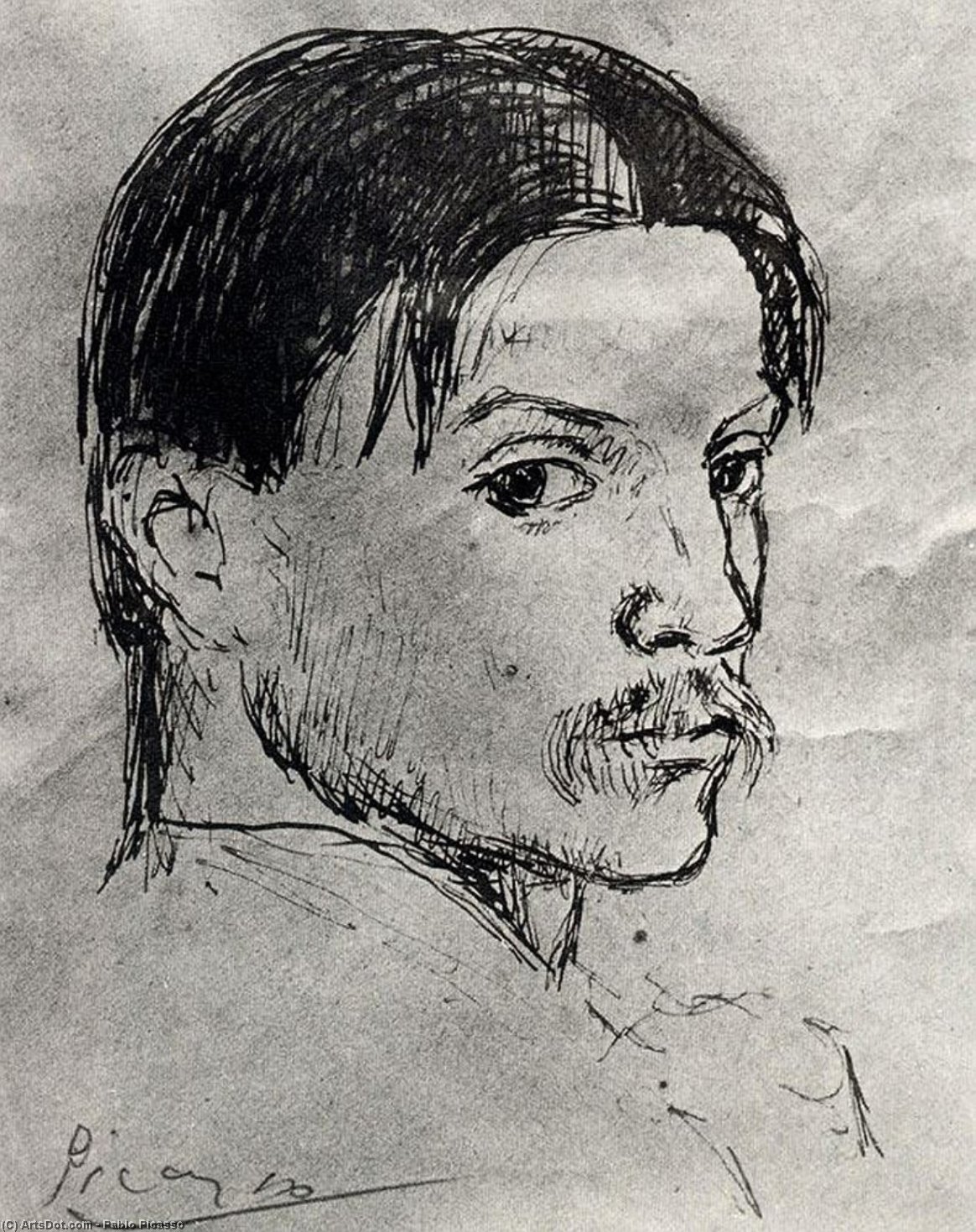
To encounter Pablo Picasso’s “Portrait de l'artiste regardant en arrière” is to step directly into the restless, searching mind of a genius. Executed around 1927, this evocative charcoal drawing transcends the boundaries of traditional portraiture, offering far more than a mere likeness of the artist. It serves as a profound visual manifestation of introspection and identity. During this pivotal period of his life, Picasso was not merely observing the world; he was dismantling it to understand its core. The piece captures a moment of deep self-reflection, where the subject—likely the artist himself—appears caught in a state of quiet contemplation, looking back not just at a physical space, but through the layers of his own evolving consciousness.
The emotional weight of the work lies in its raw, unshielded intimacy. There is a haunting quality to the way the eyes are rendered, suggesting a soul navigating the complexities of change and the heavy shadows of memory. For collectors and lovers of fine art, this piece offers a rare opportunity to possess a fragment of the Cubist revolution—a moment where the artist’s hand meets his deepest psychological truths.
The Architecture of Fragmentation
Technically, the drawing is a masterclass in the use of monochromatic intensity. Eschewing the distractions of color, Picasso relies entirely on the interplay between light and shadow to build form. The technique is characterized by thick, assertive hatching and energetic cross-hatching that lends the paper a tactile, vibrating texture. This is not a smooth, polished academic study; rather, it is an expressive, gestural performance. You can see the very movement of the charcoal as it breaks the contours of the face into geometric planes and angular facets.
This fragmentation is the hallmark of his Cubist influence. By breaking down the anatomy into simplified, somewhat distorted shapes, Picasso rejects the illusion of three-dimensional depth in favor of a more conceptual reality. The heavy, dark strokes defining the beard and hair contrast sharply with the lighter, more delicate lines of the facial features, creating a sense of immediacy and spontaneity. For an interior designer, this piece provides a sophisticated focal point, bringing a sense of intellectual depth and structural dynamism to any curated space.
A Legacy of Transformation
Understanding this work requires a glance at the historical landscape of the 1920s, a period of immense artistic upheaval. Picasso was moving through his most transformative years, having already shaken the foundations of art with Les Demoiselles d'Avignon. This drawing sits at the intersection of his earlier explorations and his burgeoning mastery of form. It reflects a broader intellectual climate that sought to move away from objective observation toward a more subjective, psychological experience of reality.
When considering a high-quality reproduction of this masterpiece for a home or gallery, one is not just selecting a decoration, but an invitation to dialogue. The piece embodies the very essence of modernism: the courage to break, the will to reconstruct, and the eternal human desire to look back and understand where we have been. It remains a timeless testament to the power of the artist's gaze, making it an enduring choice for those who value art that challenges, inspires, and moves the spirit.