A Quiet Encounter with Realism
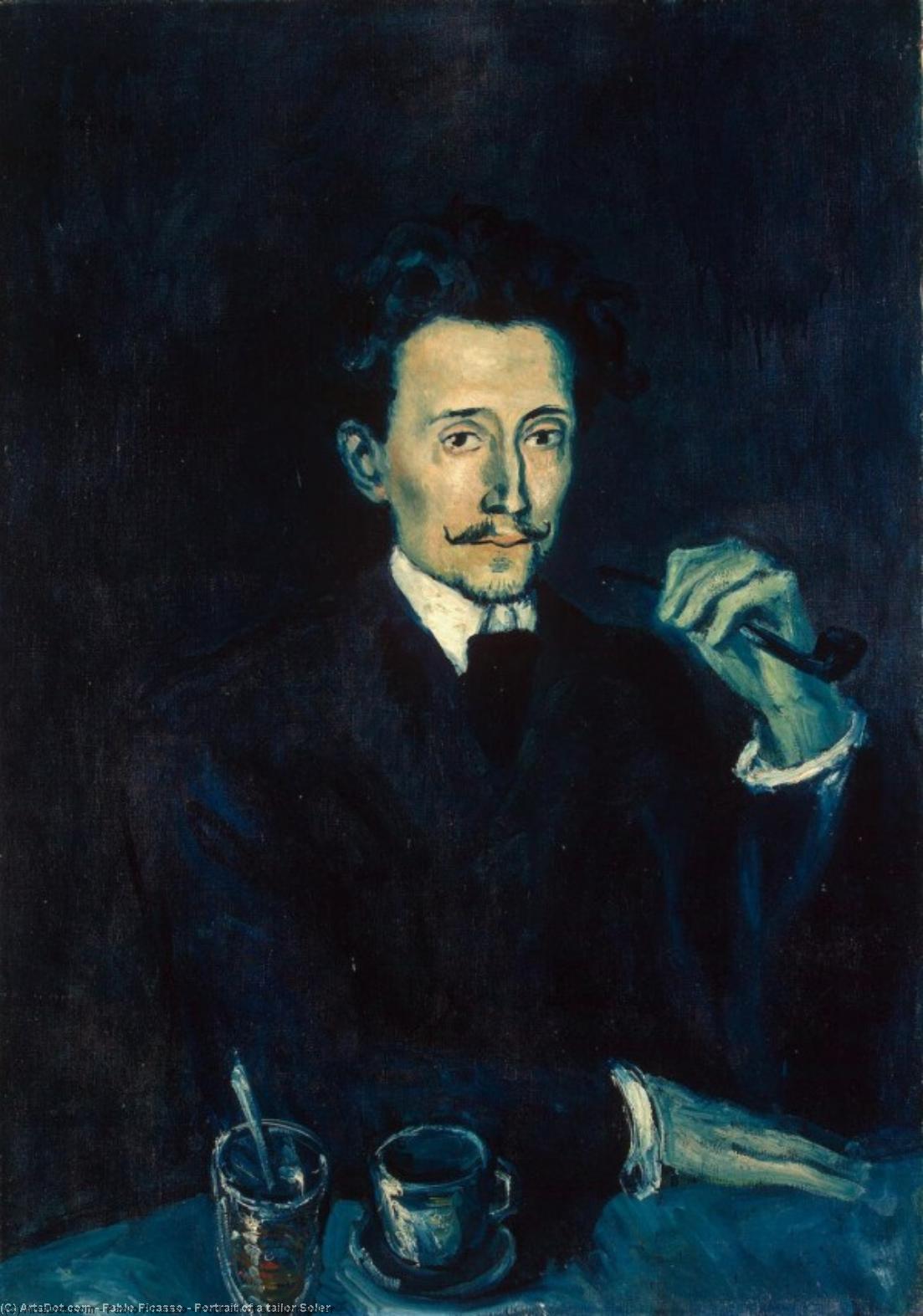
In the vast, revolutionary trajectory of Pablo Picasso’s career, there exist rare, tender moments of stillness that predate the fractured planes of Cubism and the raw emotion of his Blue Period. Portrait of a Tailor Soler, painted in 1903, is one such profound window into the artist's formative years. This work captures a moment of unassuming domesticity, presenting us with a seated man whose steady, contemplative gaze invites the viewer into a shared space of quiet reflection. Rather than reaching for the dramatic or the monumental, Picasso embraces a deliberate, candid realism, focusing on the dignity found in the everyday. The subject occupies much of the frame, anchored by a simple table setting where two cups, a spoon, and a bottle suggest a brief respite from the labors of trade. It is an intimate composition that feels less like a formal sitting and more like a stolen glance into a private moment of leisure.
The emotional resonance of the piece lies in its subtle melancholy, a quality achieved through Picasso’s masterful command of a restrained color palette. The canvas is bathed in cool, somber tones—deep blues, muted grays, and earthy browns—that imbue the scene with an air of introspection and soft solitude. There is no grand spectacle here; instead, the artist uses light to guide our emotional journey, casting a gentle glow upon the man's face and his crisp white shirt collar. This strategic use of luminosity creates a focal point of vitality amidst the surrounding shadows, suggesting that even within the mundane, there is a spark of human presence that demands our attention.
The Tactile Language of the Brush
For the discerning collector or interior designer, the technical brilliance of this work offers a rich sensory experience. Executed in oil on canvas, the painting showcases Picasso’s early mastery of texture and light. The artist employs an impasto technique, applying paint with enough thickness to create palpable surfaces that catch the light and invite tactile engagement. While the overall impression is one of smooth, atmospheric depth, a closer inspection reveals purposeful, visible brushstrokes that lend the work a sense of movement and life. These strokes are not merely functional; they contribute to an organic, slightly unfinished quality that adds a layer of modern vitality to the classical subject matter.
The composition avoids rigid geometric constraints, opting instead for fluid, organic shapes that follow the natural contours of the man and the objects surrounding him. This lack of sharp, defining lines creates a soft-focus effect, where boundaries between light and shadow blur, much like a fading memory. For those looking to integrate such a piece into a curated space, its understated elegance makes it an ideal centerpiece for rooms designed for contemplation—such as a library, study, or a sophisticated lounge. It provides a sense of historical weight and artistic depth without overwhelming the surrounding decor, acting instead as a soulful anchor that celebrates the beauty of the unadorned human experience.