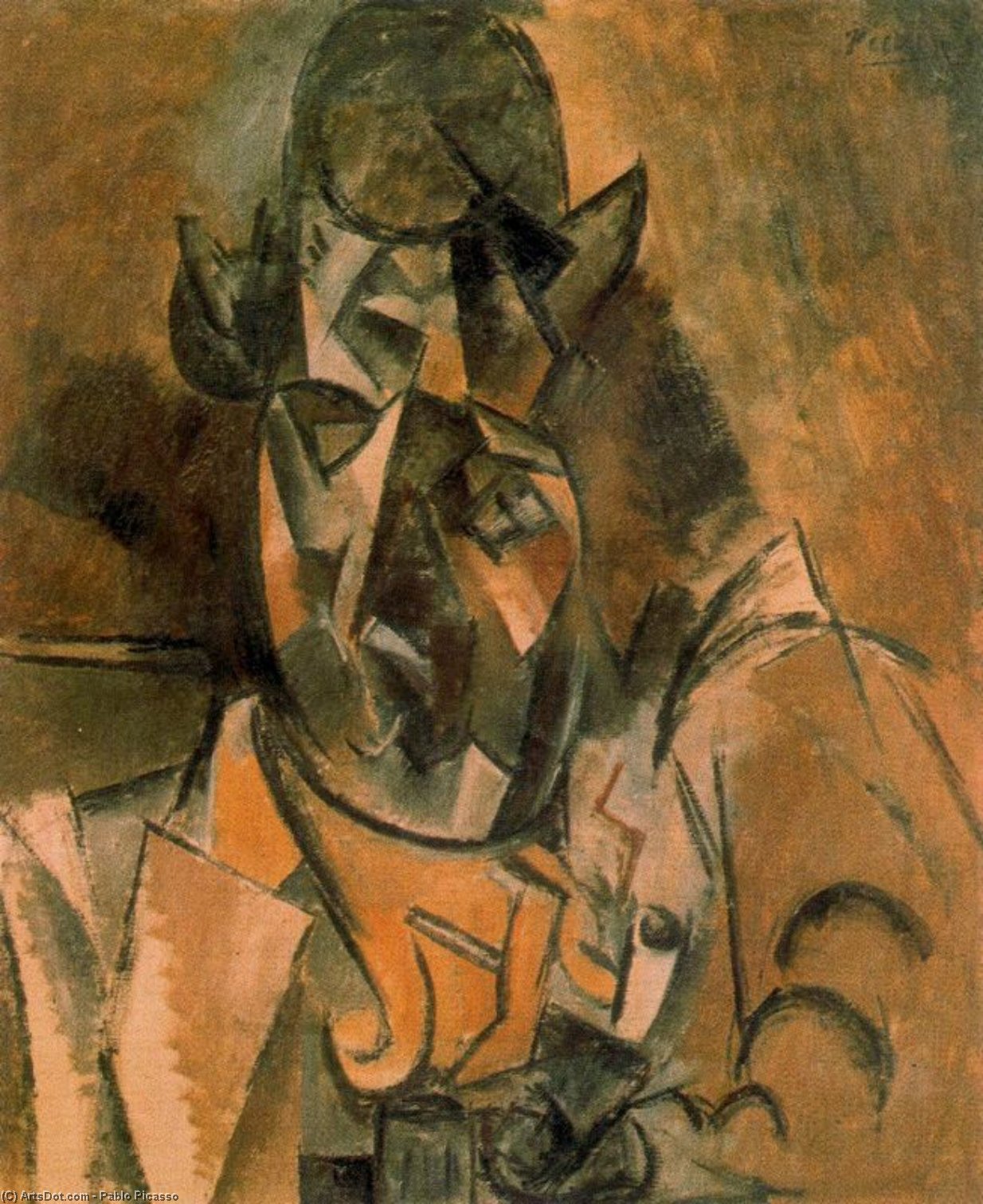
Explore Picasso's iconic 'Portrait of Georges Braque,' a masterpiece of Analytic Cubism. Fragmented forms & muted tones reveal a pivotal moment in modern art history.
Pablo Picasso (1881-1973) was a revolutionary Spanish painter and sculptor, co-founder of Cubism, and master of diverse styles. Known for iconic works like Guernica & Les Demoiselles d'Avignon, his legacy continues to inspire.
Subject and Composition
The artwork, "Portrait of Georges Braque," created by Pablo Picasso in 1910, presents an intimate depiction of the artist's close friend and fellow pioneer of Cubism, Georges Braque. The portrait is not a traditional representation; instead, it embodies the principles of Analytic Cubism, breaking down the subject into fragmented geometric forms and multiple perspectives. Braque’s face is deconstructed into interlocking planes and angles, rendered in a predominantly monochromatic palette of browns, grays, and ochres. The composition lacks a clear focal point, as Picasso deliberately avoids traditional notions of perspective and realism. The figure appears almost abstracted, yet retains a recognizable human presence through subtle cues like the suggestion of a hat and facial features dispersed across the canvas.
Style and Technique: Analytic Cubism
"Portrait of Georges Braque" is a quintessential example of Analytic Cubism, a phase in Picasso's artistic development characterized by its intellectual rigor and analytical approach to representation. Unlike earlier Synthetic Cubist works that incorporated collage elements, this portrait focuses on dissecting the subject into its constituent parts. Picasso employed a technique of fracturing forms and presenting them from multiple viewpoints simultaneously. This creates a sense of dynamism and complexity, challenging the viewer's perception of space and form. The limited color palette further emphasizes the analytical nature of the work, directing attention to the interplay of shapes and lines rather than vibrant hues. Picasso’s brushstrokes are subtle and controlled, contributing to the overall feeling of intellectual detachment and precision.
Historical Context: A Revolutionary Movement
The creation of "Portrait of Georges Braque" occurred during a pivotal moment in art history – the height of the Cubist movement. Picasso and Braque collaborated closely during this period, pushing the boundaries of artistic expression and fundamentally altering the course of modern art. Analytic Cubism emerged as a response to traditional representational methods, rejecting the illusionistic depiction of reality in favor of exploring the underlying structure of objects and space. This portrait reflects the shared intellectual exploration between Picasso and Braque, symbolizing their collaborative spirit and their commitment to challenging artistic conventions. The work was created amidst a broader cultural shift towards abstraction and experimentation, reflecting a growing disillusionment with traditional values and a desire for new forms of expression.
Symbolism and Emotional Impact
While seemingly devoid of overt emotionality, "Portrait of Georges Braque" carries profound symbolic weight. The fragmentation of the subject can be interpreted as a reflection of the complexities of human identity and perception. The monochromatic palette evokes a sense of introspection and intellectual contemplation, inviting viewers to engage with the artwork on an analytical level. The portrait also serves as a testament to the enduring friendship between Picasso and Braque, celebrating their artistic partnership and mutual influence. The overall emotional impact is one of quiet intensity and intellectual stimulation – a work that rewards careful observation and invites repeated viewing. It’s not about immediate emotional gratification but rather a slow unfolding of understanding and appreciation for the artist's innovative approach to representation.
Legacy and Significance
"Portrait of Georges Braque" remains a landmark achievement in the history of modern art, solidifying Picasso's reputation as one of the most influential artists of the 20th century. The work’s impact extends far beyond the Cubist movement, influencing subsequent generations of artists across various disciplines. Its innovative approach to representation continues to inspire and challenge viewers today, prompting a re-evaluation of traditional notions of beauty and artistic expression. Housed in the Peggy Guggenheim Collection, this masterpiece stands as a powerful symbol of artistic innovation and the transformative power of collaboration.