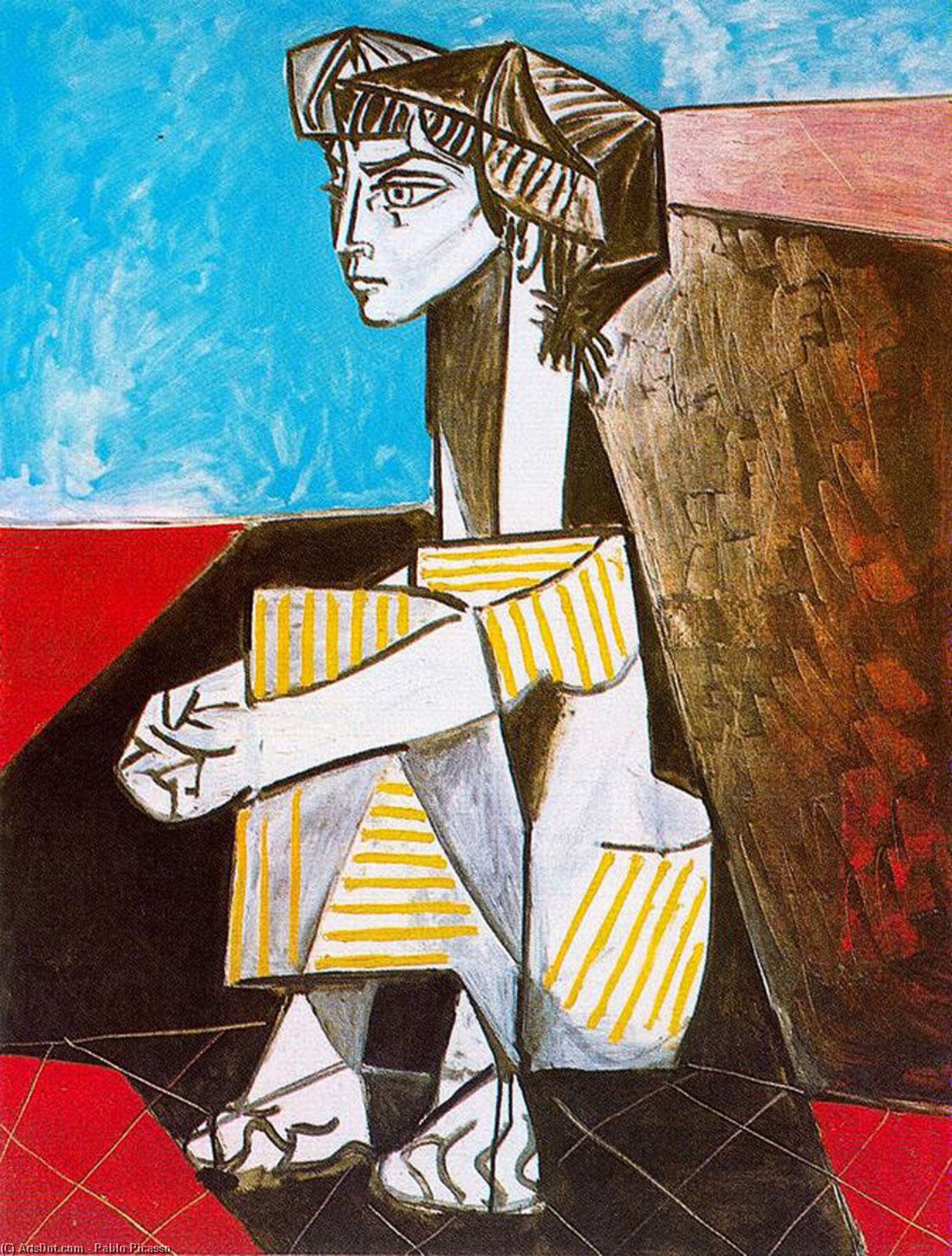
A Portrait of Intimacy: Picasso’s Jacqueline Roque with Crossed Hands
Painted in 1954, this striking portrait of Jacqueline Roque transcends a simple depiction of likeness; it is a profound exploration of presence, emotion, and the evolving relationship between artist and muse. Pablo Picasso, already a titan of modern art, found renewed inspiration in Roque, who would become his second wife, and her image dominates much of his output from this period. This particular work offers a compelling glimpse into that dynamic, rendered with the characteristic boldness and fragmented beauty of his mature style.
The Muse: Jacqueline Roque’s Influence
Jacqueline Roque entered Picasso's life in 1953 while he was working at a pottery studio in Vallauris. She wasn’t simply a model, but an active intellectual companion and emotional anchor for the aging artist. Unlike Olga Khokhlova, his first wife, Jacqueline possessed a quiet strength and reserved dignity that captivated Picasso. Her influence is palpable in the shift towards more emotionally resonant portraits during this phase of his career – a move away from purely formal experimentation toward a deeper psychological engagement with his subject.
Deconstructing Form: Cubism & Primitivism
While often categorized within the broader context of Cubism, this portrait also demonstrates elements of *Primitivism*. Picasso doesn’t merely break down Jacqueline's form into geometric shapes; he reassembles them with a raw energy and expressive distortion. The angularity of her features, the fractured planes of her face and clothing, aren’t simply stylistic choices but convey a sense of inner tension or contemplation. The bold use of color – particularly the vibrant blue background – further intensifies this emotional impact. It's important to note Picasso wasn't aiming for photographic realism; he sought to represent *how* he perceived Jacqueline, not merely what she looked like.
Composition and Symbolic Weight
The composition is powerfully centered around Jacqueline’s figure. Her hands, crossed in front of her face, are a key element. This gesture can be interpreted in multiple ways: as a sign of vulnerability, introspection, or even a subtle defense mechanism. The blue background isn't merely decorative; it creates a sense of depth and isolation, drawing the viewer’s eye directly to Jacqueline’s expression. The red floor provides a grounding contrast, hinting at passion or perhaps underlying turmoil.
Historical Context & Artistic Lineage
This portrait is one of several created between October 5th and 16th, 1954, in Picasso's Paris studio on the rue des Grands-Augustins. Interestingly, art historians have noted a fleeting resemblance between Jacqueline’s profile and figures within Eugène Delacroix’s *Women of Algiers*, though Picasso hadn’t yet begun his series directly inspired by that work. This subtle echo speaks to Picasso’s deep engagement with art history and his ability to reinterpret classical motifs through a modern lens.
Emotional Resonance & Lasting Impact
The power of this portrait lies in its ambiguity. It doesn't offer easy answers or a straightforward narrative. Instead, it invites the viewer to engage with Jacqueline’s inner world – her thoughts, feelings, and complexities. It is a testament to Picasso’s genius that he could capture not just a likeness, but an *essence* of his subject. This work remains a significant example of 20th-century portraiture, demonstrating the enduring influence of Cubism and its capacity for profound emotional expression.
- Style: Cubism, Primitivism
- Medium: Oil on canvas
- Emotional Impact: Introspective, contemplative, emotionally charged.
- Ideal For: Collectors of modern art, interior spaces seeking a statement piece, those drawn to psychologically complex portraiture.