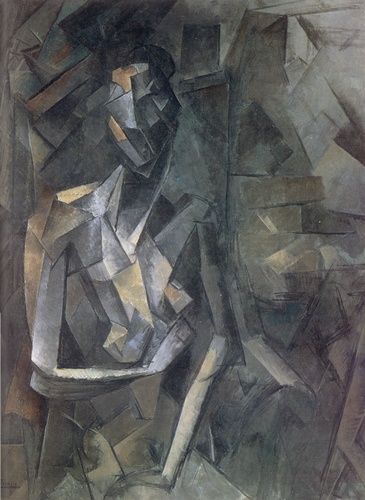
A Pivotal Moment in Modern Art: Exploring Picasso’s 1910 “Seated Nude”
This striking work by Pablo Picasso, painted in 1910, represents a crucial juncture in the artist's revolutionary development towards Cubism. More than simply a depiction of the human form, it embodies a deliberate departure from traditional representation and an embrace of fragmented perspectives – a visual manifesto signaling the dawn of modern art.
Deconstructing Form: Style & Technique
The painting features a female nude seated on a chair, her hands clasped delicately before her face in a gesture that simultaneously conveys introspection and vulnerability. A simple necklace provides a subtle focal point within the evolving abstraction. Picasso doesn’t offer conventional beauty; instead, he begins to deconstruct the figure, subtly shifting planes and angles. To the right, another partially obscured figure hints at spatial complexity. A bowl in the lower left anchors the composition, contributing to an intimate, observed atmosphere.
Executed with a limited palette of black and white, Picasso emphasizes form over color, intensifying the intellectual engagement with the subject matter. The brushwork is deliberate yet varied – areas are smoothly blended while others retain visible strokes, adding texture and depth. This technique underscores the painting’s exploration of perception and representation.
Proto-Cubism & Influences
Painted during Picasso's “proto-Cubist” period (roughly 1907-1912), this work marks a clear break from Post-Impressionism. This phase is characterized by simplification and geometricization of form, heavily influenced by Paul Cézanne’s emphasis on underlying geometric structures in nature. Picasso wasn't merely copying what he saw; he was analyzing it, breaking it down into its constituent parts, and reassembling them on the canvas.
1910 was a particularly fertile year for Picasso. His engagement with African sculpture further encouraged him to move away from realistic representation towards more abstracted forms. This exploration of non-Western art profoundly impacted the development of Cubism, challenging conventional Western artistic traditions.
Symbolism & Emotional Resonance
The clasped hands before the face are often interpreted as a symbol of self-reflection or perhaps even a veiled expression of anxiety. The fragmented form doesn’t diminish the figure's humanity; rather, it invites viewers to consider multiple perspectives simultaneously. It isn’t about seeing a nude woman, but about experiencing her presence in a new and intellectually stimulating way.
The painting evokes a sense of quiet contemplation and psychological depth. The austerity of the palette and composition focuses attention on the underlying structure and emotional weight of the subject matter.
Display & Interior Design Considerations
- Setting: A minimalist space with neutral tones will allow the painting’s subtle complexities to shine. Avoid overly busy backgrounds that might distract from its impact.
- Lighting: Soft, diffused lighting is ideal to avoid harsh shadows and highlight the nuances of the black and white composition. Consider directional lighting to emphasize texture.
- Companion Pieces: Pair this work with other examples of proto-Cubist paintings or drawings by Picasso, or works by Cézanne that demonstrate similar explorations of form. Abstract sculptures can also complement its aesthetic.
- Framing: A simple, elegant frame in a dark wood or metal will complement the painting without overpowering it. Consider a floating frame for a contemporary look.
Owning a reproduction of Seated Nude is an investment in artistic legacy – a testament to the power of innovation and the enduring influence of Pablo Picasso, bringing a touch of modern art history into your space.