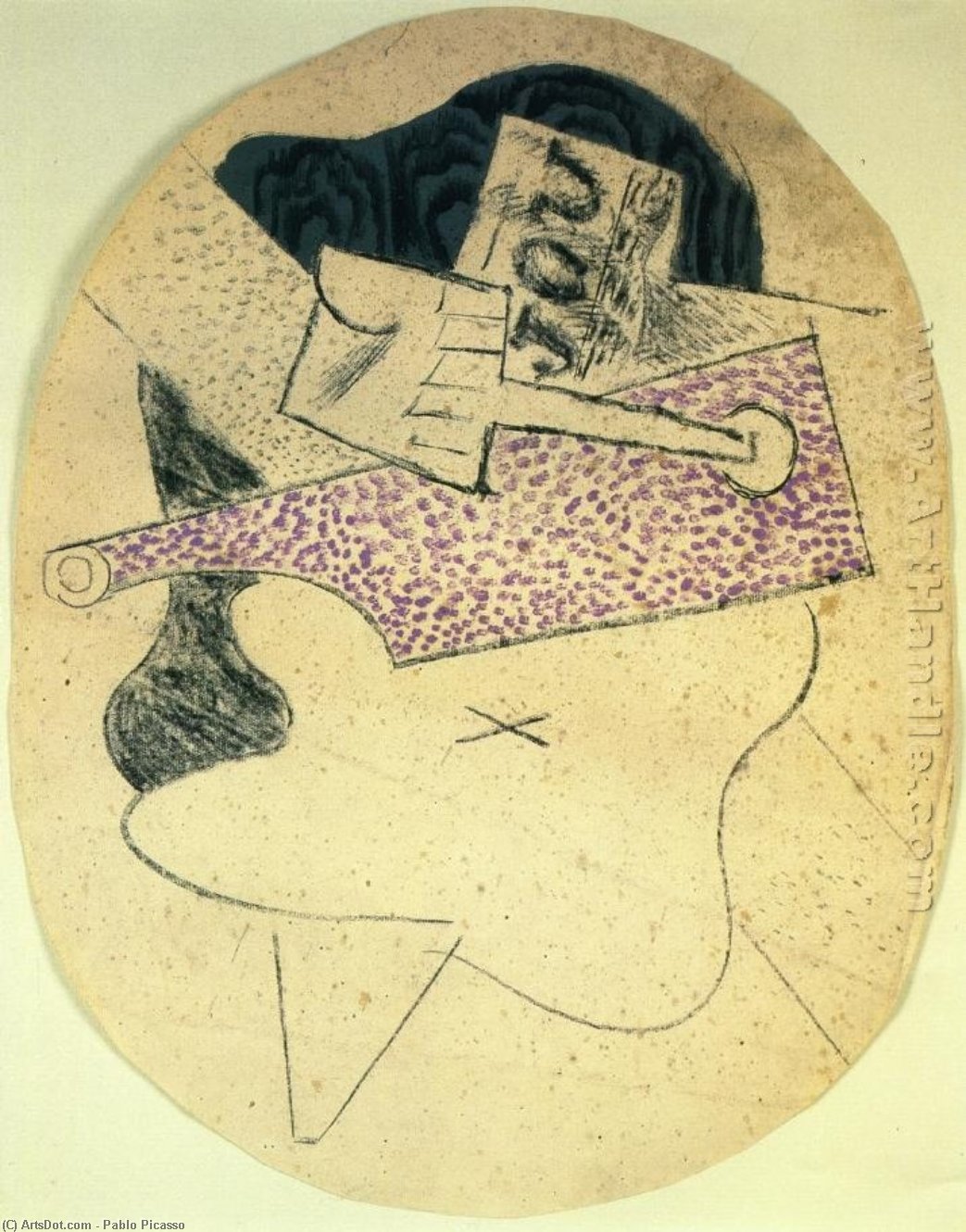
Explore Pablo Picasso's groundbreaking 'Still Life with Guitar,' a masterpiece of Synthetic Cubism showcasing geometric forms and innovative collage techniques.
Pablo Picasso (1881-1973) was a revolutionary Spanish painter and sculptor, co-founder of Cubism, and master of diverse styles. Known for iconic works like Guernica & Les Demoiselles d'Avignon, his legacy continues to inspire.
Still Life with Guitar: A Fragmented Reflection of Modern Art
Pablo Picasso’s “Still Life with Guitar,” created in 1914 during the height of Synthetic Cubism, stands as a pivotal moment in artistic history—a daring experiment that simultaneously dismantled traditional representation and embraced new expressive possibilities. Measuring 111 x 144 cm, this painting isn't merely an arrangement of objects; it’s a deliberate provocation against convention, embodying Picasso’s unwavering commitment to pushing the boundaries of visual language.
The Genesis of Synthetic Cubism
Picasso’s artistic evolution charted a remarkable course from the melancholic hues of the Blue Period and the warmer tones of the Rose Period through his exploration of African influences and Analytic Cubism's meticulous dissection of form. However, Synthetic Cubism represented a decisive shift—a move away from analytical fragmentation toward a more structured approach where geometric shapes were combined to create abstracted images. This technique sought to capture not just what was seen but also how it felt, prioritizing visual impact over literal accuracy. The creation of “Still Life with Guitar” coincided with the burgeoning avant-garde scene in Paris, fueled by artists like Henri Matisse and marked by galleries such as Galeries Dalmau championing innovative artistic endeavors.
Composition and Technique: Breaking Down Reality
The painting’s centerpiece is a guitar—a seemingly simple instrument rendered with astonishing complexity. Picasso employed a technique of collage, layering cardboard, paper, and wire onto a ferrous sheet metal surface to construct the guitar. These materials were meticulously cut, folded, threaded, and glued, resulting in a sculpture that defied conventional artistic norms. The checkered background serves as a counterpoint to the fragmented guitar, emphasizing its isolation within the broader composition. Picasso’s masterful manipulation of perspective and color contributes to the painting's dynamic energy—a visual dialogue between solidity and abstraction.
Symbolism Beyond Form
Beyond its formal innovations, “Still Life with Guitar” carries profound symbolic weight. The guitar itself represents musical expression, creativity, and perhaps even a yearning for beauty amidst the anxieties of the era. Its placement in the center underscores its importance as a focal point—a deliberate gesture to draw the viewer’s eye into the heart of Picasso's artistic vision. The inclusion of two additional figures adds another layer of intrigue, hinting at human presence within this meticulously constructed space and inviting contemplation on themes of solitude and connection.
A Legacy of Innovation
“Still Life with Guitar” solidified Picasso’s position as a pioneer—a sculptor who invented constructed sculpture, a painter who championed collage, and an artist whose unwavering belief in artistic freedom resonated throughout the 20th century. His monumental painting “Guernica,” created in response to the horrors of the Spanish Civil War, stands as testament to his ability to transform personal experience into universal symbolism—a powerful indictment of violence and oppression that continues to inspire audiences worldwide. This artwork embodies Picasso’s enduring legacy: a celebration of artistic experimentation and a profound exploration of human emotion.