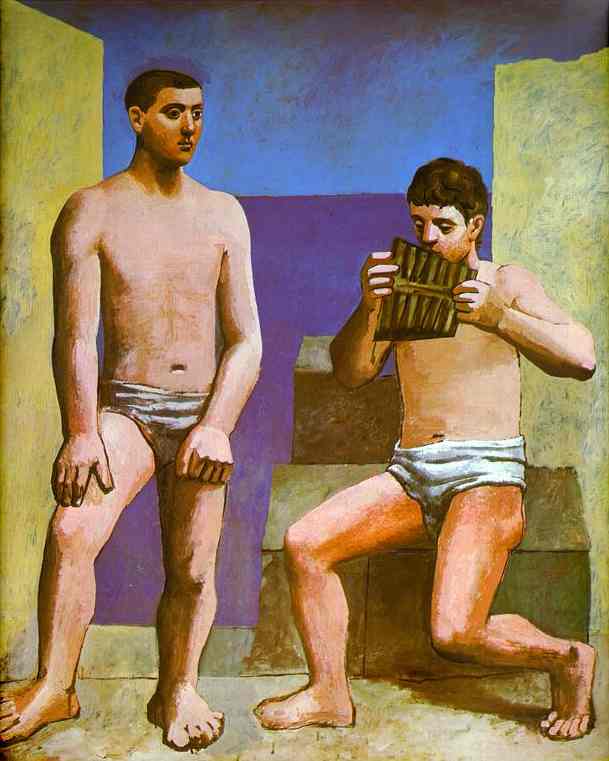
The Pipes of Pan: A Symphony in Cubist Form
Pablo Picasso’s *The Pipes of Pan* (1923) stands as a cornerstone of his neoclassical period, marking a deliberate return to monumental sculpture after years exploring abstraction. More than just a depiction of mythic figures—Pan and Argus—the painting embodies Picasso's masterful synthesis of classical inspiration with the revolutionary tenets of Cubism.
A Mythological Landscape Transformed
The scene unfolds in an idealized Arcadia, reminiscent of ancient Greek pastoral landscapes. Two colossal sculpted figures dominate the composition: Pan, god of shepherds and pipes, gazing intently towards the horizon, and Argus, a shepherd guarding his flock. These figures are rendered with meticulous detail—smooth surfaces, subtle shading—reflecting Picasso’s renewed fascination with classical sculpture techniques honed during his travels in Italy.
Cubist Innovation Amidst Classical Echoes
However, Picasso doesn't simply recreate antiquity; he fractures it. The figures themselves aren’t presented as unified forms but are dissected into geometric planes—a hallmark of Cubism—creating a dynamic interplay of perspectives that challenges traditional representation. This fragmentation isn’t merely stylistic; it symbolizes the artist’s exploration of psychological depth and his desire to convey multiple viewpoints simultaneously. Notice how Picasso utilizes overlapping planes to suggest movement and dimensionality, pushing beyond the limitations of single-point perspective.
Symbolism and Emotional Resonance
*The Pipes of Pan* is laden with symbolic significance. The pipes themselves represent music—specifically pastoral melodies—a connection to nature and innocence. Yet, Pan’s gaze directs his attention outwards, hinting at contemplation and perhaps a yearning for something beyond the immediate present. Argus's posture conveys vigilance and protection, mirroring the timeless themes of guardianship and responsibility. Picasso skillfully captures these ideas through careful positioning and subtle tonal variations, creating an artwork that evokes both serenity and profound introspection.
Technical Mastery: Oil on Canvas
Executed in oil paint on canvas, *The Pipes of Pan* demonstrates Picasso’s unwavering commitment to craftsmanship. The artist meticulously builds up layers of pigment—a technique known as glazing—to achieve luminous colors and textural richness. This painstaking process contributes significantly to the painting's emotional impact, allowing for a nuanced portrayal of form and light that elevates it beyond mere visual spectacle.
- Artist: Pablo Picasso
- Year Painted: 1923
- Medium: Oil on Canvas
- Location: Musée Picasso, Paris
This monumental artwork exemplifies Picasso’s ability to fuse classical ideals with groundbreaking artistic innovation.