A Fragmented Reflection: The Cubist Vision of Picasso
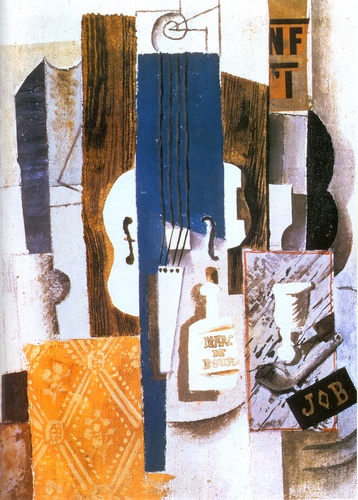
In the annals of modern art, few moments are as transformative as the era when Pablo Picasso began to dismantle the very concept of sight. His 1913 masterpiece, “Violin, Bottle, and Glass,” stands as a profound testament to this revolution. Rather than offering a mere window into a quiet corner of a studio, this work serves as an exploration of perception itself. Captured on a muted, atmospheric blue canvas—a palette that whispers of the melancholic depths of his earlier Blue Period—the painting confronts the viewer with an unsettling yet hypnotic beauty. It is not a depiction of objects as they appear to the eye in a single moment, but rather a reconstruction of reality through the artist’s internal, multifaceted vision.
The composition centers around a familiar trio: a violin, a bottle, and a glass. Yet, these are no longer the unified, recognizable forms of traditional still life. Through the lens of Synthetic Cubism, Picasso has dissected these items into a complex arrangement of geometric planes that overlap, intersect, and bleed into one another. The violin appears as a rhythmic series of angular shards, while the bottle and glass are similarly fractured, creating an illusionistic depth that defies the constraints of traditional perspective. This technique forces the eye to dance across the canvas, piecing together the subject matter from multiple viewpoints simultaneously, much like a memory that shifts and reforms with every thought.
Technique and the Texture of Reality
Beyond its intellectual complexity, the painting possesses a tangible, visceral quality that makes it an extraordinary piece for any curated collection. Picasso employed oil on canvas with a meticulous attention to detail that belies the abstract nature of the subject. The brushstrokes are subtly visible, providing a rich texture that grounds the fragmented forms in a physical reality. This interplay between the structured geometry of Cubism and the organic touch of the artist's hand creates a captivating tension. For the discerning collector or interior designer, this duality offers a unique decorative advantage: the painting possesses the intellectual weight of a museum masterpiece while maintaining a tactile warmth that complements sophisticated modern interiors.
The color palette is intentionally restrained, dominated by deep blues and muted earth tones. This choice does more than just unify the composition; it imbues the work with a sense of introspection and quietude. The blue hues evoke a certain psychological complexity, reflecting the turbulent years leading up to World War I and Picasso's own preoccupation with themes of loss and disillusionment. It is a painting that does not shout for attention but rather commands it through its profound stillness and the layered mysteries hidden within its fractured planes.
An Enduring Legacy for the Modern Home
To possess a reproduction of “Violin, Bottle, and Glass” is to invite a piece of art history into one's personal space. It is an invitation to contemplate the nature of reality and the beauty found in fragmentation. For those seeking to inspire guests or add a layer of profound intellectual depth to a room, this work offers endless fascination. Its ability to harmonize with both minimalist contemporary settings and more traditional, classic decors makes it a versatile cornerstone for any high-end art arrangement.
As we look back at the trajectory of Picasso’s career, from the somber shadows of his youth to the radical deconstructions of his maturity, this painting remains a pivotal milestone. It captures the exact moment when the old world of representation began to dissolve into the new world of abstraction. Owning such a piece is not merely about decoration; it is about celebrating the enduring human spirit of innovation and the eternal quest to see the world through a more complex, beautiful lens.