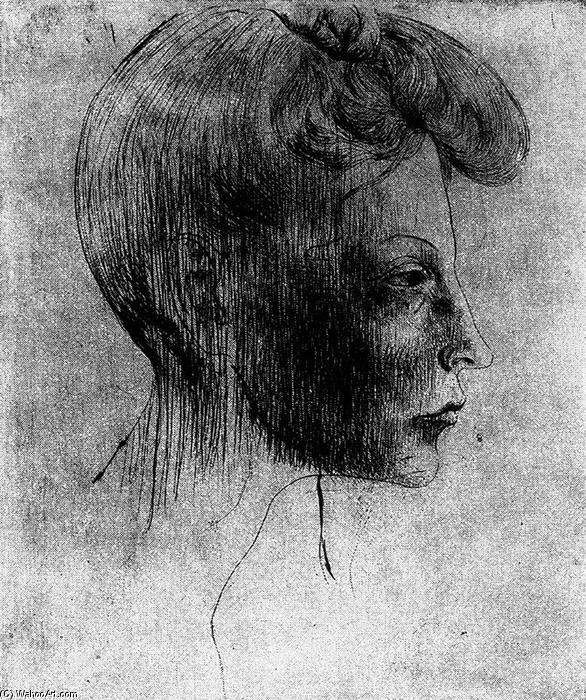
Admire Pablo Picasso’s ‘Woman’s Head,’ a poignant 1905 pencil sketch capturing intimacy & emotion. Explore this iconic work's realism, expressive lines, and the artist’s profound vision.
A Portrait of Introspection: Picasso’s ‘Woman’s Head in Profile’
Pablo Picasso’s “Woman’s Head in Profile,” executed in 1905, stands as a cornerstone of his early artistic explorations and embodies the burgeoning spirit of Symbolism alongside nascent Cubist influences. More than just a depiction of a woman's visage, this deceptively simple pencil sketch delves into themes of vulnerability and contemplation—qualities that resonate powerfully within Picasso’s oeuvre.
- Subject Matter: The artwork centers on a meticulously rendered portrait of a female subject viewed in profile. This deliberate compositional choice prioritizes conveying emotion through facial expression, focusing solely on the contours of her head and shoulders.
- Style & Technique: Picasso’s masterful use of pencil demonstrates an unwavering commitment to realism tempered by expressive stylistic choices. Heavy shading creates depth and texture, simulating the softness of skin and hair—a technique that foreshadows his later embrace of Cubism's fragmentation.
Decoding Symbolism & Emotion
The stark monochrome palette – predominantly black and white – amplifies the artwork’s emotional impact. Picasso eschews overt narrative elements, instead inviting viewers to interpret the image through its formal qualities. The intense concentration conveyed by the woman's gaze speaks to a deeper psychological exploration—a preoccupation with inner experience that would become characteristic of Picasso’s artistic vision.
- Symbolic Resonance: While devoid of explicit iconography, “Woman’s Head in Profile” operates on a symbolic level. The profile view itself suggests stillness and introspection, mirroring the subject's contemplative demeanor.
- Emotional Impact: Picasso skillfully captures a moment of quiet vulnerability—a subtle expression that invites viewers to contemplate themes of solitude and self-awareness.
Historical Context & Artistic Influences
Created during Picasso’s formative years, “Woman’s Head in Profile” reflects the broader artistic currents of the time. Symbolist painters like Edvard Munch explored psychological landscapes and emotional intensity—influences that subtly permeate Picasso's approach to portraiture. Simultaneously, the groundwork for Cubism was being laid, marking a pivotal shift away from traditional representational conventions.
- Symbolist Legacy: The artwork’s subdued palette and focus on inner emotion align with the Symbolist movement’s emphasis on conveying subjective experience rather than objective observation.
- Cubist Precursors: Picasso's meticulous line work—particularly in capturing the texture of hair—anticipates Cubism’s revolutionary exploration of geometric abstraction and multiple perspectives.
A Testament to Artistic Precision
The artwork’s execution is entirely manual, highlighting Picasso’s dedication to traditional artistic methods. Graphite pencils meticulously layered onto paper produce a textured surface that enhances the image's visual richness. The slight aging of the paper lends an air of authenticity and invites contemplation on the passage of time—a final element contributing to “Woman’s Head in Profile’s” enduring appeal.
- Material & Technique: Graphite pencils on paper – a deliberate choice that underscores Picasso's commitment to craftsmanship and artistic exploration.
- Texture & Detail: The artist’s masterful shading creates depth and dimension, capturing the subtle nuances of light and shadow—a testament to his technical prowess.