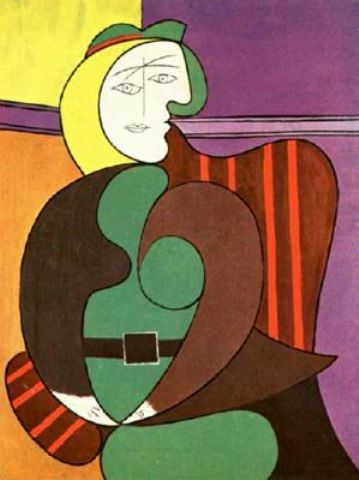
A Fragmented Portrait of Femininity: Exploring Picasso’s “Woman with Flower”
Pablo Picasso's "Woman with Flower," created in 1932, stands as a quintessential example of Cubism and Surrealist influences converging to produce an arresting visual experience. More than just a depiction of a woman—likely Olga Koklova—the painting delves into the complexities of identity and emotion through a radical stylistic approach that defies traditional representation.
Cubist Innovation: Deconstructing Form and Space
Picasso’s mastery of Cubism is immediately apparent. Rejecting Renaissance perspective and realism, he dismantles the subject into geometric planes—primarily rectangles and triangles—that overlap and intersect without adhering to conventional spatial relationships. This fragmentation isn't merely aesthetic; it symbolizes a psychological exploration of the woman’s inner self, mirroring Picasso’s own preoccupation with capturing intangible concepts.
Bold Color Palette and Textured Surface
The artwork employs a striking color palette—yellow, green, brown, and purple—that contributes to its dramatic effect. These hues clash deliberately, creating visual tension and emphasizing the angular structure of the composition. The surface appears remarkably flat, devoid of brushstrokes or discernible texture, achieved through meticulous outlining and solid color application. This technique underscores Picasso’s commitment to conveying form and emotion with uncompromising precision.
Symbolism Beyond Appearance
The inclusion of a flower—a recurring motif in Picasso's oeuvre—adds layers of symbolic meaning. Traditionally associated with beauty, femininity, and rebirth, the flower juxtaposed against the geometric abstraction represents an attempt to capture not just the woman’s physical form but also her spirit and potential for growth. It speaks to themes of vulnerability and resilience, reflecting Picasso’s own artistic journey.
Historical Context: Surrealism's Influence
"Woman with Flower" exemplifies Picasso's embrace of Surrealist ideas alongside his Cubist foundation. Influenced by artists like André Breton and Giorgio Morandi, Picasso sought to liberate art from rational constraints, tapping into the subconscious mind and exploring dreamlike imagery. This fusion of styles reflects a broader artistic movement that challenged conventional notions of beauty and representation during the interwar period.
A Legacy of Artistic Revolution
Pablo Picasso’s “Woman with Flower” remains an enduring testament to his revolutionary vision—a painting that transcends mere visual appeal to engage viewers in profound contemplation about identity, emotion, and the transformative power of art. Its meticulous technique, bold color palette, and symbolic richness continue to inspire artists and collectors alike.