A Portrait of Melancholy: The Soul Within Picasso’s Vision
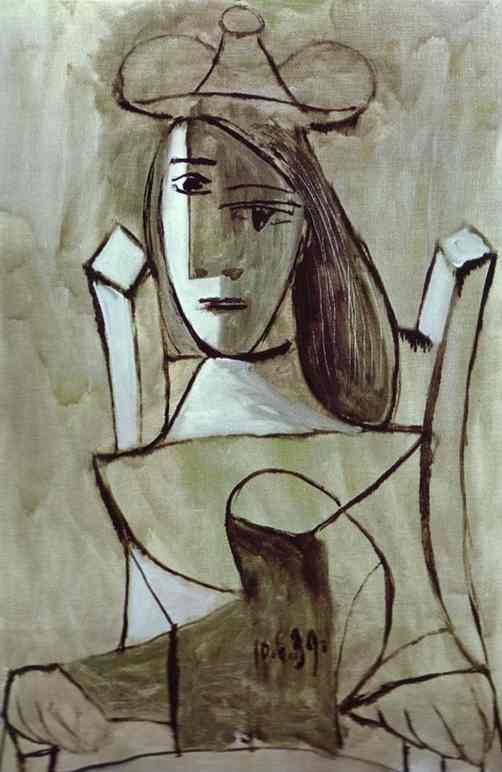
In the vast, revolutionary canon of Pablo Picasso, few works capture the quiet, devastating weight of human sorrow as intimately as “Young Girl Struck by Sadness.” Painted around 1937, this masterpiece transcends a mere portrait of a woman; it serves as a profound window into a psyche fractured by both personal intimacy and global catastrophe. The subject, often identified as Picasso’s muse and lover Dora Maar, is captured in a moment of deep introspection. Seated in a chair, her gaze drifts toward an unseen distance, her posture radiating a vulnerability that pulls the viewer into her silent, internal monologue. It is a painting that does not merely show sadness but makes the observer feel its heavy, lingering presence.
The technical brilliance of the piece lies in Picasso’s masterful application of Cubist principles to convey emotional instability. Rather than relying on traditional, smooth transitions of light and shadow, Picasso utilizes fractured planes and a deliberate manipulation of form to dismantle the subject's physical boundaries. This fragmentation serves as a visual metaphor for a broken spirit. The thick, textured brushstrokes add a tactile dimension to the canvas, creating a sense of materiality that grounds the abstract elements in a raw, visceral reality. For the collector or designer, this interplay of structure and chaos offers a sophisticated focal point that commands attention through its complex visual rhythm.
Historical Echoes and Symbolic Depth
To understand the gravity of this work, one must look toward the turbulent horizon of 1937. The painting was birthed during the harrowing years of the Spanish Civil War, a period defined by the shadows of conflict and the devastating bombing of Guernica. While not as overtly political as his monumental Guernica, “Young Girl Struck by Sadness” carries a similar atmospheric dread. The muted, somber palette—dominated by earthy browns and deep, shadowy tones—mirrors the pervasive despair of an era gripped by war. Every shade of umber and sepia seems to echo the dust and mourning of a nation in turmoil.
Symbolically, the composition is a masterclass in subtle communication. The averted gaze of the young woman suggests a profound detachment from the external world, signaling a retreat into the sanctuary of the self. This psychological isolation is reinforced by the arrangement of the space around her; the presence of other chairs, partially obscured or positioned in the background, creates a sense of depth that feels both expansive and claustrophobic. For those seeking to incorporate art into a curated interior, this piece offers more than decoration; it provides a narrative of resilience and contemplation. It is an invitation to pause, to reflect, and to find beauty within the complexities of the human experience.