The Morgan Codex (Folio 22): A Florentine Lament
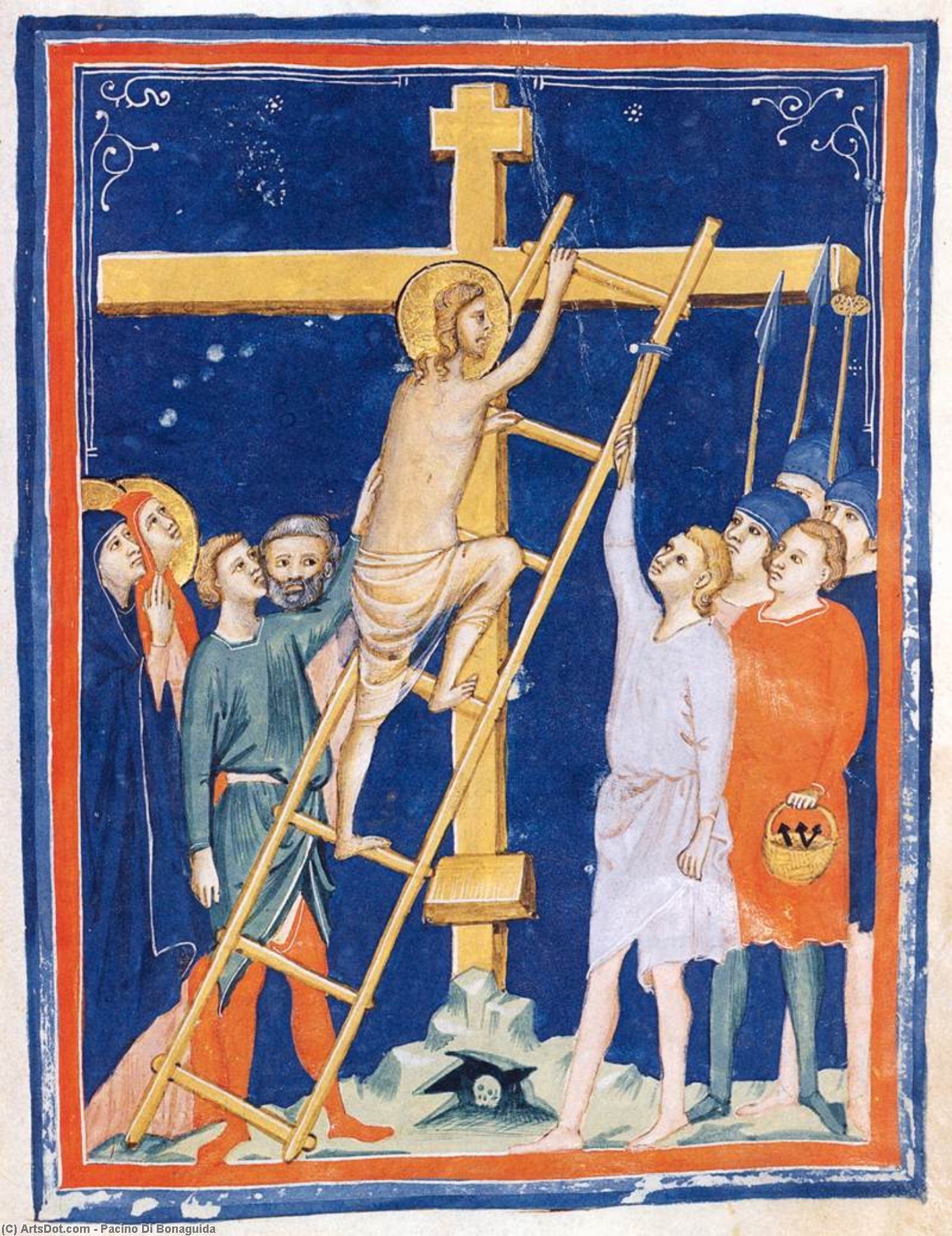
Pacino di Bonaguida’s “The Morgan Codex (Folio 22)” is not merely a depiction of Christ's crucifixion; it’s a visceral plunge into the heart of medieval piety and artistic innovation. Painted in 1320, this folio, part of the famed Morgan Codex, offers a profoundly moving meditation on suffering and redemption, executed with the characteristic somber beauty that defined Florentine Gothic art during its twilight years. The scene unfolds with an almost unnerving realism – Jesus, centrally positioned upon the cross, is rendered with a startlingly human quality, his expression conveying both agony and acceptance. Surrounding him are figures caught in moments of intense emotion: a man desperately clinging to the timber, another ascending the ladder towards him, and a throng of observers, their faces etched with grief and contemplation. The inclusion of the ladder itself – a detail that immediately draws the eye – speaks to the medieval fascination with both salvation and the arduous path required to attain it.
- Artist: Pacino di Bonaguida
- Date: 1320
- Style: Florentine Gothic
- Size: 245 x 176 cm
Technique and Materials – A Window into the Workshop
Bonaguida’s mastery lies in his meticulous application of tempera paint upon a gesso panel. The layering technique, visible upon close inspection, reveals a sophisticated understanding of color mixing and glazing—essential elements in achieving the luminous quality that characterizes much of Florentine art. Note the subtle gradations of tone within Christ's drapery, the delicate modeling of his musculature, and the expressive rendering of the surrounding figures. The artist’s use of gold leaf, though likely reduced over time, would have originally provided a radiant halo around Christ’s head, further emphasizing his divinity. The painting demonstrates a clear influence from Byzantine iconographic traditions, particularly in its frontal depiction of Christ and the stylized representation of the figures, yet it is infused with a distinctly Florentine sensibility – a growing emphasis on naturalism and emotional depth.
Symbolic Resonance – Layers of Meaning
Beyond the immediate narrative of the crucifixion, “The Morgan Codex (Folio 22)” is rich in symbolic meaning. The ladder represents the arduous spiritual journey towards salvation, while the figures surrounding the cross embody various aspects of human response to suffering: grief, faith, and perhaps even a touch of morbid curiosity. The act of climbing toward Christ can be interpreted as an aspiration for divine grace, a desperate plea for forgiveness. The painting’s placement within the Morgan Codex – a collection of illuminated manuscripts – further elevates its significance, suggesting that it was intended not just as a devotional image but also as a work of scholarly and artistic importance.
Historical Context – Florence at the Crossroads
Painted in 1320, this artwork reflects a pivotal moment in Florentine art history. The late medieval period witnessed a gradual shift away from the rigid formalism of Byzantine iconography towards a more naturalistic and emotionally expressive style—a precursor to the burgeoning Renaissance. Pacino di Bonaguida stands as a key figure in this transition, skillfully blending traditional devotional themes with emerging artistic innovations. His work exemplifies the spiritual intensity and artistic ambition that characterized Florence during this transformative era, offering a poignant glimpse into the beliefs and aesthetic sensibilities of 14th-century Italy.