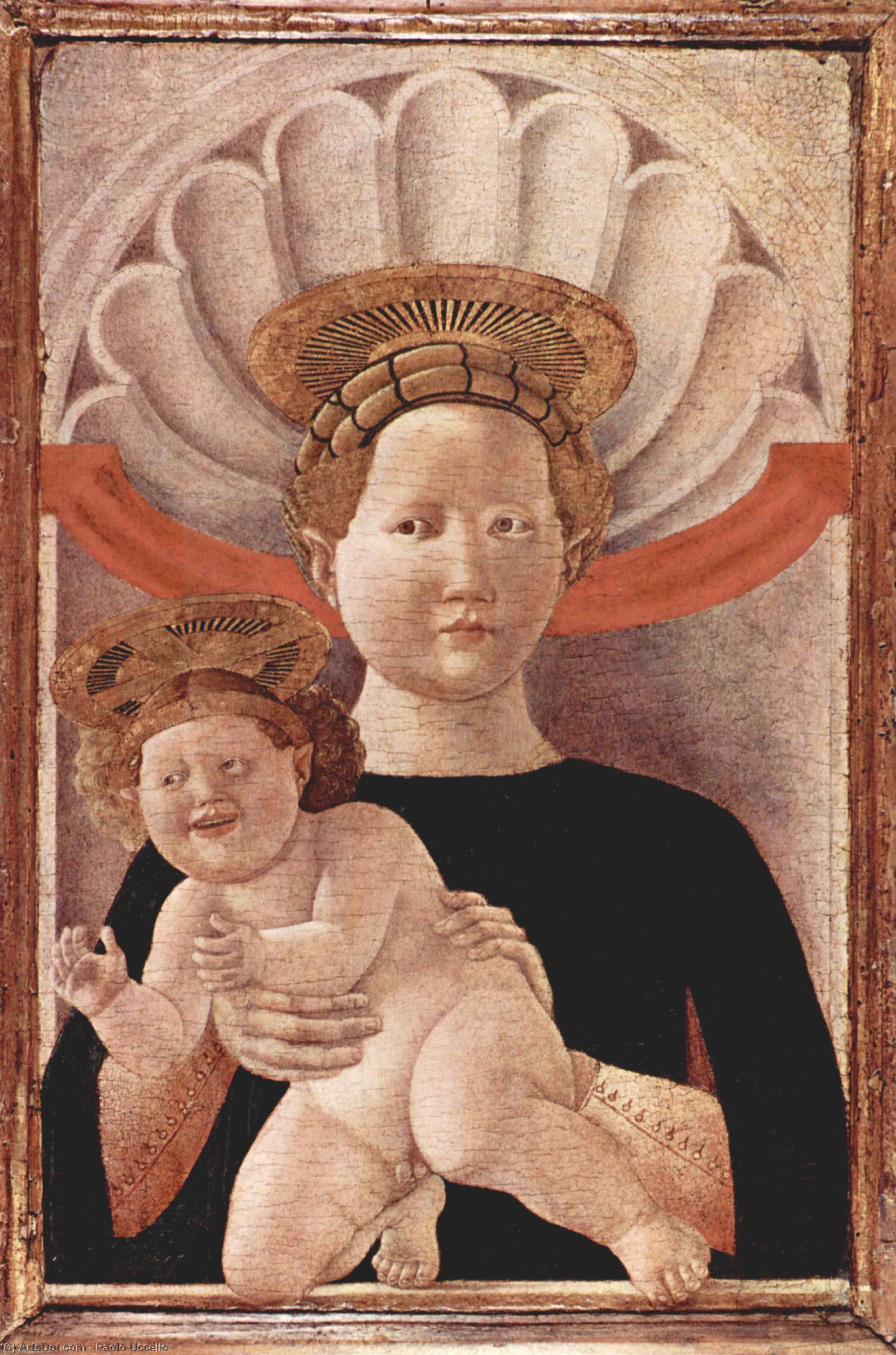
Experience the mathematical precision of Paolo Uccello's Madonna, an Early Renaissance masterpiece showcasing groundbreaking linear perspective and divine grace, available to bring timeless Florentine beauty to your collection.
A Florentine Pioneer: Exploring Paolo Uccello’s Madonna
Paolo Uccello's 'Madonna', painted in 1445, stands as an extraordinary testament to the burgeoning artistic spirit of Florence during the Early Renaissance. More than just a depiction of Mary cradling Jesus—a motif deeply rooted in Christian iconography—this painting represents a radical departure from convention, driven by Uccello’s unwavering fascination with mathematical precision and his groundbreaking experimentation with perspective. It's a work that continues to captivate viewers centuries later, offering insights into the intellectual landscape of its time and demonstrating Uccello’s mastery of artistic technique.
- Subject Matter & Composition: The central focus is undeniably Mary, portrayed with regal dignity—a crown adorning her head signifying divine authority—holding Jesus securely in her arms. This intimate portrayal speaks volumes about maternal love and protection, a theme prevalent throughout Renaissance art. However, Uccello doesn’t simply present a static image; he orchestrates a complex visual narrative enhanced by two additional figures positioned subtly behind Mary, adding depth and dynamism to the scene.
- Style & Technique: Uccello's style is characterized by its meticulous attention to detail and its ambitious application of linear perspective—a technique pioneered during this period. Unlike earlier depictions where figures appeared flattened on a two-dimensional surface, Uccello strives to create an illusion of depth, drawing inspiration from scientific treatises on optics. This painstaking effort involved extensive preparatory sketches and careful calculation to accurately represent spatial relationships.
Historical Context: Renaissance Innovation in Prato
The painting’s creation coincided with a period of intense artistic ferment in Florence—a city at the forefront of humanist thought and artistic innovation. Uccello's work reflects the broader influence of Leonardo da Vinci and Filippo Brunelleschi, who were similarly grappling with challenges posed by mathematical principles and striving to achieve unprecedented realism. The Museo dell’Opera del Duomo in Prato houses this masterpiece, safeguarding it for future generations and allowing visitors to appreciate its significance within the larger context of Renaissance art history.
- Symbolism: Beyond its religious subject matter, ‘Madonna’ is laden with symbolic meaning. The crown symbolizes Mary's holiness and divine grace, while her posture conveys tenderness and devotion—values central to Christian faith. Furthermore, the ornate wall behind the figures serves as a visual reminder of the grandeur and splendor associated with royal patronage during the Renaissance.
- Emotional Impact: Uccello’s masterful rendering captures an aura of serenity and contemplation. The gaze of Mary is serene, inviting viewers to engage in a profound reflection on themes of faith, motherhood, and divine grace. It's precisely this ability to evoke emotion—to transcend mere visual representation—that distinguishes ‘Madonna’ as a truly exceptional work of art.
Beyond the Canvas: Exploring Paolo Uccello’s Legacy
‘Madonna’ exemplifies Uccello’s commitment to pushing artistic boundaries and establishing new standards for realism. Its influence can be seen in subsequent artworks, demonstrating the enduring power of innovation and experimentation. For those seeking inspiration or desiring a stunning reproduction of this iconic piece, ArtsDot offers exceptional quality reproductions that faithfully capture the beauty and intricacy of Uccello’s original vision. Discovering the Masterpieces of Museo dell'Opera del Duomo in Prato, Italy, provides invaluable insight into appreciating its historical context and artistic significance.