A Grand Venetian Spectacle: Paolo Veronese’s “Feast in the House of Simon”
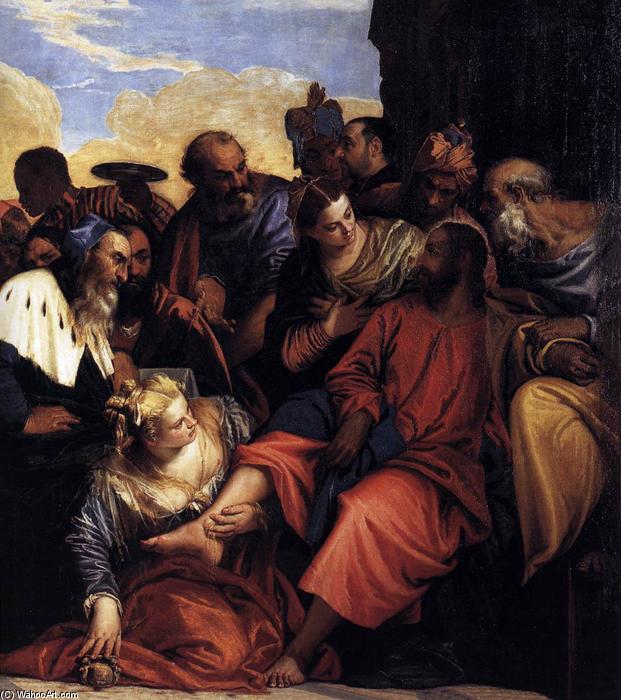
Paolo Veronese's "Feast at the House of Simon," specifically this exquisite detail panel, offers a captivating glimpse into the opulent world of 16th-century Venice. More than just a depiction of a banquet, it’s a meticulously constructed tableau vivant – a staged scene brimming with social commentary and artistic virtuosity. Painted in 1556, during his peak creative period, this work exemplifies Veronese's mastery of color, perspective, and the art of creating an illusion of immense space within a relatively contained canvas.
The painting itself is a monumental group portrait, capturing a lavish gathering within what appears to be a grand hall. The figures are remarkably diverse – nobles, merchants, musicians, and servants – all engaged in various activities: feasting, conversing, playing instruments, and observing the spectacle. Veronese’s genius lies not just in his ability to render individual likenesses with striking accuracy but also in his orchestration of the scene as a whole. He employs a complex system of aerial perspective, creating a sense of depth and distance that draws the viewer into the heart of the room. The use of light is particularly dramatic, highlighting key figures and illuminating the rich textures of their clothing and furnishings.
The Painter’s Palette: Technique and Style
Veronese was renowned for his vibrant color palette and masterful handling of oil paint. He employed a technique known as “coloristic painting,” prioritizing the expressive potential of color over strict adherence to naturalism. Notice how he uses deep reds, blues, and golds to create a sense of luxury and abundance. The brushstrokes are often loose and fluid, contributing to the overall impression of movement and energy within the scene. He was heavily influenced by Titian’s use of color and composition, but Veronese developed his own distinctive style characterized by an almost theatrical quality – a deliberate exaggeration of reality that served to heighten the drama and spectacle.
The detail panel we are examining offers a particularly rich study in this regard. Veronese's meticulous attention to costume, jewelry, and tableware is breathtaking. The folds of fabric, the gleam of silver, and the intricate patterns on the carpets all contribute to the overwhelming sense of wealth and sophistication. He skillfully uses chiaroscuro – the contrast between light and dark – to sculpt the figures and create a dynamic interplay of form and shadow.
A Window into Venetian Society
“Feast at the House of Simon” is more than just a beautiful painting; it’s a social commentary on 16th-century Venice. The gathering represents the height of Venetian prosperity, fueled by trade and maritime power. However, Veronese subtly critiques this wealth through his depiction of the figures – their gestures, expressions, and interactions reveal a complex web of social hierarchies and rivalries. The inclusion of musicians and servants highlights the importance of these roles in maintaining the lavish lifestyle of the wealthy elite.
Interestingly, the painting is believed to be based on a biblical episode from the Gospel of Matthew, where Simon the Pharisee hosts Jesus and his disciples. However, Veronese departs significantly from the original narrative, transforming it into a secular celebration of Venetian society. The presence of numerous figures, many of whom are not explicitly mentioned in the Bible, underscores this shift.
Symbolism and Emotional Resonance
Beyond its social commentary, “Feast at the House of Simon” is rich in symbolism. The abundance of food and drink represents prosperity and hospitality, while the musical instruments symbolize entertainment and pleasure. The figures themselves can be interpreted as allegorical representations of various virtues and vices. The painting’s overall effect is one of exuberant celebration – a visual feast that delights the eye and stimulates the imagination.
Reproductions of this masterpiece offer an unparalleled opportunity to bring the grandeur of Venetian society into any space. The vibrant colors, intricate details, and dynamic composition create a focal point that will captivate viewers and evoke a sense of timeless beauty. Whether adorning a grand salon or a more intimate setting, Veronese’s “Feast at the House of Simon” remains a testament to the enduring power of art to transport us to another time and place.