A Venetian Spectacle: Unveiling Veronese’s “Mars and Neptune”
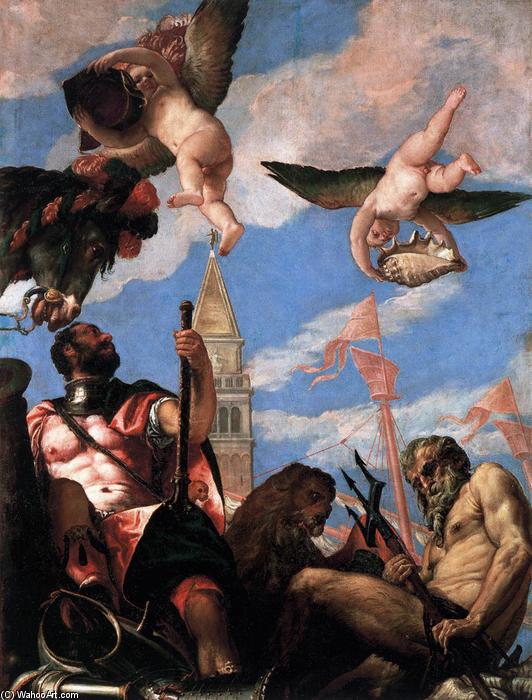
Paolo Veronese's "Mars and Neptune," painted in 1575-1578, isn’t merely a mythological scene; it’s a meticulously constructed theatrical tableau vivant – a vibrant snapshot of Venetian society and artistic ambition. Born in Verona, Veronese arrived in Venice during its golden age, inheriting the legacy of Titian's mastery of color and composition while forging his own distinctive path toward opulent spectacle. This painting, destined for the Sala del Collegio in the Doge’s Palace, exemplifies this approach, transforming a classical narrative into a dazzling display of wealth, power, and divine intervention.
The scene unfolds with an arresting dynamism. Mars, god of war, sits in the foreground, casually crossing his legs – a gesture both arrogant and inviting. He is attended by Neptune, lord of the sea, who gestures expansively towards the horizon. The figures surrounding them are a carefully curated collection of nobles, merchants, and citizens, each rendered with an almost photographic realism that belies the painting’s fantastical subject matter. Notice the intricate details: the shimmering fabrics, the elaborate jewelry, the subtle expressions on the faces – all contribute to a sense of palpable luxury and social hierarchy. The inclusion of three birds soaring above adds a touch of ethereal grace, hinting at the divine realm intertwined with earthly affairs.
The Language of Mannerism and Venetian Grandeur
“Mars and Neptune” firmly resides within the realm of Mannerism, a style that flourished in Venice during the late 16th century. Unlike the High Renaissance’s emphasis on balance and harmony, Mannerism embraced exaggeration, distortion, and artificiality. Veronese masterfully employs these techniques to create an atmosphere of heightened drama and visual richness. The perspective is deliberately skewed, drawing the viewer into the scene with a sense of immersive depth. The color palette is extraordinarily vibrant – deep reds, blues, and golds dominate, reflecting the opulent tastes of Venice’s elite. This use of intense color was influenced by Titian's work, but Veronese pushed it to new heights, creating a truly dazzling effect.
Crucially, “Mars and Neptune” is not simply an illustration of mythology; it’s a carefully constructed allegory. The painting served as a visual statement about the power and prestige of Venice itself – a city that had risen to become a dominant force in trade, diplomacy, and culture. The lavish setting, populated by wealthy patrons and prominent figures, subtly celebrates Venice's wealth and influence. The inclusion of Mars and Neptune reinforces the city’s connection to both war (its maritime power) and the sea (its economic prosperity).
Symbolism and Emotional Resonance
Beyond its surface grandeur, “Mars and Neptune” is laden with symbolic meaning. The presence of a dog – often interpreted as representing loyalty or fidelity – adds another layer to the narrative. The composition itself suggests a dynamic tension between opposing forces: war and peace, land and sea, order and chaos. Mars’ relaxed posture contrasts sharply with Neptune's energetic gesture, hinting at an underlying conflict. Yet, the overall effect is one of controlled exuberance—a celebration of Venetian power and prosperity.
The painting evokes a powerful emotional response – a sense of wonder, intrigue, and perhaps even a touch of melancholy. The sheer scale of the work, combined with its vibrant colors and intricate details, creates an immersive experience for the viewer. It’s a testament to Veronese's skill as a painter and his ability to transform classical mythology into a captivating spectacle that continues to resonate centuries later. Reproductions capture only a fraction of the original’s impact, but they offer a valuable opportunity to appreciate this extraordinary masterpiece.