Explore the vibrant world of Paolo Veronese, a Renaissance master renowned for his opulent compositions, masterful use of color, and dramatic Venetian scenes. Discover key artworks & legacy.
Paolo Veronese (1528-1588): Venetian Renaissance master celebrated for vibrant color, dramatic compositions & opulent scenes of feasts and architecture. Explore his legacy!
Discover Villa Barbaro in Matera, Italy: a UNESCO World Heritage site showcasing Renaissance frescoes by Veronese & Palladio's architecture. Explore Italian art and history!
A Venetian Visionary: The Life and Art of Paolo Veronese
Paolo Caliari, known universally as Paolo Veronese (1528-1588), stands as one of the most celebrated figures in Venetian Renaissance art. Born into a modest stonecutter’s family in Verona, his formative years were steeped in the visual richness of his hometown – a city already brimming with classical influences and humanist ideals. This early exposure undoubtedly nurtured an artistic sensibility that would blossom into unparalleled mastery over color, composition, and theatrical spectacle. His initial training under Antonio Badile and Giovanni Francesco Caroto instilled foundational skills in traditional painting techniques, yet it was his relocation to Venice in the 1550s that irrevocably propelled him toward artistic greatness. The city itself became Veronese’s unwavering muse, its bustling marketplaces, magnificent palaces, and shimmering canals serving as constant inspiration for his ambitious projects. He swiftly absorbed the stylistic currents circulating amongst established Venetian masters like Titian and Tintoretto, whose groundbreaking explorations of light and pigment profoundly impacted Veronese's own palette—though he ultimately forged a distinctive style characterized by an unwavering commitment to grandeur and illusionistic realism.
Muse with Lyre: A Symphony of Color and Form
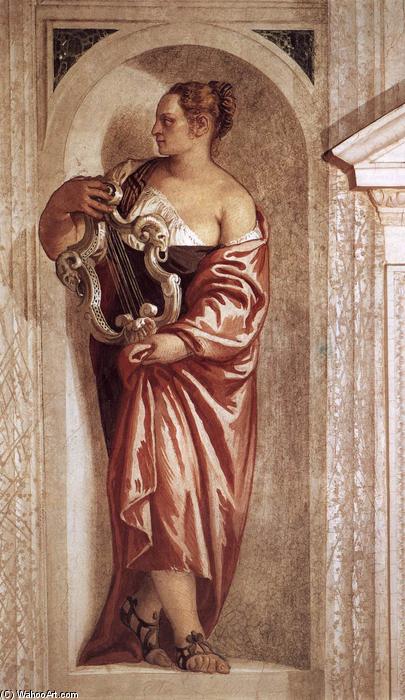
“Muse with Lyre,” completed in 1560-61, exemplifies Veronese’s signature approach to monumental painting. Located within Villa Barbaro in Maser—a villa designed by Andrea Palladio—the fresco occupies a prominent position within the palazzo's decorative scheme, demonstrating Veronese’s dedication to creating immersive environments that captivated viewers. The artwork depicts a woman adorned with opulent jewelry and draped in crimson fabric, holding aloft a lyre – an instrument symbolizing music and divine inspiration. This evocative image transcends mere representation; it embodies Veronese’s masterful manipulation of perspective and color to convey a profound sense of serenity and contemplation.
Technique and Style: Illusionistic Realism
Veronese's technique is rooted in the principles of Mannerism, a stylistic movement that prioritized stylized forms and exaggerated proportions over naturalistic accuracy. He achieved breathtaking visual effects through meticulous layering of glazes—thin coats of translucent pigment—creating luminous surfaces that shimmer with reflected light. This painstaking process allowed him to capture not only the physical appearance of his subjects but also their psychological states, imbuing the painting with an emotional resonance that continues to captivate audiences centuries later. The artist’s masterful use of chiaroscuro – dramatic contrasts between light and shadow – further enhances the depth and dimensionality of the scene, guiding the viewer's gaze across the composition and emphasizing key elements.
Historical Context: Venetian Patronage and Mythological Narrative
“Muse with Lyre” reflects the prevailing artistic tastes of its time—a period marked by fervent interest in classical mythology and humanist scholarship. Villa Barbaro itself was conceived as a testament to Palladio’s architectural ideals, aiming for harmonious proportions and elegant ornamentation. Veronese's commission underscored the importance of aristocratic patronage within Venice, where artists like him thrived on commissions from wealthy families eager to adorn their homes with masterpieces that proclaimed their status and refined sensibilities. The fresco’s depiction of Apollo—the Greek god of music and poetry—and Daphne—transformed into laurel trees by Apollo’s divine intervention—references prominent myths exploring themes of beauty, transformation, and the pursuit of artistic excellence.
Symbolism and Emotional Impact: Beauty and Tranquility
Beyond its formal brilliance, “Muse with Lyre” communicates a powerful emotional message. The woman's serene gaze and graceful posture convey an aura of composure and contemplation—a deliberate contrast to the turbulent political landscape of Venice during Veronese’s lifetime. The lyre itself serves as a potent symbol of artistic creativity and divine grace, reminding viewers of the transformative power of beauty and intellect. Ultimately, Veronese’s masterpiece invites us to savor the sublime – an experience characterized by awe and wonder—and celebrates the enduring legacy of Venetian Renaissance art.