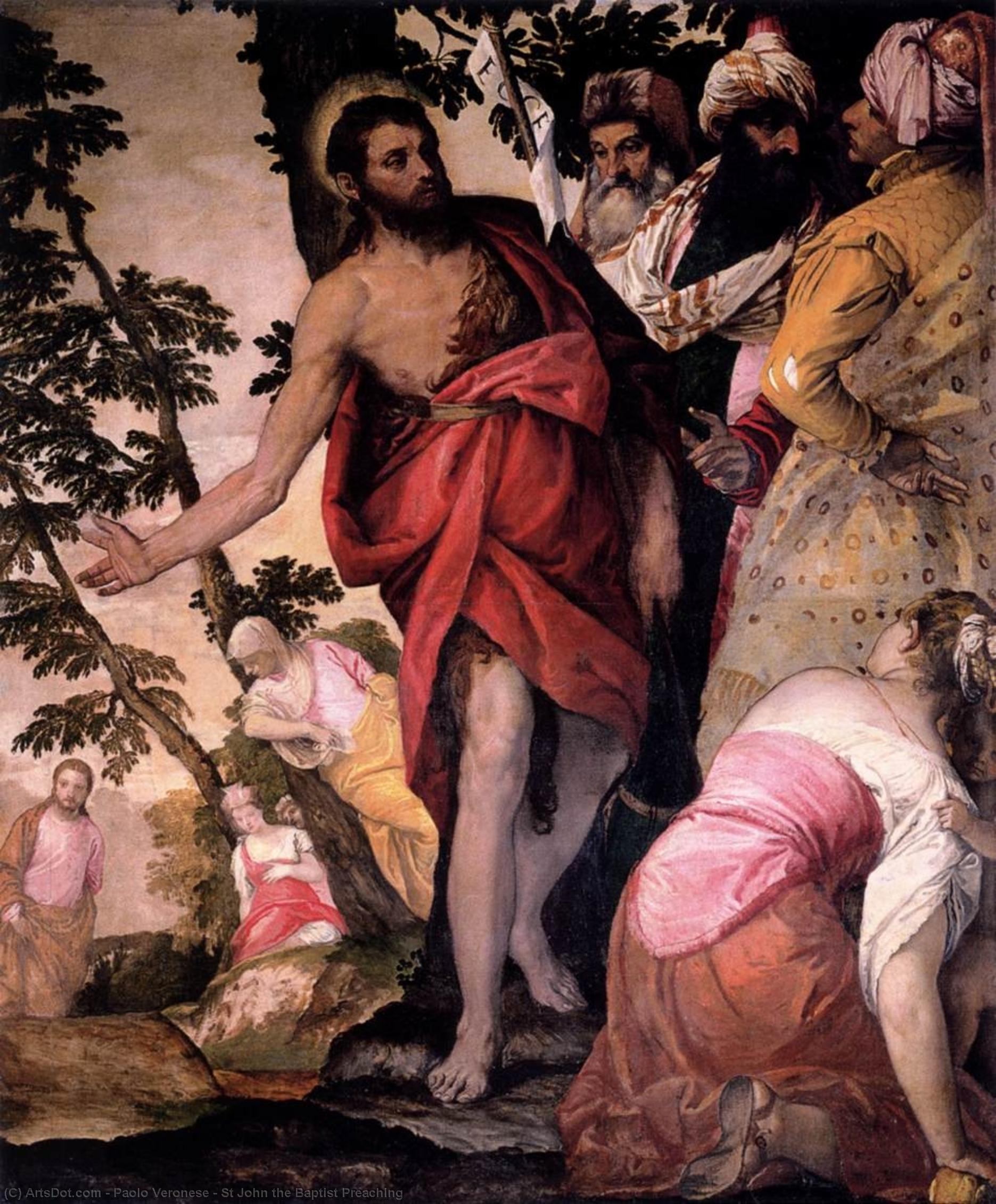
A Vision of Venetian Grandeur
In the heart of the sixteenth century, amidst the shimmering canals and opulent palazzos of Venice, Paolo Veronese breathed life into a scene of profound spiritual intensity. His masterpiece, St John the Baptist Preaching, is far more than a mere religious depiction; it is a theatrical window into an era of fervent devotion. As the viewer approaches this monumental work, they are immediately swept into a moment of divine encounter. The central figure of St. John stands with arms outstretched, a gesture that serves as both a welcoming embrace and a powerful call to repentance. Around him, a diverse tapestry of humanity gathers—men and women captured in various states of contemplation, curiosity, and awe. This assembly does not merely observe a sermon; they inhabit a sacred space where the earthly and the divine converge.
The painting is a quintessential triumph of the Venetian Baroque style, a period defined by its dramatic use of light and its ability to evoke emotion through sheer visual splendor. Veronese, a master of illusionistic perspective, crafts a composition that feels boundless, drawing the eye from the central preacher toward the periphery of the crowd and into the lush, verdant landscape beyond. The technique employed is nothing short of miraculous; through the meticulous layering of thin, translucent glazes, Veronese achieves a luminous quality that makes the canvas appear to glow from within. Every fold of drapery, every subtle shift in skin tone, and every leaf in the background is rendered with a textural richness that invites the eye to linger, creating an immersive experience that blurs the line between the painted world and our own reality.
Symbolism and the Spirit of the Age
Beyond its aesthetic brilliance, the work is deeply embedded in the historical and theological currents of 1562. Commissioned by the influential Cardinal Federico Borromeo for his cathedral in Milan, the painting served as a potent instrument of the Counter-Reformation. Every element within the frame is laden with symbolic weight designed to inspire piety. The outstretched arms of St. John represent the availability of divine grace, while the gathered crowd acts as a mirror for humanity’s collective yearning for salvation. Even the natural setting plays a role in this spiritual narrative; the surrounding trees and lush greenery evoke the concept of paradise and the eternal renewal promised through faith. It is a visual metaphor for the flourishing of the soul under the light of truth.
For the discerning collector or interior designer, a reproduction of this magnitude offers an unparalleled opportunity to introduce a sense of historical gravity and classical elegance into a space. The painting’s balanced composition and rich, saturated palette make it a commanding focal point, capable of anchoring a room with its sophisticated drama. Whether placed in a grand library, a formal dining hall, or a contemporary gallery setting, St John the Baptist Preaching brings with it the prestige of the Italian Renaissance. It is an invitation to surround oneself with art that does not merely decorate a wall, but tells a story of human aspiration, artistic mastery, and the enduring power of the sublime.