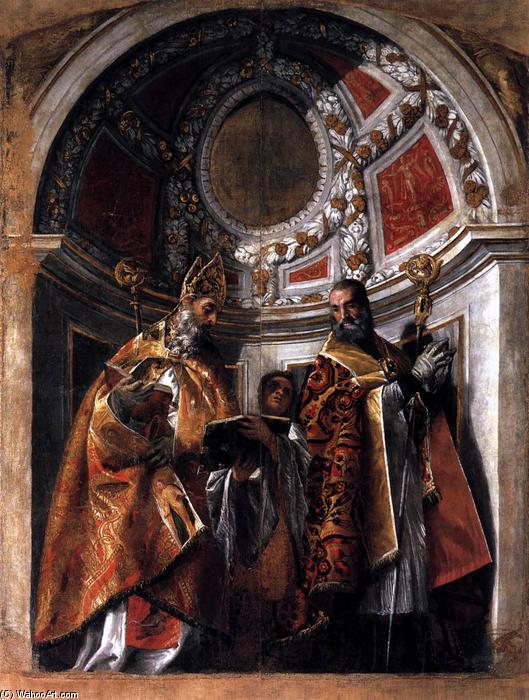
Sts Geminianus and Severus by Paolo Veronese
Paolo Caliari, universally known as Paolo Veronese (1528-1588), stands as an undisputed titan of Venetian Renaissance art—a painter whose legacy continues to captivate audiences centuries later. Born in Verona amidst the burgeoning humanist fervor of his time, Veronese’s formative years instilled within him a profound appreciation for classical ideals and artistic innovation, shaping his distinctive approach to visual storytelling. His early training under Antonio Badile and Giovanni Francesco Caroto honed foundational skills in traditional fresco painting techniques, yet it was his relocation to Venice in 1550 that irrevocably propelled him toward artistic greatness. The city itself became an inexhaustible source of inspiration—its opulent palaces, bustling marketplaces, and shimmering canals fueling the ambition of Veronese’s imagination and informing the monumental scale of his canvases. He swiftly assimilated the stylistic influences of Venetian masters like Titian and Tintoretto, absorbing their mastery of color and dramatic composition while simultaneously forging a singular artistic voice characterized by unparalleled grandeur and meticulous detail.
- Subject Matter: The painting depicts Saint Geminianus and Saint Severus, two saints venerated in Venice, standing alongside each other before an elaborate arched gateway adorned with a monumental circular window.
- Style: Veronese’s style embodies Venetian Mannerism—a movement that prioritized stylized forms, exaggerated perspective, and refined decorative elements over naturalistic representation. This stylistic choice reflects the intellectual currents of the era, emphasizing idealized beauty and spiritual contemplation.
- Technique: Executed in oil on canvas, Veronese employed a masterful glazing technique—layering translucent pigments upon opaque undercoats to achieve luminous color effects and create an illusion of depth that surpasses conventional realism. The meticulous attention to detail is evident throughout the composition, from the intricate drapery folds to the subtle nuances of facial expressions.
The artwork’s historical context resides firmly within the Venetian Republic's golden age—a period marked by unparalleled artistic patronage and cultural flourishing. Commissioned for the organ in San Geminiano church, Veronese’s monumental panel served as a powerful symbol of Venetian piety and civic pride. Following Napoleon’s invasion in 1807, the painting was tragically divided into two halves, mirroring its original function—the wings concealing the pipes of the instrument when closed and revealing the saints' portraits upon opening. This deliberate fragmentation underscores Veronese’s artistic intention to convey a sense of unity and transcendence.
Beyond its formal qualities, Sts Geminianus and Severus resonates with profound symbolic significance. Saint Geminianus, depicted on the left wing, embodies humility and penitence—attributes revered in Venetian Christianity. Conversely, Saint Severus, positioned on the right, symbolizes courage and fortitude—qualities championed by the saints as protectors of the faithful. The circular window above them serves as a visual metaphor for divine illumination—suggesting that faith and contemplation illuminate the human soul.
Veronese’s masterful use of color—particularly crimson, gold, and azure—creates an atmosphere of regal splendor and spiritual solemnity. These hues evoke associations with papal authority and ecclesiastical grandeur, reflecting Venice's prominent role in European Christendom. The painting’s overall impact is one of awe and reverence—inspiring contemplation on faith, virtue, and the enduring beauty of artistic achievement.
This artwork exemplifies Veronese’s unparalleled ability to synthesize classical ideals with Venetian artistic traditions, resulting in a masterpiece that continues to inspire admiration for its grandeur, color, and symbolic depth.