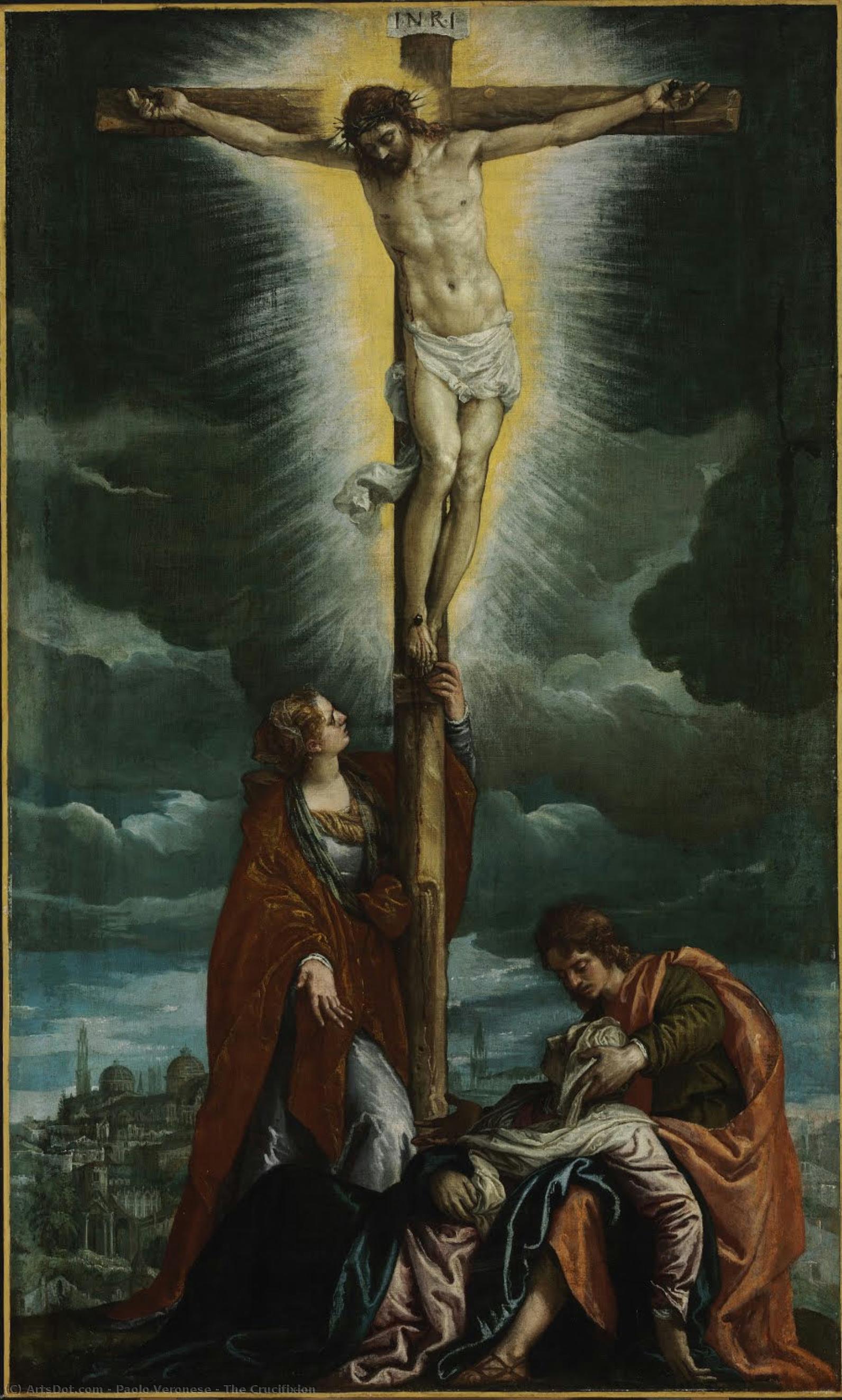
The Crucifixion by Paolo Veronese: A Venetian Spectacle of Faith and Drama
Paolo Veronese’s “Crucifixion,” painted around 1582, isn't merely a depiction of a pivotal religious event; it’s an immersive theatrical experience rendered in the vibrant, opulent style that defined the Venetian Renaissance. More than just a historical scene, this monumental canvas—measuring a commanding 102 x 102 centimeters—is a testament to Veronese’s mastery of color, composition, and his uncanny ability to infuse religious subjects with a palpable sense of drama and earthly grandeur.
The painting unfolds within a meticulously constructed cityscape, unmistakably Venice. The background is dominated by the recognizable silhouette of the Rialto Bridge, instantly grounding the scene in its Venetian context. However, Veronese doesn’t simply portray a biblical event; he elevates it to a grand spectacle worthy of a royal court. Figures throng the foreground, creating a bustling tableau of onlookers – soldiers, mourners, and even a few figures who appear to be engaged in lively conversation, adding an element of earthly realism to the solemnity of the occasion.
Mannerist Innovation: Color, Scale, and Dramatic Lighting
Veronese’s style firmly resides within the Mannerist period, a transitional phase between the High Renaissance and Baroque. He inherited from Titian's legacy a profound understanding of color theory, but pushed it to new extremes. The palette is extraordinarily rich—deep reds, vibrant blues, shimmering golds, and earthy browns—all blended with an almost impossible luminosity. This isn’t simply decorative; it serves to heighten the drama and create a sense of overwhelming visual intensity.
The scale of the painting is deliberately imposing, reflecting Veronese's ambition to rival the grand history paintings of Rome. He employs a technique known as *quadratura*, or illusionistic painting, to extend the architectural elements of the scene beyond the confines of the canvas itself, blurring the boundaries between reality and representation. Notice how the arches and columns seem to recede into an infinite space, drawing the viewer deeper into the drama.
Symbolism and Narrative Depth
Beyond the immediate depiction of Christ’s crucifixion, “Crucifixion” is laden with symbolic meaning. The presence of the demon emerging from the earth in the foreground represents temptation and sin, a constant threat to humanity. The soldiers, rendered with meticulous detail, embody earthly authority and the brutal realities of Roman justice. Even the gestures of the onlookers—some weeping, others conversing – contribute to the complex narrative of faith, doubt, and human response to suffering.
The inclusion of a clock on the wall, a subtle yet significant detail, alludes to the passage of time and the inevitability of death. Similarly, the bird soaring above the scene can be interpreted as a symbol of hope or redemption. Veronese’s genius lies in his ability to weave these layers of symbolism into a visually stunning and emotionally resonant composition.
A Legacy of Venetian Splendor
“Crucifixion” stands as one of Veronese's most ambitious and celebrated works, showcasing the culmination of his artistic development. It’s a painting that demands attention, inviting viewers to contemplate not only the profound tragedy of Christ’s sacrifice but also the vibrant beauty and complex social dynamics of 16th-century Venice. Today, it remains a cornerstone of the Louvre Museum's collection, continuing to captivate audiences with its dramatic intensity and unparalleled artistic skill.