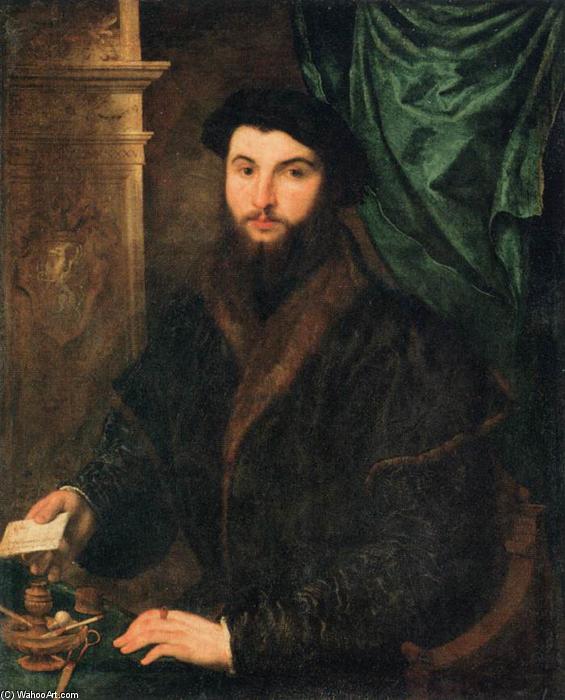
Paris Bordone’s ‘Portrait of Thomas Stachel,’ created in 1540, exemplifies Mannerist style with intricate composition and provincial vibrancy. Located at the Musée du Louvre, this oil on canvas depicts a man adorned in robes, holding a letter bearing the crest of Augsburg's Stachel family.
Portrait of Thomas Stachel by Paris Bordone: A Venetian Mannerist Masterpiece
Paris Bordone’s “Portrait of Thomas Stachel,” completed in 1540, stands as a testament to the flourishing artistic spirit of Venice during its High Renaissance. More than just a depiction of an individual, it embodies the complex stylistic tensions characteristic of Mannerism—a movement that sought to transcend the idealized beauty championed by earlier generations and instead embraced expressive distortion and psychological depth.
Subject Matter & Composition: The portrait portrays Thomas Stachel, a prominent Augsburg merchant whose identity was initially debated amongst scholars. Bordone meticulously rendered Stachel in a richly textured robe adorned with heraldic emblems—a deliberate choice reflecting the importance of social status within Renaissance society. The composition is deliberately asymmetrical, drawing the eye to Stachel’s gaze and subtly emphasizing his contemplative posture. This technique aligns perfectly with Mannerist tendencies toward unsettling perspectives and ambiguous spatial relationships.
Style & Technique: Bordone skillfully employed oil paint on canvas—a favored medium for Venetian artists at the time—to achieve remarkable tonal gradations and textural nuances. Notice the meticulous layering of brushstrokes, particularly around Stachel’s face and hands, creating a palpable sense of volume and realism despite the stylized rendering. The artist's use of chiaroscuro – dramatic contrasts between light and dark – amplifies the emotional impact of the portrait, conveying both dignity and introspection.
Historical Context & Symbolism: Created during a period marked by political intrigue and artistic experimentation, “Portrait of Thomas Stachel” reflects the broader cultural landscape of Venice. Bordone’s stylistic choices echo those of artists like Tintoretto and Veronese, who pushed the boundaries of artistic convention. The heraldic crest on the pilaster—representing the Stachel family—adds a layer of symbolic significance, highlighting the sitter's lineage and social standing. Furthermore, Stachel’s gaze directs towards the viewer, inviting contemplation and prompting questions about identity and perception.
Emotional Impact & Legacy: Beyond its formal qualities, “Portrait of Thomas Stachel” possesses an undeniable emotional resonance. Bordone captures a moment of quiet contemplation—a subtle expression of inner life that distinguishes Mannerist art from the more overtly celebratory styles prevalent elsewhere in Europe. Today, housed at the Musée du Louvre, this painting continues to captivate audiences with its masterful technique and profound psychological insight—a lasting achievement of Venetian Renaissance artistry.
- Artist: Paris Bordone
- Year Created: 1540
- Medium: Oil on Canvas
- Location: Musée du Louvre, Paris