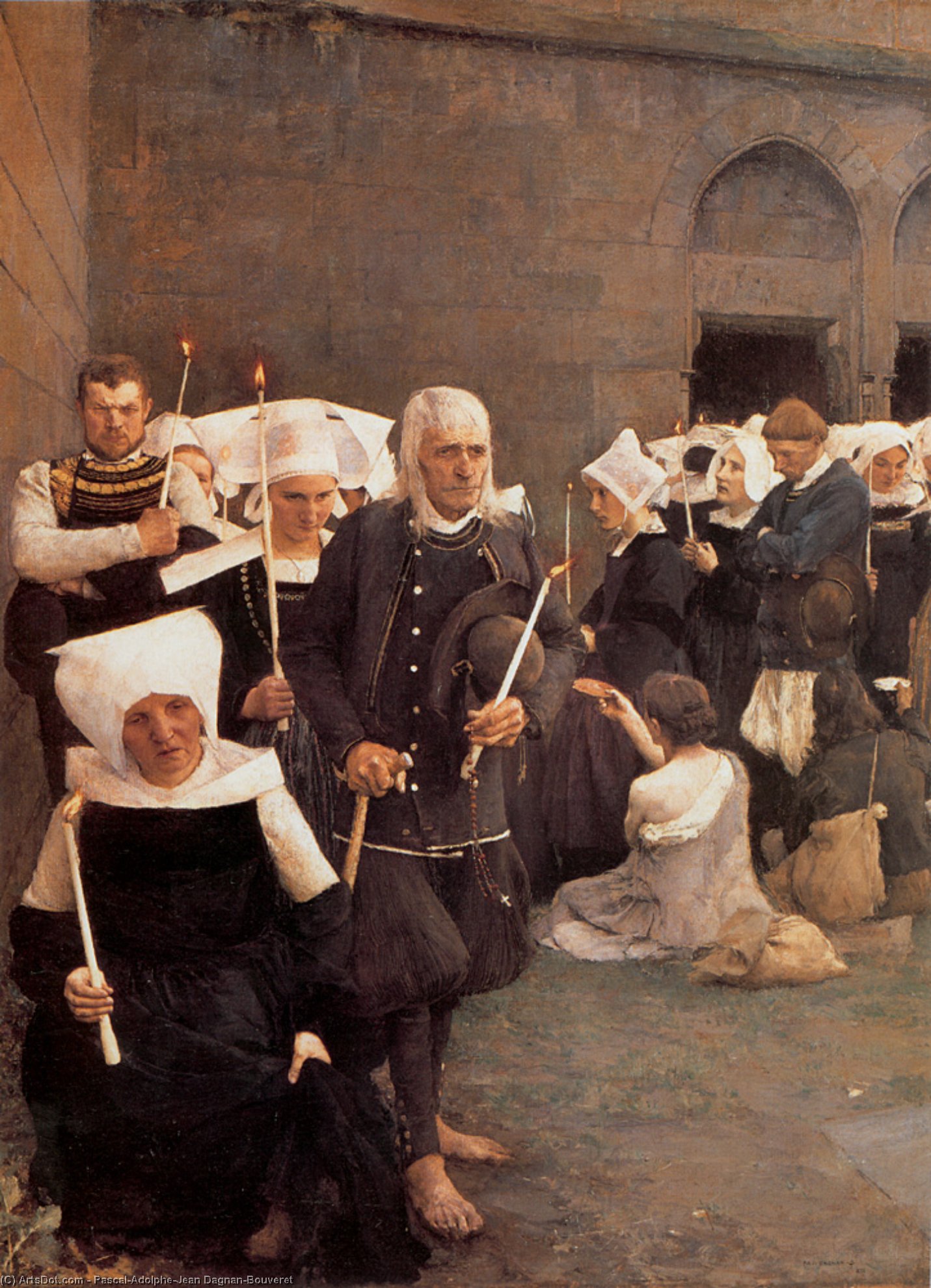
Experience 'The Pardon in Brittany' by Pascal Dagnan-Bouveret, a poignant realist depiction of Breton tradition and ritual. Explore the scene’s solemn atmosphere and detailed artistry.
Discover Pascal Dagnan-Bouveret (1852-1929), a leading French Naturalist painter known for realistic depictions of everyday life & evocative Breton scenes. Explore his legacy!
A Glimpse into Breton Tradition: "Le Pardon en Breetagne"
Pascal-Adolphe-Jean Dagnan-Bouveret’s “Le Pardon en Breetagne” offers a poignant and evocative window into the religious traditions of Brittany, France. Painted around the late 19th century, this work captures a *pardon*, a traditional Breton pilgrimage and penance ceremony often held at sacred sites or chapels. The scene unfolds with a quiet solemnity; a semi-circle of figures, clad in historical attire, gather before an ancient stone building distinguished by its arched doorways. The muted color palette – dominated by earthy tones and subtle shadows – contributes to the painting’s overall atmosphere of reverence and introspection. This isn't merely a depiction of people; it's a study of faith, community, and enduring cultural practices.
Naturalism and Artistic Technique
Dagnan-Bouveret was a leading figure in the Naturalist movement, which sought to portray everyday life with unflinching realism. This painting exemplifies that approach. The artist’s meticulous attention to detail is evident in the rendering of the figures' clothing – from the dark garments of the central woman to the lighter attire and head covering of the seated younger woman who holds a book or manuscript, likely representing a religious text or participating in recitation. Realism isn't just about accurate depiction; it’s about conveying the texture of experience. Dagnan-Bouveret masterfully uses light and shadow to create depth and three-dimensionality, enhancing the sense of presence and drawing the viewer into the scene. His training under Alexandre Cabanel and Jean-Léon Gérôme is clearly visible in his technical skill and compositional structure, while he ultimately forged his own path toward a more naturalistic style.
Symbolism and Cultural Significance
The *pardon* itself holds deep symbolic meaning within Breton culture. These pilgrimages were traditionally opportunities for confession, penance, and spiritual renewal. The candles held by several figures represent faith, hope, and the light of divine guidance. The older woman at the center, likely a key figure in the ceremony, embodies wisdom and leadership. Her upright posture and direct gaze suggest authority and connection to tradition. The seated younger woman with the book symbolizes learning, scripture, and perhaps the transmission of religious knowledge across generations. The aged architecture—the stone walls and arched doorways—further reinforces the sense of history and enduring faith. The painting isn't just about a specific event; it’s about the continuity of belief and community in a rural setting.
Emotional Impact and Lasting Appeal
“Le Pardon en Breetagne” evokes a profound sense of quiet contemplation and reverence. The subdued lighting, coupled with the solemn expressions of the figures, creates an atmosphere that is both melancholic and deeply moving. The painting invites viewers to reflect on themes of faith, tradition, and the human search for meaning. Its appeal lies not only in its artistic merit but also in its ability to transport us to another time and place, offering a glimpse into a rich cultural heritage. For collectors and interior designers alike, this reproduction offers a unique opportunity to bring a touch of historical depth and emotional resonance to any space.