Paul Cézanne’s ‘Boy in a Red Vest’: A Window into Post-Impressionist Vision
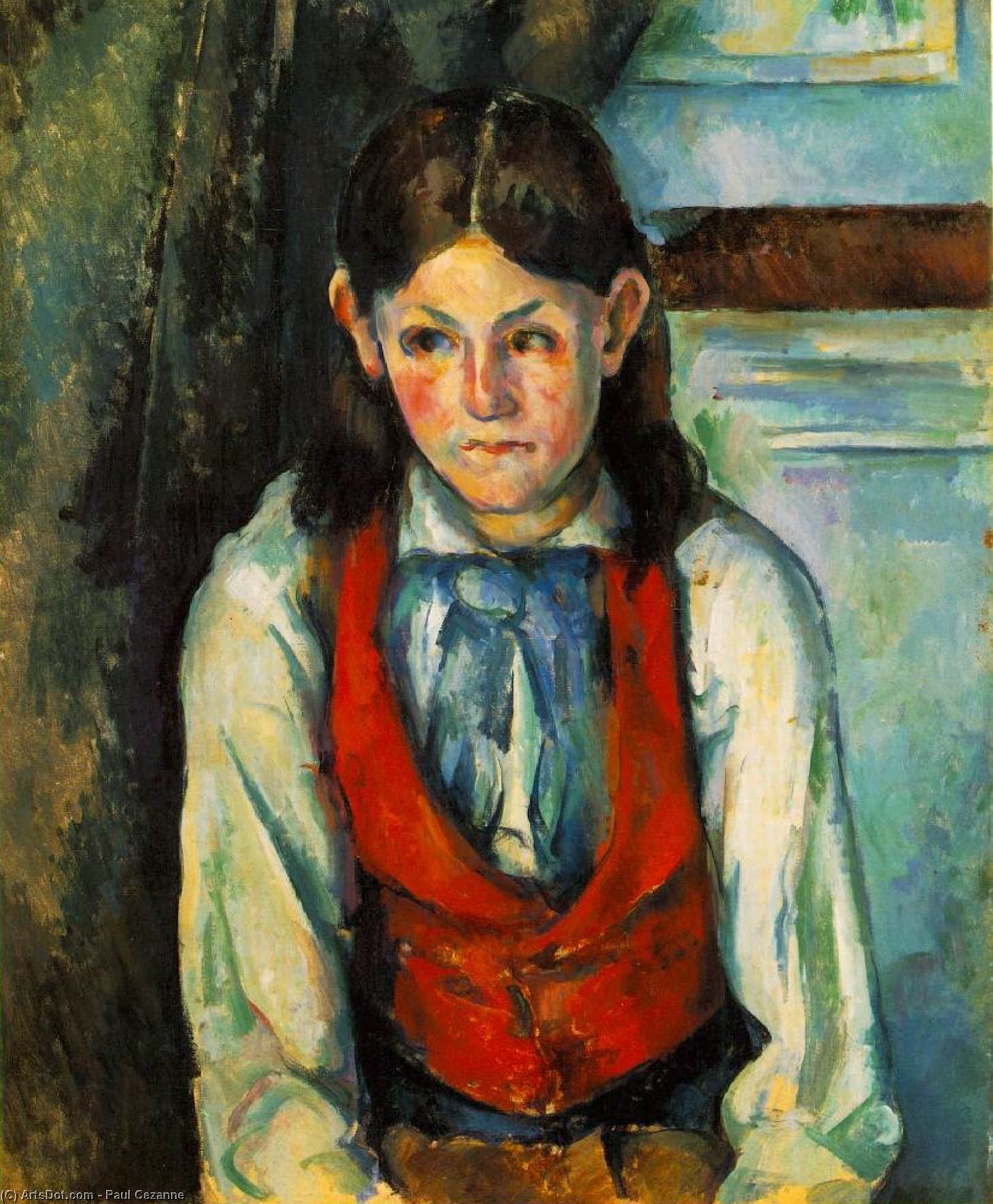
Paul Cézanne's “Boy in a Red Vest” (Le Garçon au gilet rouge), painted between 1888 and 1890, isn’t merely a portrait; it’s a carefully constructed meditation on form, color, and the very essence of seeing. This deceptively simple scene—a young boy seated against a muted backdrop, clad in a vibrant red waistcoat—holds within it the revolutionary spirit of Post-Impressionism and Cézanne's unique approach to capturing reality. It’s a work that continues to resonate with viewers today, not just for its aesthetic beauty but also for the profound questions it raises about representation and perception.
Cézanne’s artistic journey leading up to this pivotal painting was marked by a gradual shift away from the fleeting impressions of Impressionism. He sought to move beyond simply recording what the eye sees, instead focusing on the underlying structure and geometry of objects. This is strikingly evident in “Boy in a Red Vest.” The composition isn't haphazard; it’s meticulously arranged around a series of intersecting diagonals—the boy’s tilted back, the angle of his arm, the lines created by the curtain behind him, and even the table he leans on. These diagonals aren’t merely decorative elements; they are fundamental to Cézanne’s desire to depict objects as they *exist* in space, rather than as they appear at a single moment in time. He was essentially building a visual architecture, exploring how forms interact and define each other.
The Post-Impressionist Revolution: Color, Form, and Emotion
“Boy in a Red Vest” stands as a cornerstone of the Post-Impressionist movement, an artistic reaction against the limitations of Impressionism. While Impressionists were primarily concerned with capturing the effects of light and color, Cézanne sought to imbue his paintings with greater emotional depth and structural clarity. The red waistcoat, a bold splash of color against the predominantly neutral background, isn’t just a detail; it acts as a focal point, drawing the viewer's eye and injecting a sense of vitality into the scene. Cézanne masterfully uses color not to mimic reality but to express his subjective experience of it – a technique that would profoundly influence artists like Van Gogh and Picasso.
Furthermore, Cézanne’s brushwork is deliberately visible, rejecting the smooth blending characteristic of Impressionism. Instead, he employs short, broken strokes—a technique known as *impasto*—that create a textured surface and suggest the physicality of paint itself. This tactile quality invites the viewer to engage with the painting on a more immediate level, emphasizing the act of seeing and the artist’s hand in shaping the image.
Symbolism and the Portrait's Quiet Intensity
The identity of the boy remains deliberately ambiguous. He is not a specific individual but rather a representation of childhood innocence and contemplation. His slightly downturned gaze, coupled with his posture—leaning against the table, seemingly lost in thought—evokes a sense of melancholy or introspection. Some art historians suggest that Cézanne may have been drawing on memories of his own childhood, using the portrait as a means to explore themes of memory, loss, and the passage of time. The red waistcoat itself could be interpreted as a symbol of youthfulness, vitality, or even rebellion—a vibrant counterpoint to the muted tones surrounding him.
The background, composed of two staircases, adds another layer of complexity to the painting. Staircases often symbolize transitions and journeys, suggesting that the boy is caught between childhood and adulthood, or perhaps contemplating a future path. The neutral backdrop serves as a stage for this internal drama, allowing Cézanne to focus on the figure’s emotional state.
A Legacy of Innovation: Influence and Reproduction
“Boy in a Red Vest” is more than just a beautiful painting; it's a pivotal work that fundamentally altered the course of modern art. Cézanne’s emphasis on form, color, and structure paved the way for Cubism and other avant-garde movements of the 20th century. His innovative approach to perspective and his willingness to challenge traditional artistic conventions continue to inspire artists today.
At ArtsDot, we are proud to offer meticulously crafted oil painting reproductions of this iconic masterpiece. Our skilled artisans painstakingly recreate every detail—from the subtle nuances of Cézanne’s brushwork to the rich depth of his color palette—ensuring an authentic representation that captures the essence of this timeless work. Experience the beauty and profound impact of “Boy in a Red Vest” with an ArtsDot reproduction, bringing a touch of Post-Impressionist genius into your home or studio.
Explore our collection of Paul Cézanne reproductions today! Learn more about Paul Cézanne and his works on ArtsDot.