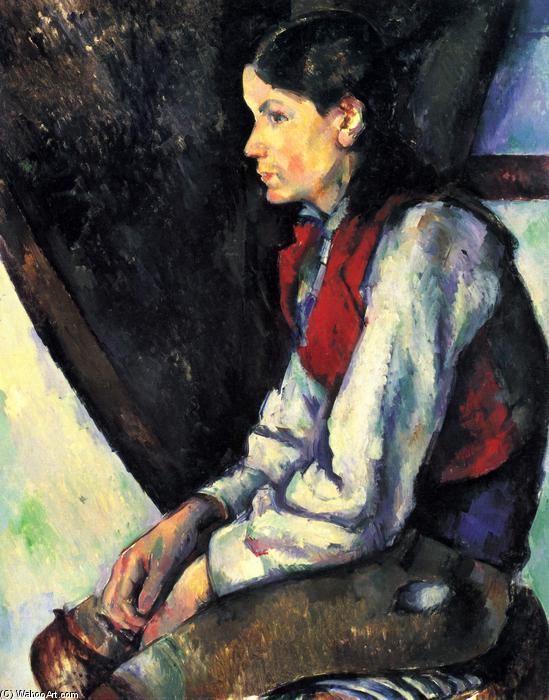
Experience Paul Cézanne's iconic 'Boy in the Red Vest'! This masterpiece captures a contemplative youth, showcasing his revolutionary style & influencing modern art. Explore its rich history and captivating beauty.
Discover Paul Cézanne (1839-1906): Post-Impressionist pioneer bridging Impressionism & Cubism. Explore geometric forms, still lifes & his lasting impact on modern art. #Cezanne #PostImpressionism
The Enigmatic Figure: Paul Cézanne’s *Boy in a Red Vest*
Paul Cézanne's *Boy in a Red Vest*, painted between 1888 and 1890, isn’t merely a portrait; it’s a carefully constructed meditation on form, space, and the very essence of observation. This captivating work, currently residing within the collection of the Foundation E.G. Bührle in Zurich, represents a pivotal moment in Cézanne's artistic evolution – a deliberate departure from the fleeting impressions of Impressionism and a bold step toward the geometric explorations that would define his legacy. The painting immediately draws the viewer in with its quiet intensity; a young boy, seated pensively against a subtly rendered backdrop, holds an almost palpable sense of melancholy and introspection. It’s a scene imbued with a poignant stillness, inviting us to contemplate the weight of unspoken thoughts and the mysteries held within a single gaze.
A Revolutionary Approach to Representation
Cézanne's genius lay not in replicating reality but in distilling it – stripping away extraneous detail to reveal the underlying structure of objects and their relationship to space. *Boy in a Red Vest* exemplifies this approach brilliantly. The boy’s form is rendered with a remarkable solidity, achieved through carefully considered planes of color and subtly overlapping shapes. Notice how Cézanne doesn't simply paint the red waistcoat; he constructs it from distinct blocks of crimson, creating an illusion of depth and volume that transcends the flat surface of the canvas. This deliberate fragmentation of form was revolutionary at the time, challenging the traditional conventions of academic portraiture which prioritized smooth transitions and realistic shading. The background, a muted tapestry of greens and browns, serves not as a mere setting but as another element contributing to the painting’s complex spatial arrangement – a carefully orchestrated stage for the boy's solitary contemplation.
Symbolism and Emotional Resonance
While seemingly straightforward, *Boy in a Red Vest* is rich with symbolic potential. The red waistcoat itself has been interpreted as representing youth, passion, or even vulnerability—a visual shorthand for the complexities of adolescence. The boy’s posture – his head bowed slightly, his hand resting on the table – speaks volumes about his inner state. He appears lost in thought, perhaps grappling with uncertainty or simply experiencing a moment of quiet reflection. The presence of the handbag suggests a connection to domestic life and perhaps hints at a longing for something beyond the confines of his immediate surroundings. The painting’s overall mood is one of gentle sadness, a poignant reminder of the fleeting nature of childhood and the inevitable passage of time.
Cézanne's Influence and Lasting Legacy
*Boy in a Red Vest* stands as a cornerstone of modern art, profoundly influencing generations of artists who followed in Cézanne’s footsteps. Its innovative use of form, color, and perspective paved the way for Cubism and other abstract movements. Picasso himself famously declared that Cézanne “destroyed all perspectives.” The painting's deliberate simplification of forms, its emphasis on geometric structure, and its exploration of spatial relationships continue to resonate with contemporary artists today. Reproductions of this iconic work offer a unique opportunity to experience the power and beauty of Cézanne’s vision – a testament to his enduring legacy as one of art history’s most transformative figures. ArtsDot offers meticulously crafted hand-painted reproductions that capture the essence of *Boy in a Red Vest*, allowing you to bring this masterpiece into your home or office, celebrating its timeless appeal and profound artistic significance.