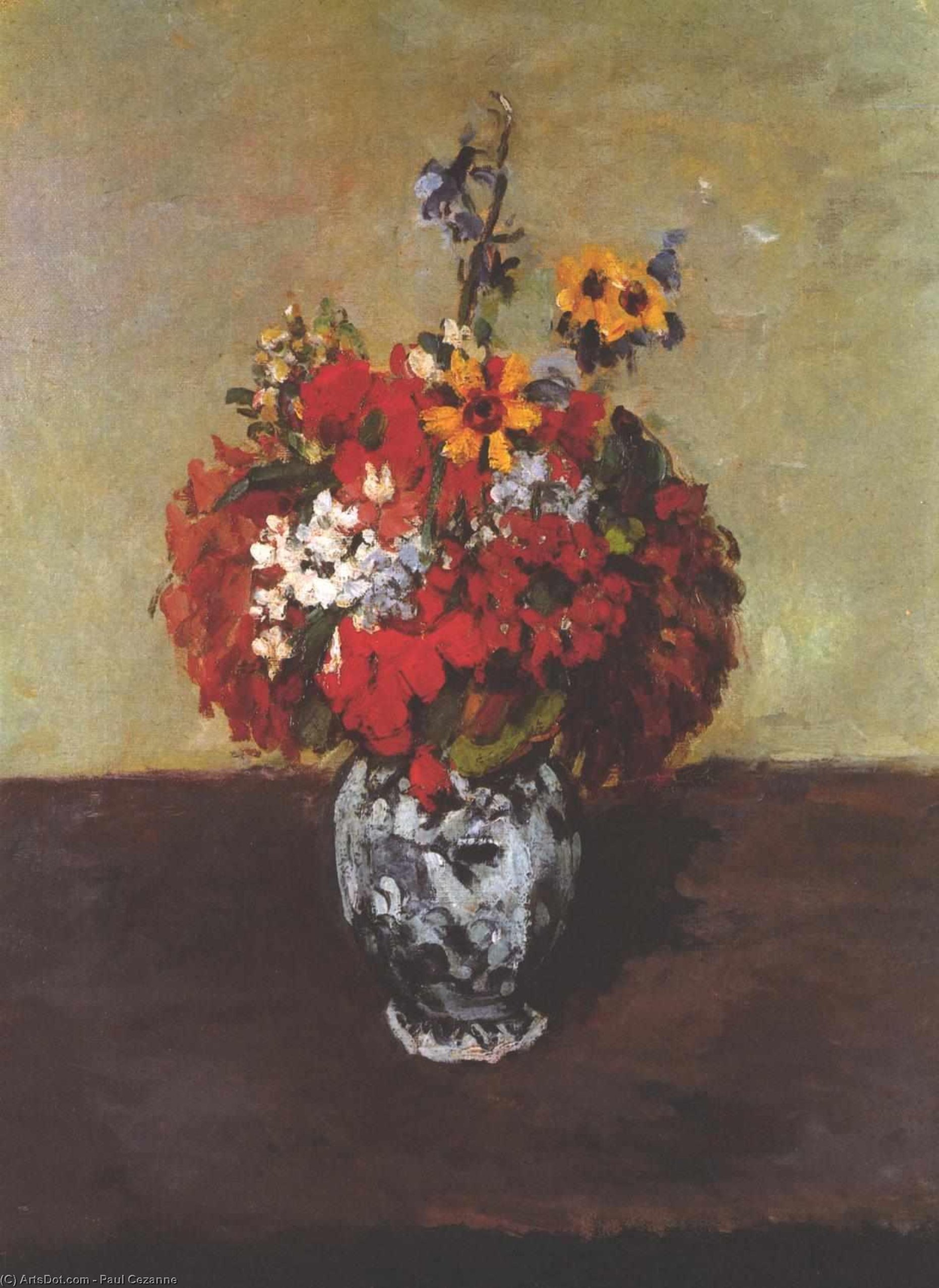
A Symphony of Color and Form: Cézanne’s *Dahlias in a Delft Vase*
Paul Cézanne's Dahlias in a Delft Vase is more than just a still life; it’s a pivotal moment in the evolution of modern art. Painted around the turn of the 20th century, this work embodies Cézanne’s revolutionary approach to representation, moving away from the fleeting impressions of Impressionism towards a deeper engagement with form and structure. The scene itself – a vase brimming with vibrant dahlias resting on a simple table – is deceptively straightforward. Yet, within its quiet composition lies a profound exploration of space, light, and color that would profoundly influence generations of artists to come.
Post-Impressionist Innovation: Deconstructing Reality
Cézanne’s style, firmly rooted in Post-Impressionism, rejects the purely optical pursuit of Impressionists like Monet. Instead, he meticulously analyzes and reconstructs his subject matter, breaking down objects into their fundamental geometric components – cylinders, spheres, and cones. This is strikingly evident in the rendering of the vase itself, which isn’t depicted as a smoothly curved form but rather as a series of overlapping planes, creating an illusion of three-dimensionality that transcends the limitations of traditional perspective. The dahlias, with their complex petal arrangements, are similarly treated, each bloom rendered with a deliberate attention to its individual shapes and textures.
- Oil on Canvas: Cézanne’s masterful use of oil paint allows for rich color saturation and subtle gradations in tone.
- Geometric Forms: The core of his technique lies in the reduction of natural forms to their underlying geometric shapes.
- Emphasis on Light and Shadow: He expertly manipulates light and shadow to create a sense of volume and depth, rejecting the flat surfaces favored by earlier styles.
Delftware and Symbolism: A Dutch Legacy
The inclusion of a Delft vase is significant. Delftware, originating in the Netherlands, was highly prized for its intricate blue and white designs, representing a connection to European artistic traditions. The choice of this particular vase suggests a deliberate engagement with established aesthetic values while simultaneously challenging them. The dahlias themselves, introduced to Europe from North America, symbolize beauty, passion, and prosperity – themes frequently explored in still life paintings. Their vibrant colors—reds, yellows, and oranges—add to the painting’s overall intensity and emotional resonance.
Emotional Impact: A Moment of Contemplation
Despite its seemingly simple subject matter, *Dahlias in a Delft Vase* evokes a powerful sense of stillness and contemplation. Cézanne's deliberate brushstrokes and careful attention to detail invite the viewer to slow down and observe the beauty of the natural world with fresh eyes. The painting’s muted palette and harmonious composition create a feeling of quiet serenity, inviting viewers to lose themselves in the subtle nuances of color and form. This work is not merely a representation of flowers; it's an invitation to engage in a profound meditation on perception, space, and the very nature of reality.
A Timeless Masterpiece: Reproduction Options
ArtsDot offers meticulously crafted hand-painted reproductions of Cézanne’s *Dahlias in a Delft Vase*, ensuring that you experience the full impact of this iconic artwork. Our skilled artisans employ traditional oil painting techniques, faithfully recreating Cézanne's innovative style and capturing the essence of his vision. Whether for your home or office, this reproduction provides an authentic connection to one of the most influential paintings of the 20th century.