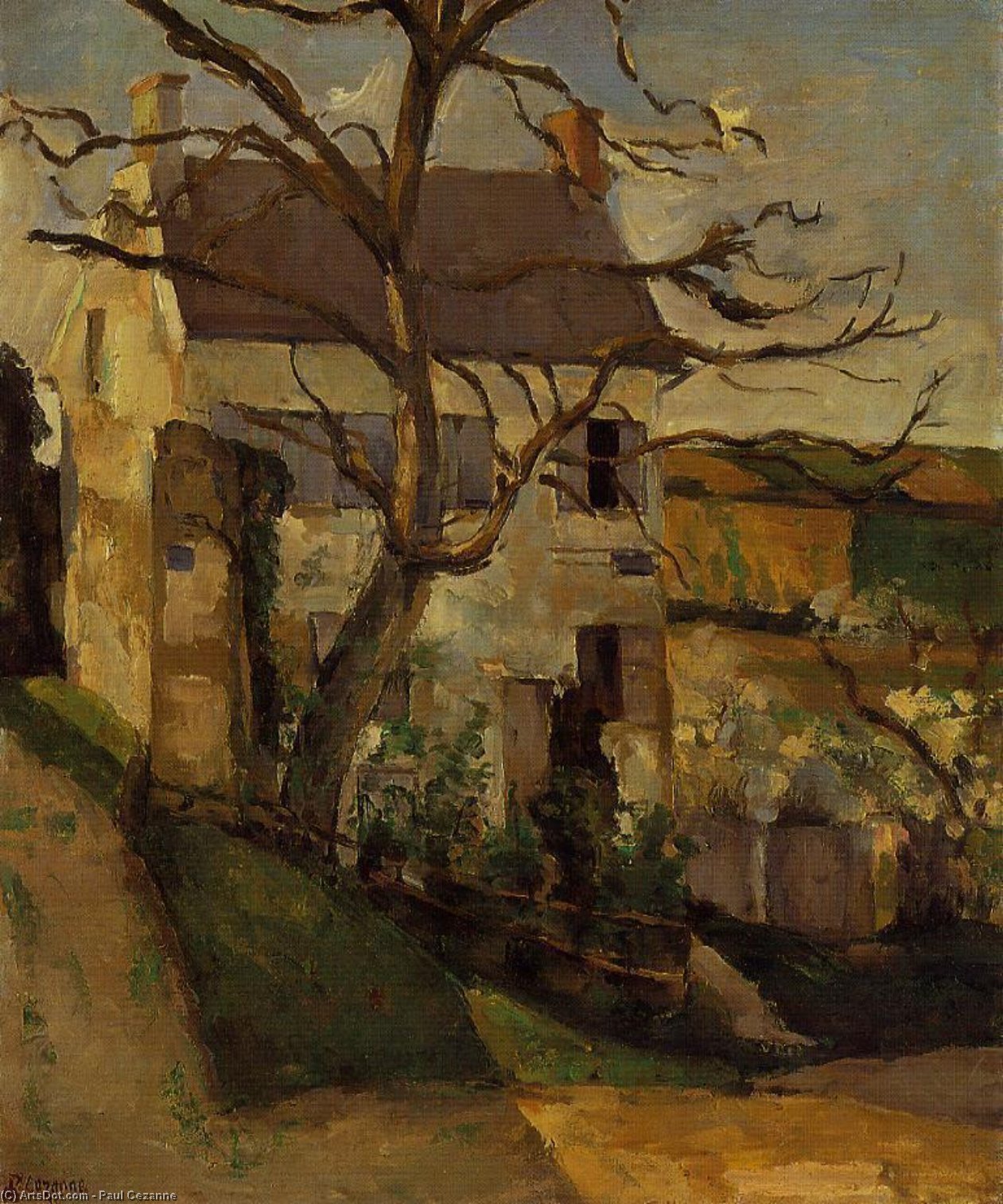
House and Tree, the Hermitage, Pontoise
Paul Cézanne’s
House and Tree, The Hermitage, Pontoise, painted in 1873, stands as a cornerstone of Cézanne’s artistic vision—a singular exploration of how to represent the essence of nature through geometric abstraction. Measuring 65 x 54 cm and executed in oil on canvas, this deceptively simple composition embodies Cézanne's revolutionary approach to painting, decisively shifting away from Impressionistic optical realism toward a more profound engagement with underlying structure and form. It’s not merely a depiction of a rural scene; it’s an assertion of Cézanne’s belief that art should strive for permanence and universality—a challenge to the fleeting impressions of light and color favored by his contemporaries.
Context and Style
Cézanne emerged as a pivotal figure during the turbulent transition from Impressionism to Post-Impressionism, marking a decisive break with established artistic conventions. While Cézanne absorbed influences from artists like Camille Pissarro—who similarly investigated the landscapes of Pontoise—he forged his own distinctive path, prioritizing spatial relationships and tonal harmonies over meticulous observation. His characteristic brushstrokes—repetitive, exploratory, and imbued with an almost obsessive attention to detail—were deliberately unsettling, rejecting traditional perspective and compositional rules. This stylistic rebellion wasn’t driven by nihilistic disregard for realism; rather, it stemmed from a conviction that Impressionism had exhausted its expressive potential and that art needed to delve deeper into the fundamental building blocks of visual experience. The painting reflects this ethos perfectly: Cézanne sought to capture not what *looked* like nature but what *felt* like nature—a quest for timeless beauty rooted in geometric precision.
Composition and Elements
The artwork presents a tranquil tableau featuring an aged stone or brick house nestled amongst lush foliage. Two chimneys punctuate the roofline, one positioned centrally and another slightly to the right, anchoring the composition’s visual weight. A window on the left side of the house offers a glimpse into interior space—a subtle invitation for contemplation. Dominating the foreground is a tree—its branches reaching outwards in a spiral gesture that draws the eye upward, mirroring Cézanne's desire to convey solidity and permanence. Scattered leaves adorn the branches, adding textural richness and reinforcing the painting’s connection to the natural world. Cézanne meticulously rendered these elements not as mere representations of their appearance but as embodiments of underlying geometric forms—a deliberate strategy that anticipates the radical innovations of Cubism.
Artistic Influences and Legacy
Cézanne's artistic trajectory was profoundly shaped by his engagement with fellow Impressionists, notably Camille Pissarro, who shared a fascination for capturing the atmospheric subtleties of Pontoise’s countryside. Their collaborative efforts—evident in works like
Camille Pissarro: L'Hermitage, Pontoise, Winter—demonstrated a willingness to experiment with new pictorial techniques while retaining a commitment to traditional subjects. However, Cézanne’s influence extended far beyond Impressionism; he served as an inspiration for avant-garde movements like Cubism, spearheaded by artists such as Henri Matisse and Pablo Picasso who acknowledged his pioneering role in redefining artistic expression. Cézanne's insistence on simplifying forms and exploring multiple viewpoints paved the way for a revolutionary aesthetic that would fundamentally alter the course of modern art.
Relevance in Modern Art
Today,
House and Tree, The Hermitage, Pontoise is recognized as a landmark achievement—a testament to Cézanne’s unwavering dedication to artistic innovation and his enduring contribution to the evolution of modern art. Its presence in prestigious collections like those at the
Museum of Modern Art (MoMA) underscores its significance as a pivotal work within the canon of 20th-century art history. For discerning collectors and enthusiasts alike, ArtsDot offers meticulously crafted oil painting reproductions—allowing viewers to immerse themselves in Cézanne’s genius and appreciate the transformative power of his artistic vision firsthand.
https://ArtsDot.com/ presents a curated selection of exceptional artworks, inviting you to enrich your home with timeless beauty.