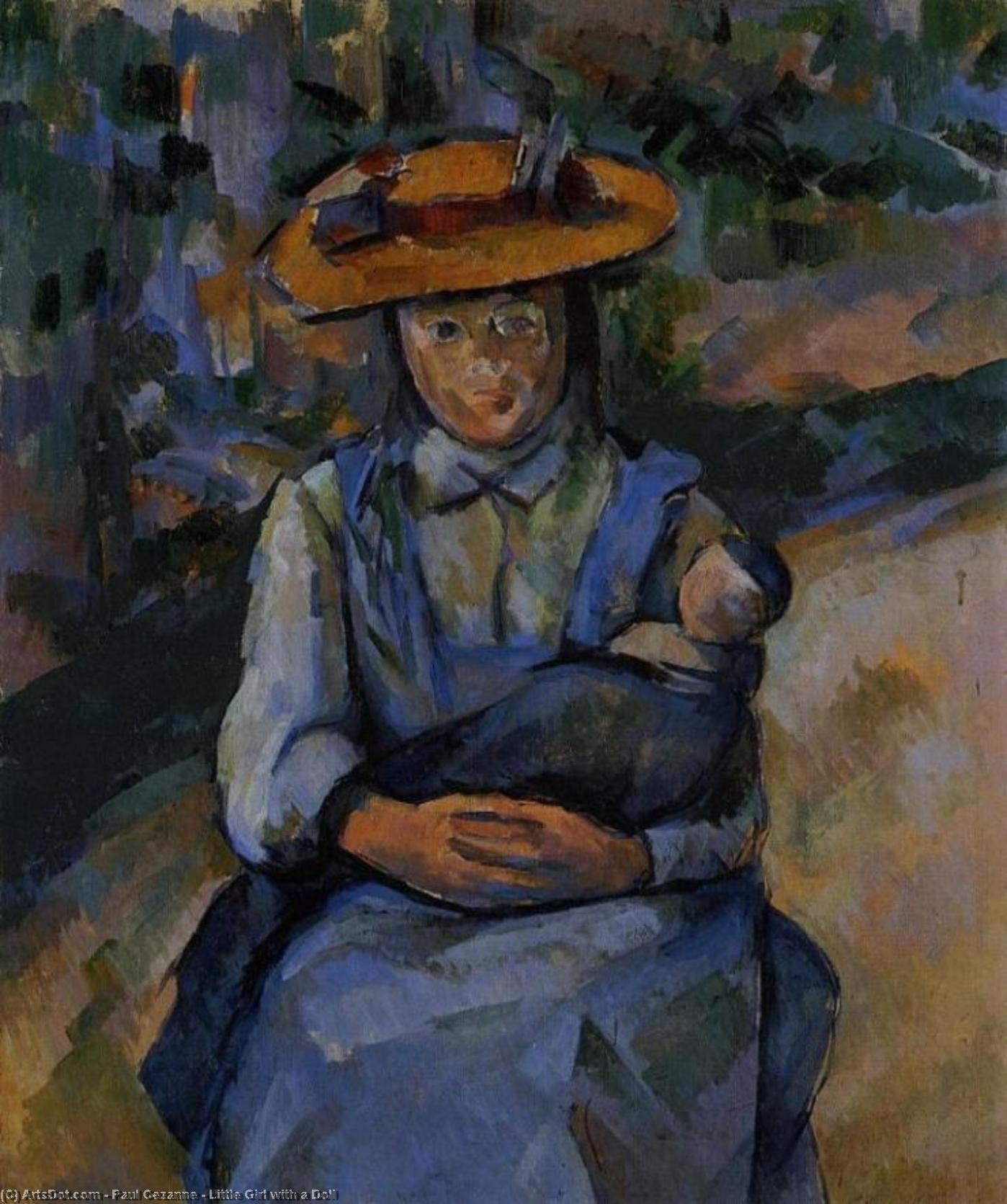
Little Girl with a Doll: A Window Into Cézanne’s Revolutionary Vision
Paul Cézanne, a name synonymous with artistic innovation and a pivotal figure in bridging the gap between Impressionism and Cubism, left an indelible mark on the art world. His singular approach to depicting reality—characterized by bold brushstrokes, geometric forms, and a deliberate simplification of perspective—challenged conventional artistic norms and profoundly influenced generations of artists. Among his vast oeuvre, “Little Girl with a Doll,” painted in 1904, stands as a particularly poignant emblem of Cézanne’s groundbreaking style and enduring legacy.
The Painting: A Study in Quiet Observation
This oil on canvas painting measures 73 x 60 cm and initially presents itself as a straightforward portrait of a young girl holding a doll. However, delving deeper into its surface reveals a world brimming with subtle nuances—a testament to Cézanne’s meticulous attention to detail and his masterful manipulation of color and form. The girl's gaze is serene yet contemplative, conveying an inner life that transcends mere visual representation. Her posture exudes composure, mirroring the stillness of the surrounding environment. The doll she cradles isn’t merely an accessory; it’s rendered with remarkable realism—a deliberate departure from Impressionistic tendencies toward blurred outlines and atmospheric haze—suggesting Cézanne's fascination with capturing tangible objects in their essence. Behind her lies a backdrop of muted greens and browns, hinting at the outdoors—specifically trees—creating depth and enriching the composition without resorting to traditional aerial perspective.
Artistic Style and Influence: Geometric Forms Meet Impressionistic Color
Cézanne’s artistic style represents a decisive break from Impressionism's preoccupation with fleeting impressions of light and color. Instead, he prioritized underlying geometric structures—cylinders, cones, and planes—to construct his subjects, mirroring the influence of Apollinaire’s sculpture “The Muse” on Cézanne’s vision. This approach anticipates Cubism’s fragmentation of form and challenges viewers to reconsider how they perceive visual space. Cézanne's technique is defined by short, broken brushstrokes that build up layers of color—a method he honed during his travels in Provence—resulting in textured surfaces that capture the materiality of the depicted objects. The painting exemplifies this transition, demonstrating Cézanne’s ability to fuse Impressionistic color palettes with Cubist structural principles.
Contextualizing the Artwork: Cézanne and the Dawn of Modern Art
“Little Girl with a Doll” emerged during a period of significant artistic upheaval—the burgeoning avant-garde movement that would reshape European art in the early 20th century. Cézanne’s work served as an inspiration for artists like Pablo Picasso and Georges Braque, who pioneered Cubism alongside him. The Salon d'Automne in Paris in 1904 proved to be a pivotal moment—a retrospective of Cézanne’s paintings galvanized the artistic community and solidified his position as a forerunner of modern art. Critics initially dismissed Cézanne’s work as “primitive” and “unfinished,” yet his unwavering conviction in his vision gradually gained acceptance, establishing him as one of the most influential artists of his time.
Relevance to Modern Art: Beyond Representation—Exploring Perception
The enduring impact of “Little Girl with a Doll” extends far beyond its own era. It fundamentally altered artistic conventions by prioritizing form over illusion—a shift that paved the way for subsequent movements like Orphism and Purism. Artists such as Henri Matisse, whose “Leçon musique,” embraced Cézanne’s bold color choices and simplified forms, recognized his contribution to capturing everyday life with vibrant hues. Ultimately, Cézanne's masterpiece reminds us that art transcends mere visual depiction—it engages our intellect and evokes profound emotional responses. It stands as a testament to the transformative power of artistic experimentation and its ability to redefine our understanding of reality itself.
ArtsDot.com offers high-quality, handmade oil painting reproductions of famous artworks like “Little Girl with a Doll.” Explore our collection to discover the beauty and significance of these masterpieces.
Size: 73 x 60 cm
Date: 1904