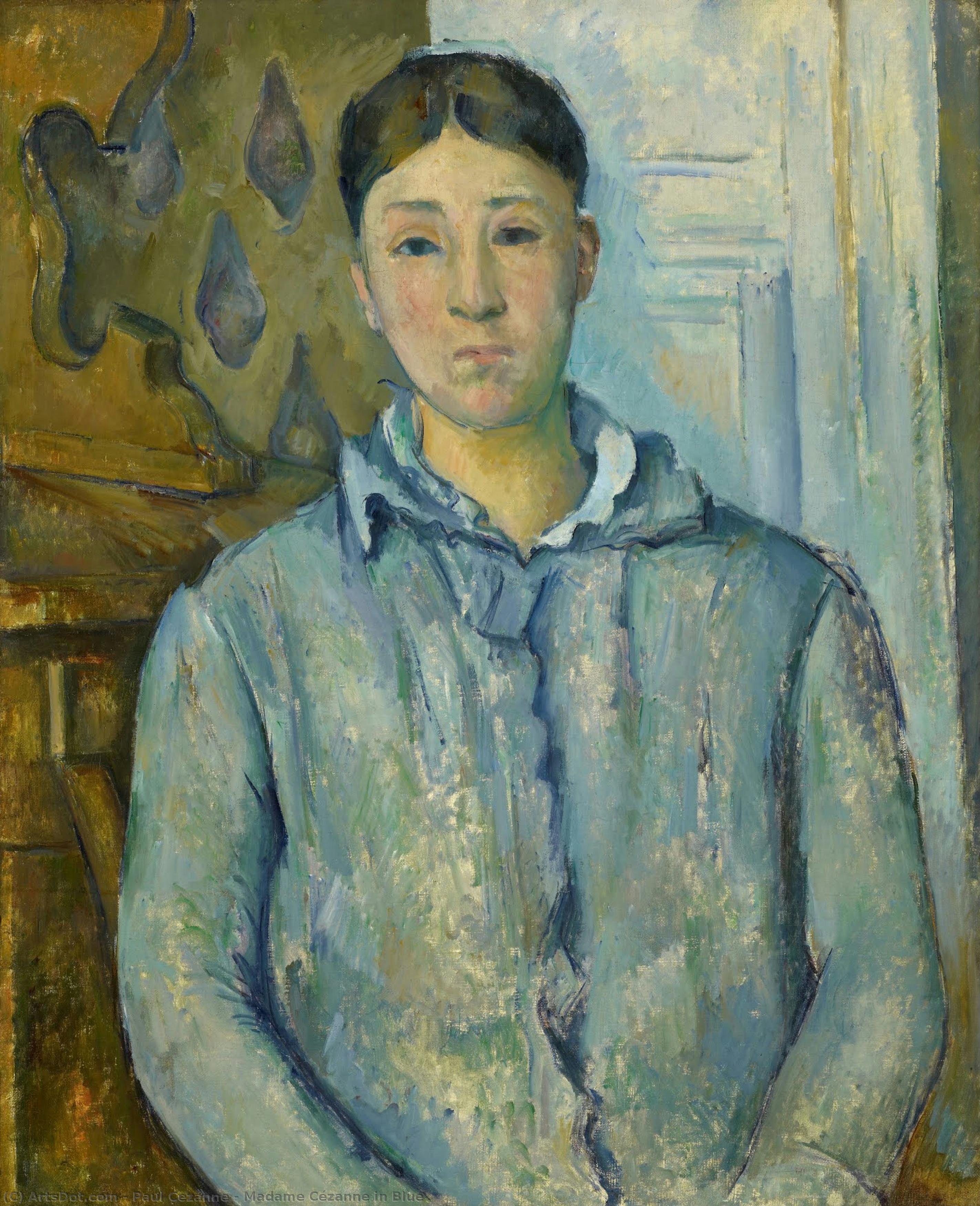
A Quiet Contemplation: Exploring Cézanne’s Madame Cézanne in Blue
Paul Cézanne's “Madame Cézanne in Blue,” painted sometime between 1869 and 1870, represents a pivotal moment in the artist’s oeuvre—a deliberate departure from Impressionistic explorations of fleeting light and color toward a more profound engagement with form and spatial relationships. Unlike many of his portraits depicting Hortense Fiquet as an active participant in life's dramas, Cézanne presents her figure in serene stillness, framed by a window that invites speculation about the world beyond. This deliberate restraint is not indicative of indifference but rather underscores Cézanne’s unwavering focus on capturing the essence of existence through geometric abstraction—a characteristic that would solidify his position as a precursor to Cubism.
- Subject Matter: The portrait depicts Hortense Fiquet, Cézanne's wife, seated in a chair against a window backdrop.
- Style & Technique: Cézanne employs a distinctive Post-Impressionist style characterized by simplified forms and flattened planes of color. He eschews traditional perspective, opting instead for an approach that prioritizes the underlying structure of the scene.
The MFAH version specifically highlights Cézanne’s masterful manipulation of tonal variations—particularly the subtle blues dominating the composition—to create a palpable sense of depth and atmosphere. The muted hues are juxtaposed with earthy browns, establishing a harmonious balance that draws attention to the contours of Hortense's body and the surrounding environment. Notice how Cézanne renders the chair and bench as solid blocks of color, mirroring the solidity of Hortense’s posture and conveying an impression of permanence amidst perceived tranquility.
Historical Context & Artistic Influences
Cézanne’s artistic trajectory was shaped by encounters with Impressionism—particularly Monet and Renoir—whose emphasis on capturing immediate sensory experience served as a springboard for his own explorations. However, Cézanne swiftly moved beyond mere optical representation, recognizing that art could convey more than just what is seen; it could communicate underlying concepts of space and structure. He drew inspiration from Japanese prints, which championed compositional asymmetry and flattened perspectives—techniques he would subsequently adopt in his groundbreaking landscapes and portraits.
Symbolism & Emotional Resonance
Beyond its formal innovations, “Madame Cézanne in Blue” possesses a subtle emotional resonance. The contemplative gaze of Hortense suggests an inner life untouched by external pressures—a quiet dignity that speaks to the enduring power of simplicity and contemplation. The inclusion of birds—one perched on the windowsill and another positioned near the center—adds layers of symbolic meaning, representing freedom, aspiration, and perhaps even a yearning for connection with nature. Cézanne’s deliberate omission of expressive gestures or facial expressions reinforces this sense of serenity, inviting viewers to contemplate the profound beauty inherent in stillness.
A Legacy of Geometric Vision
“Madame Cézanne in Blue” stands as an emblem of Cézanne's revolutionary vision—a testament to his unwavering belief that art could transcend mere imitation and achieve a deeper understanding of reality. It foreshadowed the radical transformations that would characterize Cubism, demonstrating Cézanne’s pioneering role in reshaping the landscape of modern art and establishing him as one of the most influential figures of the late nineteenth century. Its enduring appeal lies not only in its aesthetic beauty but also in its profound exploration of fundamental artistic principles—a timeless masterpiece deserving of careful observation and appreciation.