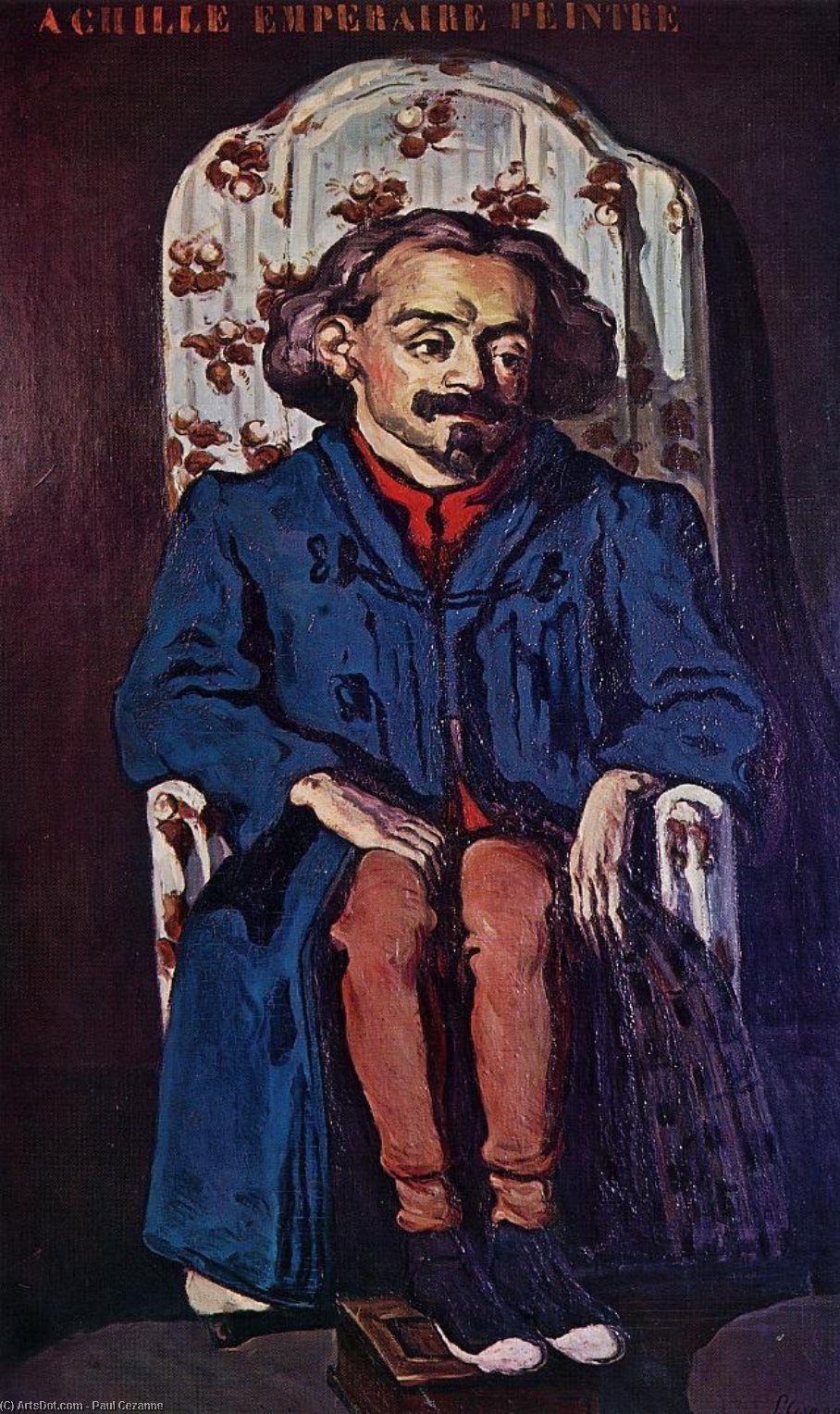
Portrait of Achille Emperaire, 1868 – Paul Cézanne
Paul Cézanne’s
Portrait of the Painter, Achille Emperaire, created in 1868, stands as a cornerstone of Post-Impressionism and a testament to Cézanne’s revolutionary approach to artistic representation. Held prominently at the
Musée d’Orsay in Paris, France, this oil on canvas painting transcends mere likeness, delving into the artist's psyche and capturing a moment of contemplative introspection.
The Painting’s Composition – A Study in Quietude
The portrait depicts Achille Emperaire seated comfortably in a chair with his legs crossed, absorbed in reading a book. Cézanne meticulously crafted this scene indoors, likely within a living room or studio setting—a deliberate choice that fosters an atmosphere of calm and focused concentration. Two vases strategically positioned on either side of the image contribute to this serene ambiance, reinforcing the painting’s contemplative mood. Cézanne's masterful use of oil paint allows for rich textures and vibrant colors, drawing the viewer into the intimate space depicted. The artist’s careful consideration of perspective—a subtle flattening of depth—is characteristic of his style and distinguishes it from the more conventional academic traditions of the time.
Artistic Style and Influence – Bridging Impressionism and Cubism
Cézanne's work embodies the pivotal transition between late 19th-century Impressionism and early 20th-century Cubism, marking a decisive break from traditional artistic conventions. Unlike his predecessors who prioritized capturing fleeting impressions of light and color, Cézanne focused on conveying the underlying structure of objects—a technique that anticipates the geometric explorations of Picasso and Braque. The artist’s distinctive brushstrokes—repetitive, exploratory, and imbued with palpable energy—are hallmarks of his style. Furthermore, Cézanne employed planes of color to create a sense of solidity and dimensionality, rejecting the illusionistic depth favored by Impressionists. This innovative approach profoundly influenced subsequent generations of artists, establishing Cézanne as “the father of us all,” according to Henri Matisse.
Historical Context – Initial Skepticism Followed by Recognition
Initially met with considerable criticism from contemporary art critics—who deemed Cézanne’s work incomprehensible and lacking in aesthetic merit—his vision gained traction among fellow artists like Camille Pissarro and the influential art dealer Ambroise Vollard, who recognized his genius early on. The first solo exhibition of Cézanne's oeuvre in 1895 at Vollard’s Paris gallery proved to be a watershed moment, propelling him into the spotlight and securing broader acknowledgment of his contributions to modern art. This exhibition challenged prevailing artistic dogma and signaled a shift towards embracing bolder experimentation.
Legacy – An Enduring Inspiration
Cézanne's influence extends far beyond the confines of Impressionism and Cubism; it resonates throughout 20th-century art history. Artists such as Picasso and Matisse have explicitly acknowledged Cézanne’s formative role in their artistic development, recognizing his pioneering techniques as a catalyst for innovation. His unwavering dedication to exploring form and color—coupled with his profound sensitivity to the human condition—continues to inspire artists and art enthusiasts worldwide. To appreciate Cézanne's enduring legacy, consider examining reproductions of other notable works like
Poplars and
Man in a Blue Smock, available at ArtsDot for high-quality hand-painted reproductions. For deeper insights into Cézanne’s life and artistic philosophy, visit
Paul Cézanne on Wikipedia. And delve further into the Musée d’Orsay's remarkable collection at
Discover the Masterpieces of Musée d’Orsay on ArtsDot.