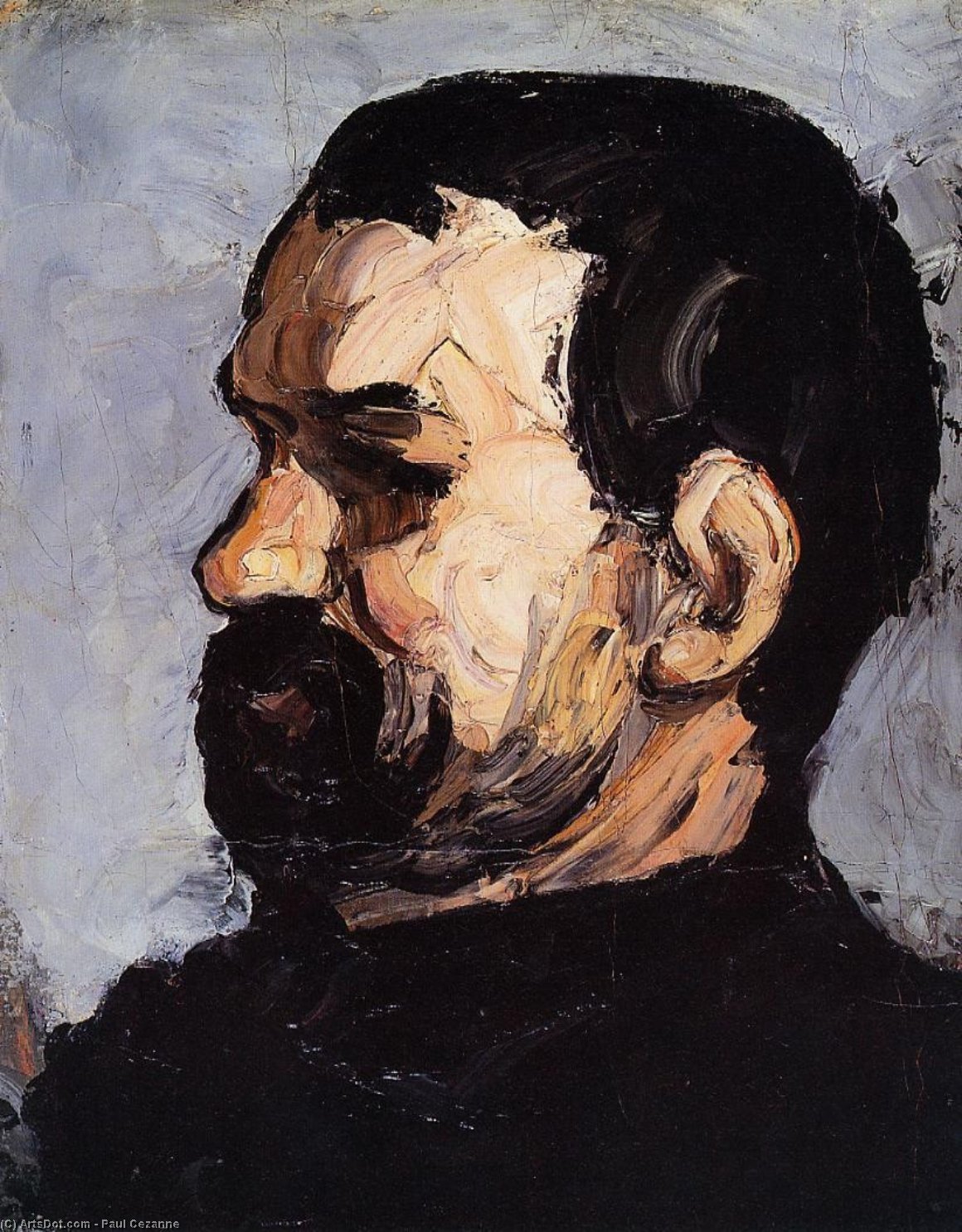
A Pioneer of Modern Vision: Exploring Cézanne’s Portrait of Uncle Dominique
Paul Cézanne, born in Aix-en-Provence in 1839, represents a pivotal moment in artistic history—a defiant assertion that Impressionism's fleeting beauty could be superseded by a deeper engagement with form and structure. Initially drawn to law, his passion for painting ultimately prevailed, shaping a career marked by perseverance and an unwavering dedication to his craft. This early work, “Portrait of Uncle Dominique in Profile,” exemplifies Cézanne’s burgeoning stylistic explorations and foreshadows the revolutionary ideas that would define his legacy.
The Canvas of Observation: Style and Technique
Painted in 1866, this portrait stands apart from the prevalent Impressionistic preoccupation with capturing atmospheric effects. Instead, Cézanne employs oil on canvas—a medium favored by artists seeking durability and tonal richness—to create a composition that prioritizes solidity and geometric precision. The dark background serves as an anchor for the subject’s head, emphasizing its contours and fostering a palpable sense of depth. Characteristic of Cézanne's evolving technique is his deliberate layering of brushstrokes; small, repetitive strokes build up complex fields, rejecting the smooth blending championed by Impressionists in favor of textured surfaces that convey materiality. This approach wasn’t merely stylistic choice but a fundamental rethinking of how visual perception operates.
A Figure Embodied: Subject Matter and Composition
The portrait depicts Uncle Dominique Aubert, Cézanne's paternal uncle—a recurring presence in his oeuvre—seated in profile. Cézanne eschews conventional depiction, presenting the figure not as an idealized representation but as a tangible object rendered with meticulous attention to detail. The downward gaze of Dominique’s eyes and the slight closure of his mouth convey a contemplative stillness, inviting viewers into a realm of introspection. Crucially, Cézanne restricts the frame to encompass only Dominique's head, eliminating extraneous elements—a deliberate decision that underscores the artist’s focus on capturing the essence of form itself. This compositional restraint is mirrored in Cézanne’s broader artistic philosophy: less about representing reality as seen, more about distilling it into its underlying geometric components.
Echoes of Romanticism and Beyond
Though influenced by Romantic ideals—particularly in his early explorations of tonal harmony—Cézanne swiftly distanced himself from the movement's emotive tendencies. He sought to transcend mere visual sensation, aiming instead for a representation that communicates an inner truth. This ambition aligns powerfully with the burgeoning intellectual currents of the time, anticipating the formal innovations of Cubism and signaling a decisive break from artistic conventions. Cézanne’s unwavering commitment to his vision—despite initial criticism—established him as a prophet of modern art.
A Lasting Influence: Recognition and Legacy
Initially dismissed by many contemporaries, Cézanne's genius was recognized by fellow artists like Camille Pissarro and Ambroise Vollard, who championed his work and secured him a crucial breakthrough in 1895 with a solo exhibition at Vollard’s gallery. Artists as diverse as Henri Matisse and Pablo Picasso acknowledged Cézanne as “the father of us all,” recognizing the profound impact of his stylistic explorations on their own artistic endeavors. The enduring fascination with Cézanne's work testifies to its timeless beauty and intellectual rigor—a testament to an artist who fundamentally reshaped our understanding of visual representation.
- Related Works: Still Life Bread and Leg of Lamb (Kunsthaus Zürich), Marion and Valabregue Posing for a Picture, Portrait of Uncle Dominique as a Monk (Metropolitan Museum of Art)