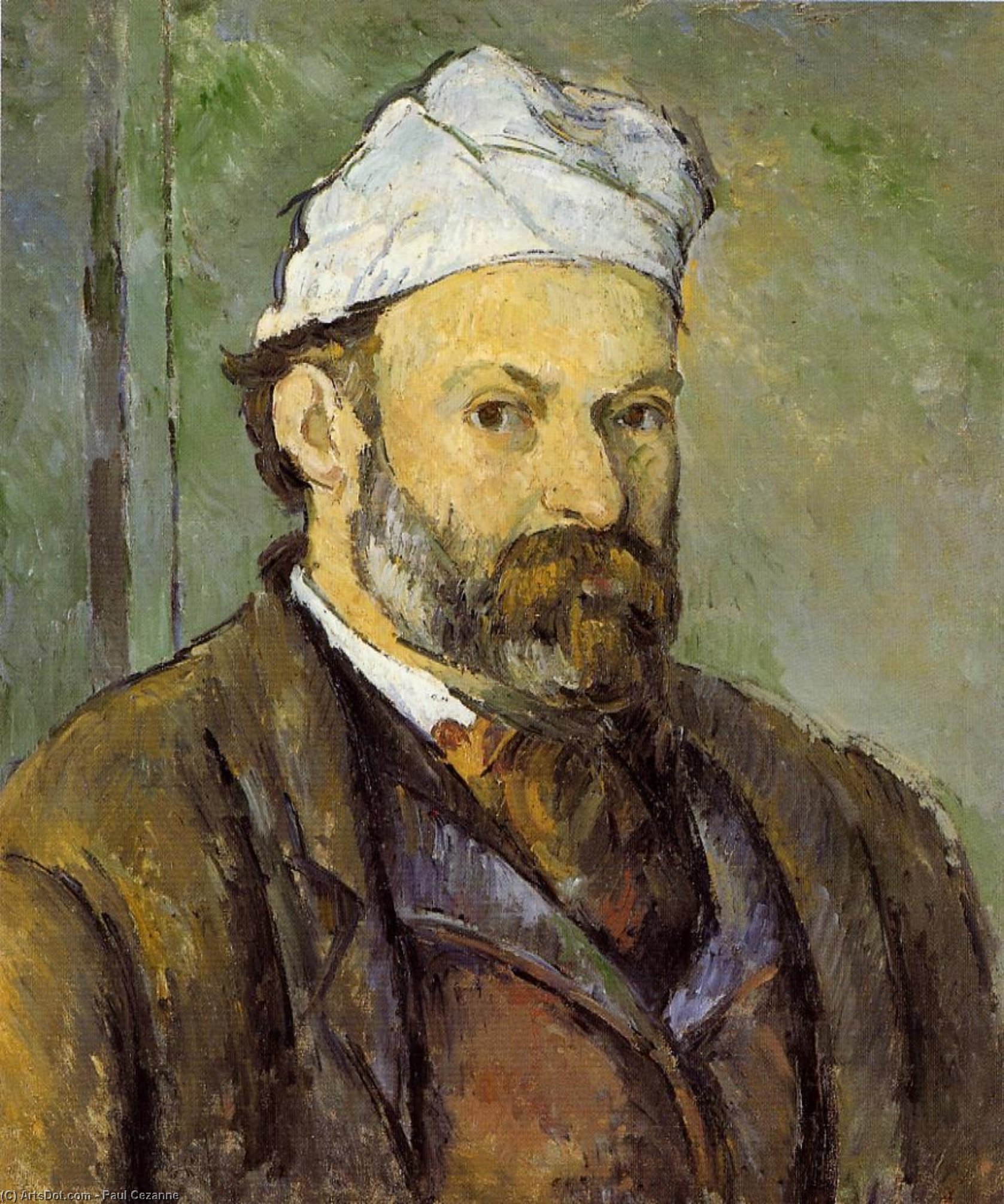
Self Portrait in a White Cap: A Pioneering Vision of Form
Paul Cézanne’s
Self Portrait in a White Cap stands as an emblem of artistic transformation—the decisive step from Impressionism’s shimmering surfaces to Cubism's fractured geometries. Painted in 1882 and housed at the Bayerische Staatsgemaldesammlungen (Munich, Germany), this chalk drawing transcends mere likeness; it embodies Cézanne’s unwavering commitment to exploring fundamental principles of visual representation.
### The Artist and His Style: Bridging Impressionism and Modernity
Born in Aix-en-Provence in 1839, Cézanne was a French artist whose influence reverberates throughout the early twentieth century. Initially drawn to Romantic landscapes and Barbizon realism—influenced by artists like Jean-François Millet—he swiftly rejected academic conventions, prioritizing instead an intensely personal aesthetic rooted in observation and experimentation. His distinctive style, characterized by bold brushstrokes and a deliberate simplification of forms, wasn’t merely stylistic choice but a profound intellectual conviction: Cézanne believed that art should capture the underlying structure of objects rather than simply mirroring their appearance. This conviction propelled him to dissect visual phenomena with meticulous precision, resulting in compositions that prioritize solidity and depth—a radical departure from Impressionism's fleeting impressions of light and color.
### The Painting: Compositional Exploration and Textured Surface
The self-portrait depicts Cézanne wearing a white cap adorned with a crimson ribbon against a muted green backdrop. His gaze directs towards the viewer, conveying an air of quiet contemplation amidst the formal attire—a dark velvet cape embellished with gold embroidery and a scarlet tie—that speaks to his meticulous attention to detail. Cézanne’s masterful use of chalk lends itself beautifully to capturing textural nuances; the surface is rendered with palpable roughness, mirroring the artist's own preoccupation with materiality and form. The subtle interplay of light and shadow enhances the portrait’s expressive power, emphasizing Cézanne’s facial features—particularly his mustache and goatee—with remarkable accuracy.
### Artistic Significance: A Legacy Beyond Imitation
Self Portrait in a White Cap is more than just a depiction of Cézanne himself; it’s a manifesto of his artistic philosophy—a testament to his unwavering belief that art should transcend mere imitation and strive for an understanding of the world's underlying essence. Cézanne’s pioneering approach to perspective, coupled with his deliberate simplification of forms, paved the way for Cubism and fundamentally reshaped the trajectory of modern art.
### Museum and Collection: A Window into European Artistic Heritage
The Bayerische Staatsgemaldesammlungen (Munich, Germany) houses a vast collection spanning from the fourteenth to the twentieth centuries—a treasure trove for scholars and enthusiasts alike. For more information on this esteemed institution and its remarkable holdings, visit
Bayerische Staatsgemaldesammlungen (Munich, Germany) - A Comprehensive Guide. Its curators diligently strive to illuminate the evolution of artistic expression across eras, offering visitors unparalleled insight into the creative spirit of bygone times.
### Conclusion: Cézanne's Enduring Influence
Paul Cézanne’s
Self Portrait in a White Cap remains an indelible symbol of artistic innovation—a cornerstone of Post-Impressionism and a beacon for subsequent generations of artists. Explore high-quality reproductions of this masterpiece at ArtsDot.com:
Painting by 'Paul Cézanne' | Paul Cézanne:Self Portrait in a White Cap. Consider commissioning a bespoke oil painting reproduction to honor Cézanne’s legacy and infuse your own space with the spirit of artistic exploration.