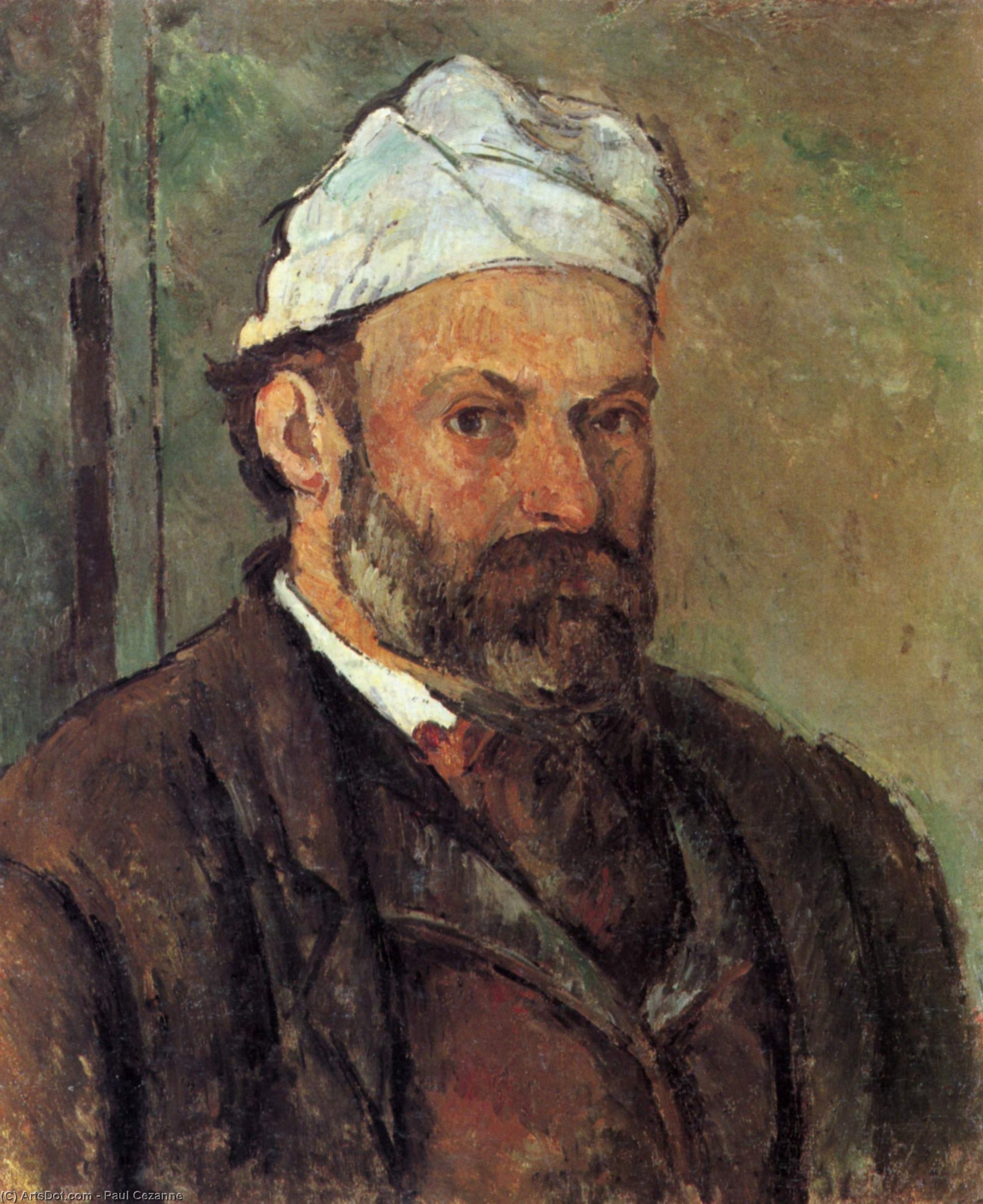
A Revolutionary Self-Examination: Paul Cézanne’s Self-Portrait with White Turbaned (1882)
Paul Cézanne, a titan in the evolution of modern art, delivers more than just a likeness in his 1882 Self-Portrait with White Turbaned. This work is a profound statement about artistic exploration, a window into the psyche of a revolutionary painter, and a pivotal moment in the transition from Impressionism to the groundbreaking styles that would follow.
Subject & Style: A Deliberate Dichotomy
Cézanne presents himself in a three-quarter view, his gaze subtly averted, fostering an air of introspective contemplation. He’s formally dressed – suit and tie signifying societal convention – yet crowned with a striking white turban. This juxtaposition is central to the painting's power. The turban isn’t simply an exotic accessory; it signals Cézanne’s fascination with non-Western cultures, fueled by the prevalent Orientalist aesthetic of the time. More importantly, it represents a deliberate break from traditional self-portraiture norms, injecting theatricality and personal symbolism into a genre often bound by rigid expectations.
Technique & The Foundations of Modernism
Measuring 55 x 46 cm, this oil on canvas showcases Cézanne’s evolving artistic approach. He moved beyond the fleeting impressions of light favored by Impressionists, instead focusing on the underlying structure and form of objects. Observe the assertive brushstrokes – not blended for smoothness, but visible and textured, building volume and solidity. The earthy palette—ochres, browns, and muted blues—reinforces this sense of permanence.
Cézanne’s analytical mind sought to reduce all natural forms to geometric shapes – cylinders, spheres, and cones. This foundational principle would profoundly influence Cubism. Within this self-portrait, hints of this nascent structural thinking are visible in his rendering of his own face and features.
Historical Context: Bridging Eras
The 1880s were a period of artistic upheaval. While Impressionism reached its zenith, artists like Cézanne questioned its limitations. He aimed to create paintings that weren’t merely representations of reality but investigations into the very act of perception. This self-portrait embodies this shift – it's less about *what* is seen and more about *how* it is perceived. The work stands as a key example of Post-Impressionism, rejecting purely optical concerns in favor of subjective vision and symbolic content.
Symbolism & Emotional Resonance
Self-Portrait with White Turbaned evokes a sense of quiet intensity and intellectual curiosity. Cézanne doesn’t offer an engaging or smiling portrait; instead, we encounter a man deeply absorbed in thought, scrutinizing himself with the same meticulous attention he would apply to any other subject. This introspective quality is profoundly compelling.
Display & Complementary Aesthetics
- Setting: This painting thrives in spaces with subdued lighting, allowing its subtle nuances of color and texture to be fully appreciated.
- Color Palette: Pair it with walls painted in muted greens, grays, or warm ochres to enhance its earthy tones.
- Framing: A simple, elegant frame – perhaps dark wood or a metallic finish – will complement the painting without distraction.
- Scale & Placement: Consider displaying it in a smaller room or as part of a curated collection to maintain intimacy and focus. Its size lends itself well to both residential and smaller gallery spaces.
Explore Further: Cézanne’s Enduring Legacy
- The Garden at Les Lauves
- Ginger Jar and Fruit (Le vase paille)
- The Feast
- The Blue Vase
- Corner of Quarry
- Mont Sainte-Victoire (Le Mont Sainte-Victoire)
Self-Portrait with White Turbaned is a testament to Cézanne’s enduring influence – a work that continues to inspire and challenge viewers over a century after its creation, solidifying his position as “the father of modern art.”