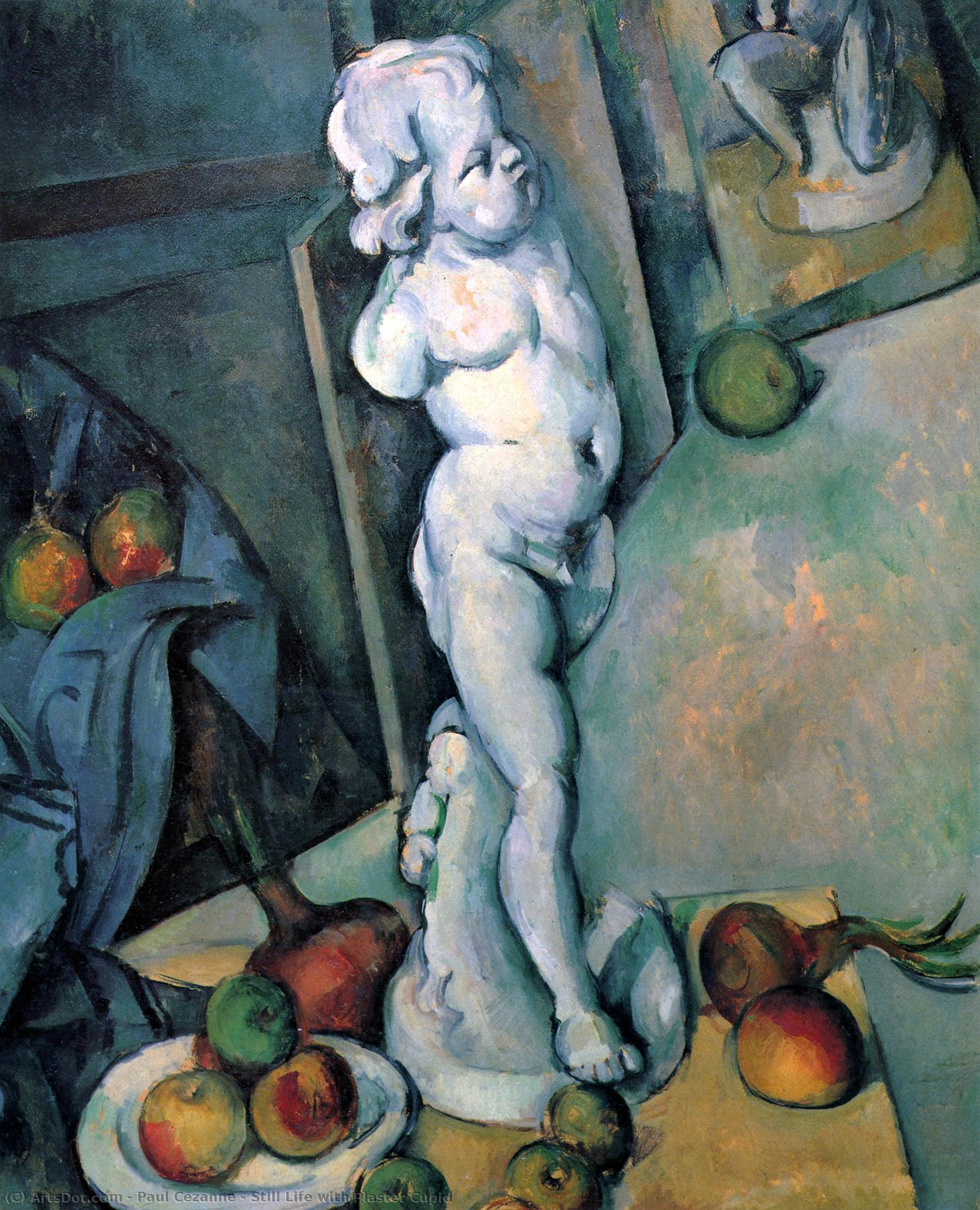
Still Life with Plaster Cupid: A Study in Form and Timelessness
Paul Cézanne's "Still Life with Plaster Cupid" is more than just a depiction of everyday objects; it’s a profound exploration of form, structure, and the interplay between classical ideals and earthly existence. Painted during his mature period, this work exemplifies Cézanne's revolutionary approach to still life painting, bridging the gap between Impressionism and Cubism while establishing him as a pivotal figure in modern art.
Composition and Symbolism
The composition centers around a pale blue plaster statue of Cupid, positioned amidst an arrangement of fruits—apples and oranges—and draped fabric. The Cupid figure, with its aged appearance and slightly melancholic expression, introduces a sense of timelessness and classical allusion to the scene. The fruit, rendered in Cézanne’s characteristic style, adds a touch of naturalism and hints at themes of abundance and mortality. The drapery provides textural contrast and further complicates the spatial relationships within the painting. The deliberate arrangement of these seemingly disparate elements creates a harmonious yet subtly unsettling visual experience.
Artistic Style and Technique
Cézanne’s Post-Impressionist style is immediately recognizable in "Still Life with Plaster Cupid." He employs a technique characterized by fragmented forms, multiple viewpoints presented simultaneously, and planes of color. This approach anticipates the later developments of Cubism, demonstrating Cézanne's pioneering role in challenging traditional perspective and representation. The use of small, visible brushstrokes builds up complex fields of color, creating a sense of depth and dimensionality despite the flattened picture plane. The limited color palette—primarily blues, greens, and muted earth tones—contributes to the painting’s overall mood of quiet contemplation and subtle melancholy. Cézanne's focus on the underlying structure of objects is evident in his careful rendering of their geometric forms, prioritizing shape over realistic detail.
Historical Context and Legacy
Initially met with criticism and incomprehension by contemporary audiences, Cézanne’s work gradually gained recognition during his lifetime. The first solo exhibition of his paintings in 1895 marked a turning point, leading to broader appreciation for his innovative approach. Cézanne's influence on subsequent generations of artists is immeasurable. He is often referred to as "the father of us all" by figures like Henri Matisse and Pablo Picasso, who acknowledged his profound impact on the development of Cubism and other avant-garde movements. “Still Life with Plaster Cupid” stands as a testament to Cézanne’s enduring legacy and his contribution to the evolution of modern art.
Emotional Impact and Interpretation
Beyond its formal innovations, "Still Life with Plaster Cupid" evokes a sense of quiet introspection and subtle emotional complexity. The juxtaposition of the classical statue with everyday objects creates a dialogue between idealized beauty and earthly reality. The painting invites viewers to contemplate themes of time, decay, and the enduring power of art to capture fleeting moments and universal truths. It is a work that rewards careful observation, revealing new layers of meaning with each viewing.
ArtsDot offers handmade oil painting reproductions of famous artworks, including those by Paul Cézanne. Visit
ArtsDot.com to explore a wide range of artistic masterpieces.