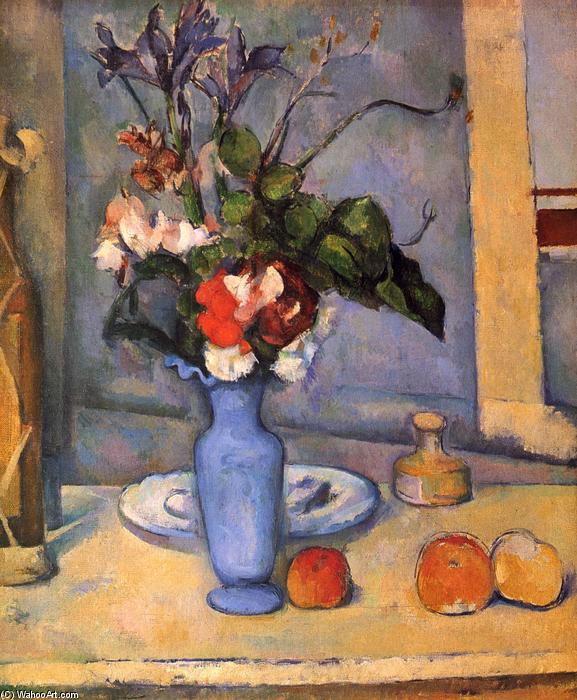
Explore Paul Cézanne's masterpiece, *The Blue Vase*, a pivotal work of Post-Impressionism characterized by innovative form and color exploration. Discover its influence on modern art!
Discover Paul Cézanne (1839-1906): Post-Impressionist pioneer bridging Impressionism & Cubism. Explore geometric forms, still lifes & his lasting impact on modern art. #Cezanne #PostImpressionism
The Blue Vase
Paul Cézanne’s *The Blue Vase*, created in 1887, stands as a cornerstone of Post-Impressionism and embodies Cézanne's revolutionary approach to artistic representation. More than just a depiction of still life—a genre he championed—it’s an exploration of form, color, and the very essence of perception itself. This painting resides in the Musée d’Orsay, Paris, France, where it continues to captivate viewers with its understated beauty and profound intellectual depth.
Composition and Elements
The scene unfolds on a tabletop, dominated by a vibrant blue vase filled with an assortment of red and white flowers. Alongside the vase sits a plate bearing apples—a deliberate choice reflecting Cézanne’s fascination with geometric forms and their relationship to organic shapes. A bottle is positioned to the right side of the canvas, adding depth and creating a balanced visual arrangement. Cézanne meticulously considered every element, striving for harmony between form and color, mirroring his belief that art should capture not merely what is seen but how it feels. The careful placement of objects contributes to an overall sense of stability and contemplation.
Artistic Style and Influence
Cézanne’s distinctive style—characterized by repetitive brushstrokes and a focus on underlying structural planes—marked a decisive break from Impressionism's fleeting effects of light and color. He rejected the illusionistic conventions of academic painting, prioritizing instead the depiction of essential forms. This approach profoundly influenced subsequent artists like Henri Matisse and Pablo Picasso, who adopted Cézanne’s techniques to forge their own artistic paths. The *Blue Vase* exemplifies this style perfectly: its textured surface reveals a complex interplay of color fields built up from small, overlapping brushstrokes—a technique that anticipates the developments of Cubism.
Historical Context
The painting emerged during a period when Cézanne’s work was gaining recognition within the Parisian art world. Ambroise Vollard, a prominent art dealer and gallery owner, organized the first solo exhibition of Cézanne's paintings in his Paris gallery in 1895—a pivotal moment that solidified Cézanne’s reputation as a significant figure among avant-garde artists. This exhibition garnered considerable attention and fueled discussions about Cézanne’s innovative vision and its impact on contemporary artistic sensibilities.
Relevance and Legacy
*The Blue Vase* represents a crucial juncture in the evolution of still life painting, reflecting the broader influence of Impressionism and Post-Impressionism on European art history. Cézanne's unwavering dedication to capturing the fundamental qualities of his subjects—his insistence on simplifying forms and exploring their underlying structure—continues to inspire artists today. The painting’s enduring appeal lies in its ability to convey Cézanne’s intellectual curiosity and artistic ambition, cementing its place as a masterpiece of modern art.